Collabtunes · Memorabilia
PRINTED PAGE - PAGE 3 OF 4
40 pieces on this page · every one an original · every photograph, nothing hidden · dashed lines are yours to fill
Item 1877
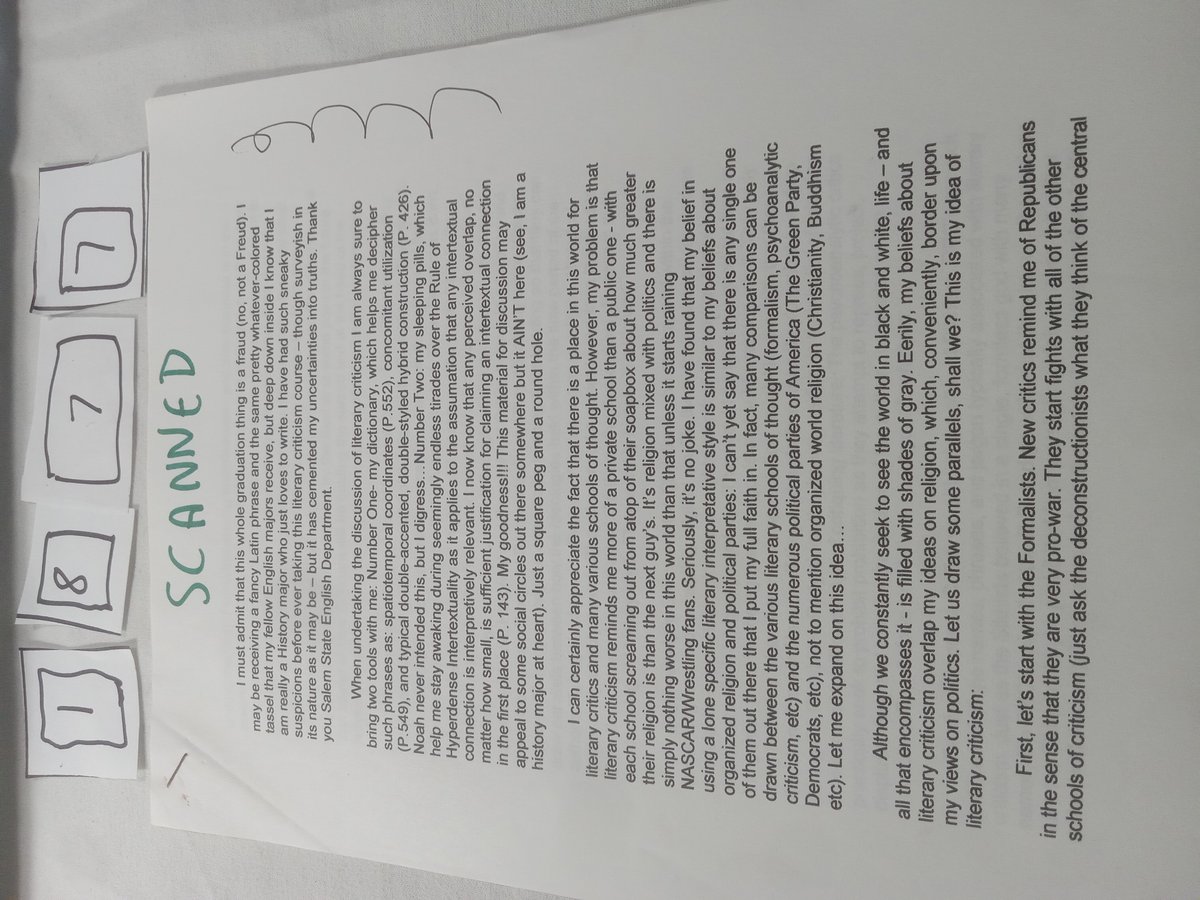
UNTITLED - first line: I must admit that this whole graduation thing is a fraud (no, not a Freud). I may be receiving a fancy Latin phrase and the same pretty water-color...
The item consists of printed white sheets of paper.
- Why it matters
- Tom writes this
- Type
- Printed page
- Collection
- Tom writes this
- Published in
- PREVIOUSLY UNPUBLISHEDSearched against the 34 albums, every book and Poems By Tom - found in none of them
Price · Tier · Tom fills these
Picture 1 of 4
Picture 2 of 4
Picture 3 of 4
Picture 4 of 4
The words on this page
I must admit that this whole graduation thing is a fraud (no, not a Freud). I may be receiving a fancy Latin phrase and the same pretty water-colored tassel that my fellow English majors receive, but deep down inside I know that I am really a History major who just loves to write. I have had such sneaky suspicions before ever taking this literary criticism course - though surveyish in its nature as it may be - but it has cemented my uncertainties into truths. Thank you Salem State English Department.
When undertaking the discussion of literary criticism I am always sure to bring two tools with me: Number One- my dictionary, which helps me decipher such phrases as: spatiotemporal coordinates (P.552), concomitant utilization (P.549), and typical double-accented, double-styled hybrid construction (P. 426). Noah never intended this, but I digress... Number Two: my sleeping pills, which help me stay awaking during seemingly endless tirades over the Rule of Hyperdense Intertextuality as it applies to the assumption that any intertextual connection is interpretively relevant. I now know that any perceived overlap, no matter how small, is sufficient justification for claiming an intertextual connection in the first place (P. 143). My goodness!!! This material for discussion may appeal to some social circles out there somewhere but it AIN'T here (see, I am a history major at heart). Just a square peg and a round hole.
I can certainly appreciate the fact that there is a place in this world for literary critics and many various schools of thought. However, my problem is that literary criticism reminds me more of a private school than a public one - with each school screaming out from atop of their soapbox about how much greater their religion is than the next guy's. It's religion mixed with politics and there is simply nothing worse in this world than that unless it starts raining NASCAR/Wrestling fans. Seriously, it's no joke. I have found that my belief in using a lone specific interpretative style is similar to my beliefs about organized religion and political parties: I can't yet say that there is any single one of them out there that I put my full faith in. In fact, many comparisons can be drawn between the various literary schools of thought (formalism, psychoanalytic criticism, etc) and the numerous political parties of America (The Green Party, Democrats, etc), not to mention organized world religion (Christianity, Buddhism etc). Let me expand on this idea...
Although we constantly seek to see the world in black and white, life - and all that encompasses it - is filled with shades of gray. Eerly, my beliefs about literary criticism overlap my ideas on religion, which, conveniently, border upon my views on politics. Let us draw some parallels, shall we? This is my idea of literary criticism:
First, let's start with the Formalists. New critics remind me of Republicans in the sense that they are very pro-war. They start fights with all of the other schools of criticism (just ask the deconstructionists what they think of the central
---
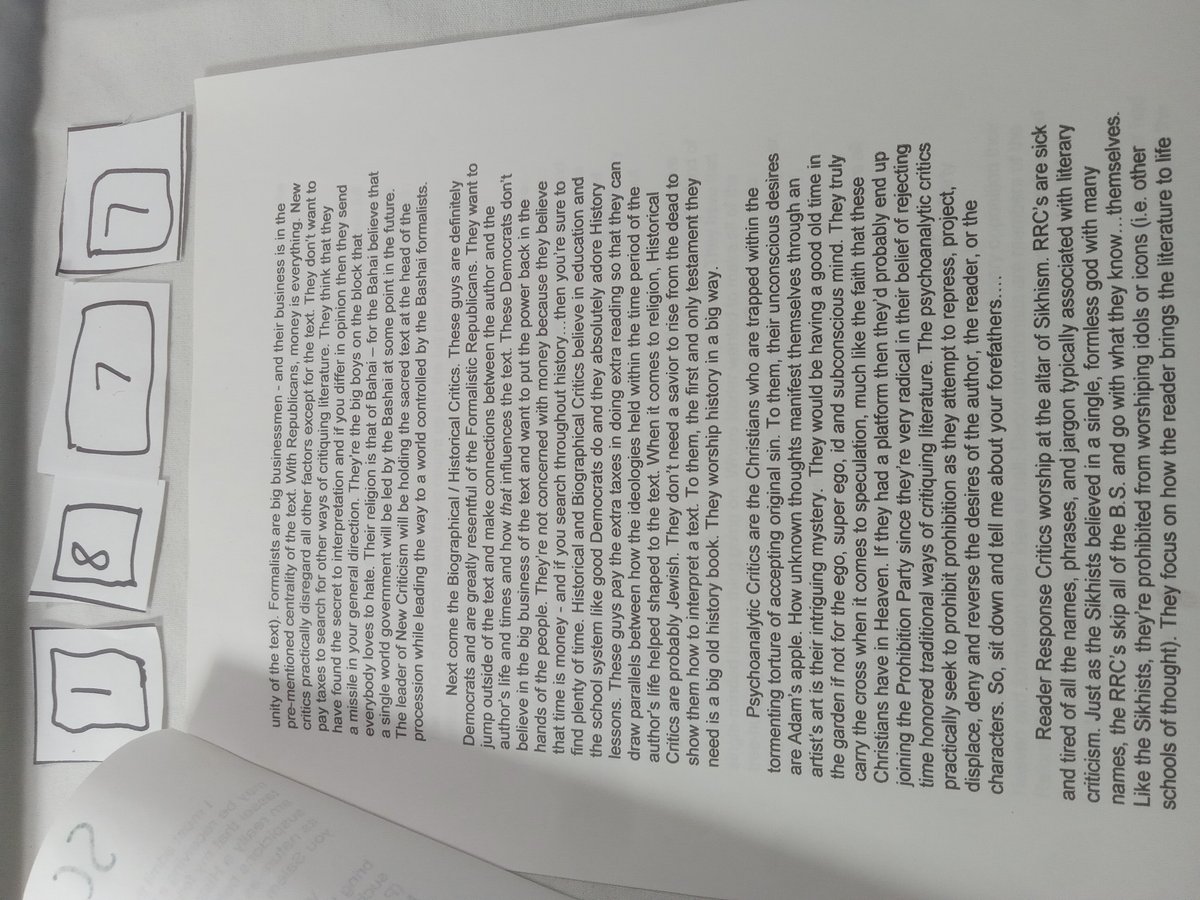
unity of the text). Formalists are big businessmen - and their business is in the pre-mentioned centrality of the text. With Republicans, money is everything. New critics practically disregard all other factors except for the text. They don't want to pay taxes to search for other ways of critiquing literature. They think that they have found the secret to interpretation and if you differ in opinion then they send a missile in your general direction. They're the big boys on the block that everybody loves to hate. Their religion is that of Bahai - for the Bahai believe that a single world government will be led by the Bashai at some point in the future. The leader of New Criticism will be holding the sacred text at the head of the procession while leading the way to a world controlled by the Bashai formalists.
Next come the Biographical / Historical Critics. These guys are definitely Democrats and are greatly resentful of the Formalistic Republicans. They want to jump outside of the text and make connections between the author and the author's life and times and how that influences the text. These Democrats don't believe in the big business of the text and want to put the power back in the hands of the people. They're not concerned with money because they believe that time is money - and if you search throughout history...then you're sure to find plenty of time. Historical and Biographical Critics believe in education and the school system like good Democrats do and they absolutely adore History lessons. These guys pay the extra taxes in doing extra reading so that they can draw parallels between how the ideologies held within the time period of the author's life helped shaped to the text. When it comes to religion, Historical Critics are probably Jewish. They don't need a savior to rise from the dead to show them how to interpret a text. To them, the first and only testament they need is a big old history book. They worship history in a big way.
Psychoanalytic Critics are the Christians who are trapped within the tormenting torture of accepting original sin. To them, their unconscious desires are Adam's apple. How unknown thoughts manifest themselves through an artist's art is their intriguing mystery. They would be having a good old time in the garden if not for the ego, super ego, id and subconscious mind. They truly carry the cross when it comes to speculation, much like the faith that these Christians have in Heaven. If they had a platform then they'd probably end up joining the Prohibition Party since they're very radical in their belief of rejecting time honored traditional ways of critiquing literature. The psychoanalytic critics practically seek to prohibit prohibition as they attempt to repress, project, displace, deny and reverse the desires of the author, the reader, or the characters. So, sit down and tell me about your forefathers....
Reader Response Critics worship at the altar of Sikhism. RRC's are sick and tired of all the names, phrases, and jargon typically associated with literary criticism. Just as the Sikhists believed in a single, formless god with many names, the RRC's skip all of the B.S. and go with what they know...themselves. Like the Sikhists, they're prohibited from worshiping idols or icons (i.e. other schools of thought). They focus on how the reader brings the literature to life
---
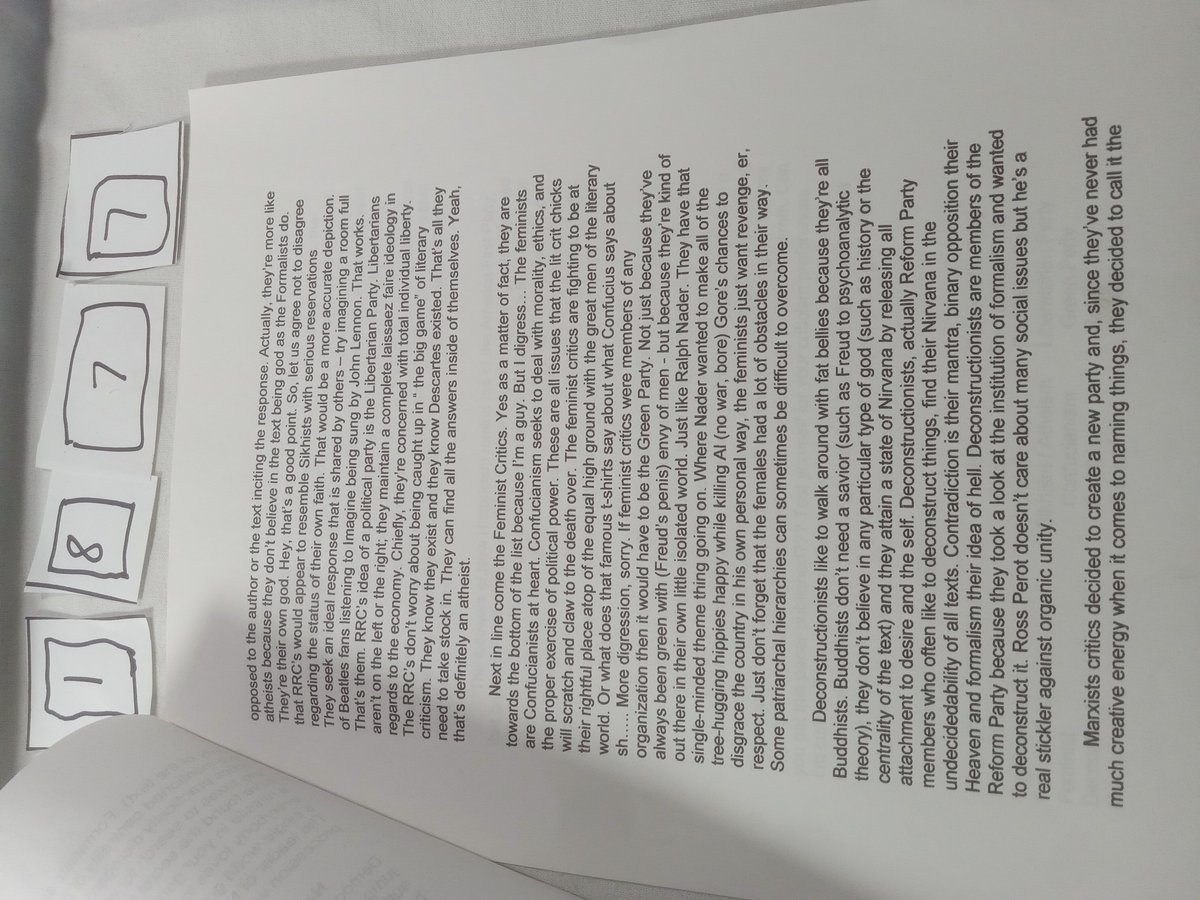
opposed to the author or the text inciting the response. Actually, they're more like atheists because they don't believe in the text being god as the Formalists do. They're their own god. Hey, that's a good point. So, let us agree not to disagree that RRC's would appear to resemble Sikhsits with serious reservations regarding the status of their own faith. That would be a more accurate depiction. They seek an ideal response that is shared by others - try imagining a room full of Beatles fans listening to Imagine being sung by John Lennon. That works. That's them. RRC's idea of a political party is the Libertarian Party. Libertarians aren't on the left or the right; they maintain a complete laissez faire ideology in regards to the economy. Chiefly, they're concerned with total individual liberty. The RRC's don't worry about being caught up in " the big game" of literary criticism. They know they exist and they know Descartes existed. That's all they need to take stock in. They can find all the answers inside of themselves. Yeah, that's definitely an atheist.
Next in line come the Feminist Critics. Yes as a matter of fact, they are towards the bottom of the list because I'm a guy. But I digress... The feminists are Confuciants at heart. Confucianism seeks to deal with morality, ethics, and the proper exercise of political power. These are all issues that the lit crit chicks will scratch and claw to the death over. The feminist critics are fighting to be at their rightful place atop of the equal high ground with the great men of the literary world. Or what does that famous t-shirts say about what Confucius says about sh.... More digression, sorry. If feminist critics were members of any organization then it would have to be the Green Party. Not just because they've always been green with (Freud's penis) envy of men - but because they're kind of out there in their own little isolated world. Just like Ralph Nader. They have that single-minded theme thing going on. Where Nader wanted to make all of the tree-hugging hippies happy while killing AI (no war, bore) Gore's chances to disgrace the country in his own personal way, the feminists just want revenge, er, respect. Just don't forget that the females had a lot of obstacles in their way. Some patriarchal hierarchies can sometimes be difficult to overcome.
Deconstructionists like to walk around with fat bellies because they're all Buddhists. Buddhists don't need a savior (such as Freud to psychoanalytic theory), they don't believe in any particular type of god (such as history or the centrality of the text) and they attain a state of Nirvana by releasing all attachment to desire and the self. Deconstructionists, actually Reform Party members who often like to deconstruct things, find their Nirvana in the undecidability of all texts. Contradiction is their mantra, binary opposition their Heaven and formalism their idea of hell. Deconstructionists are members of the Reform Party because they took a look at the institution of formalism and wanted to deconstruct it. Ross Perot doesn't care about many social issues but he's a real stickler against organic unity.
Marxists critics decided to create a new party and, since they've never had much creative energy when it comes to naming things, they decided to call it the
---
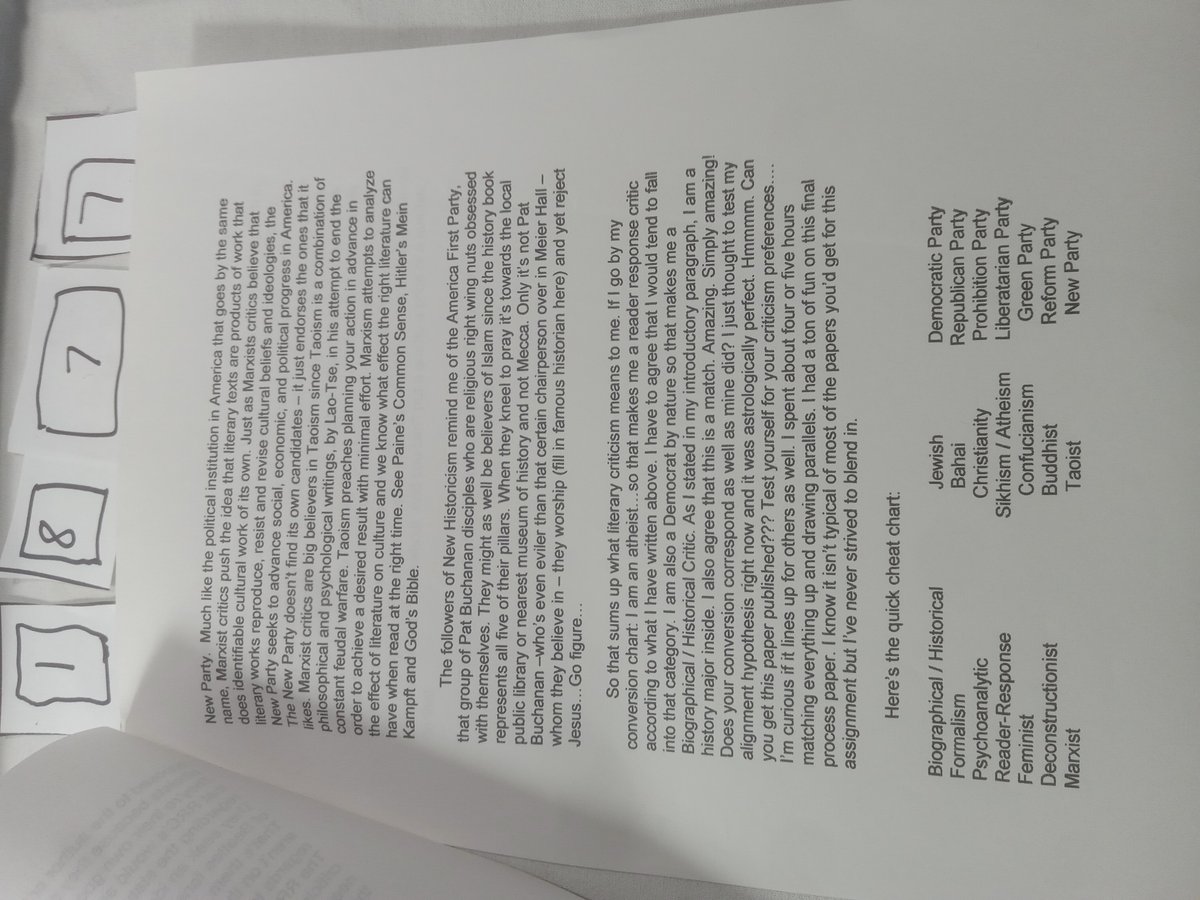
New Party. Much like the political institution in America that goes by the same name, Marxist critics push the idea that literary texts are products of work that does identifiable cultural work of its own. Just as Marxists critics believe that literary works reproduce, resist and revise cultural beliefs and ideologies, the New Party seeks to advance social, economic, and political progress in America. The New Party doesn't find its own candidates -- it just endorses the ones that it likes. Marxist critics are big believers in Taoism since Taoism is a combination of philosophical and psychological writings, by Lao-Tse, in his attempt to end the constant feudal warfare. Taoism preaches planning your action in advance in order to achieve a desired result with minimal effort. Marxism attempts to analyze the effect of literature on culture and we know what effect the right literature can have when read at the right time. See Paine's Common Sense, Hitler's Mein Kampt and God's Bible.
The followers of New Historicism remind me of the America First Party, that group of Pat Buchanan disciples who are religious right wing nuts obsessed with themselves. They might as well be believers of Islam since the history book represents all five of their pillars. When they kneel to pray it's towards the local public library or nearest museum of history and not Mecca. Only it's not Pat Buchanan -who's even eviler than that certain chairperson over in Meier Hall - whom they believe in - they worship (fill in famous historian here) and yet reject Jesus... Go figure...
So that sums up what literary criticism means to me. If I go by my conversion chart: I am an atheist... so that makes me a reader response critic according to what I have written above. I have to agree that I would tend to fall into that category. I am also a Democrat by nature so that makes me a Biographical / Historical Critic. As I stated in my introductory paragraph, I am a history major inside. I also agree that this is a match. Amazing. Simply amazing! Does your conversion correspond as well as mine did? I just thought to test my alignment hypothesis right now and it was astrologically perfect. Hmmm. Can you get this paper published??? Test yourself for your criticism preferences.... I'm curious if it lines up for others as well. I spent about four or five hours matching everything up and drawing parallels. I had a ton of fun on this final process paper. I know it isn't typical of most of the papers you'd get for this assignment but I've never strived to blend in.
Here's the quick cheat chart:
Biographical / Historical
Formalism
Psychoanalytic
Reader-Response
Feminist
Deconstructionist
Marxist
Jewish
Bahai
Christianity
Sikhism / Atheism
Confucianism
Buddhist
Taoist
Democratic Party
Republican Party
Prohibition Party
Liberatarian Party
Green Party
Reform Party
New Party
Item 1878
UNTITLED - first line: Like Leonardo Da Vinci and Benjamin Franklin, [Jefferson] he was amazingly many-sided, in a fashion which an age of specialization has outmoded. He...
White paper with printed document text and handwritten notes, featuring small paper slips or tabs attached along the edge.
- Why it matters
- Tom writes this
- Type
- Printed page
- Collection
- Tom writes this
- Published in
- PREVIOUSLY UNPUBLISHEDSearched against the 34 albums, every book and Poems By Tom - found in none of them
- Copies
- 2 in the catalogue · also written out as number 1883matched on the words by machine - Tom confirms
Price · Tier · Tom fills these
Picture 1 of 5
Picture 2 of 5

Picture 3 of 5
Picture 4 of 5
Picture 5 of 5
The words on this page
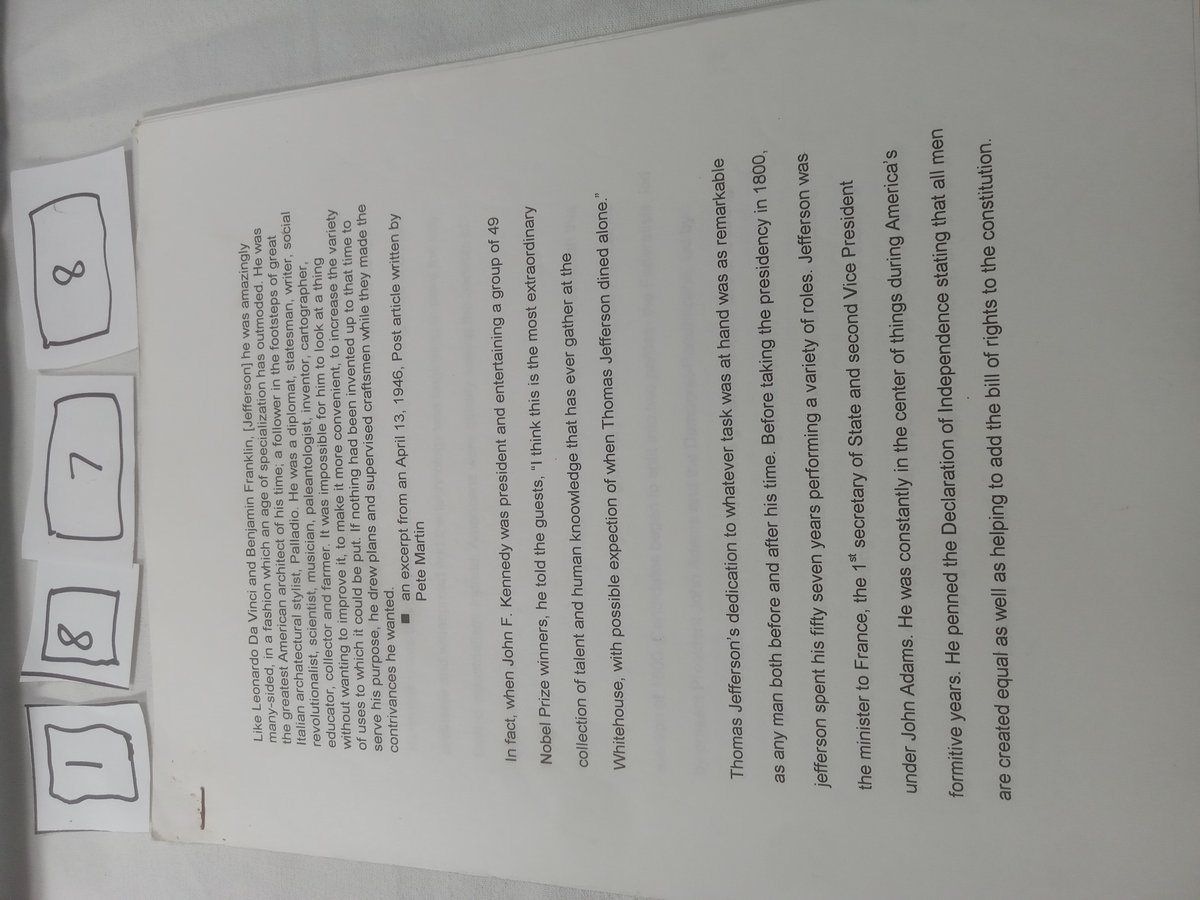
Like Leonardo Da Vinci and Benjamin Franklin, [Jefferson] he was amazingly many-sided, in a fashion which an age of specialization has outmoded. He was the greatest American architect of his time; a follower in the footsteps of great Italian archatectural stylist, Palladio. He was a diplomat, statesman, writer, social revolutionalist, scientist, musician, paleontologist, inventor, cartographer, educator, collector and farmer. It was impossible for him to look at a thing without wanting to improve it, to make it more convenient, to increase the variety of uses to which it could be put. If nothing had been invented up to that time to serve his purpose, he drew plans and supervised craftsmen while they made the contrivances he wanted.
■ an excerpt from an April 13, 1946, Post article written by Pete Martin
In fact, when John F. Kennedy was president and entertaining a group of 49 Nobel Prize winners, he told the guests, "I think this is the most extraordinary collection of talent and human knowoledge that has ever gather at the Whitehouse, with possible expection of when Thomas Jefferson dined alone."
Thomas Jefferson's dedication to whatever task was at hand was as remarkable as any man both before and after his time. Before taking the presidency in 1800, Jefferson spent his fifty seven years performing a variety of roles. Jefferson was the minister to France, the 1st secretary of State and second Vice President under John Adams. He was constantly in the center of things during America's formitive years. He penned the Declaration of Independence stating that all men are created equal as well as helping to add the bill of rights to the constitution.
---
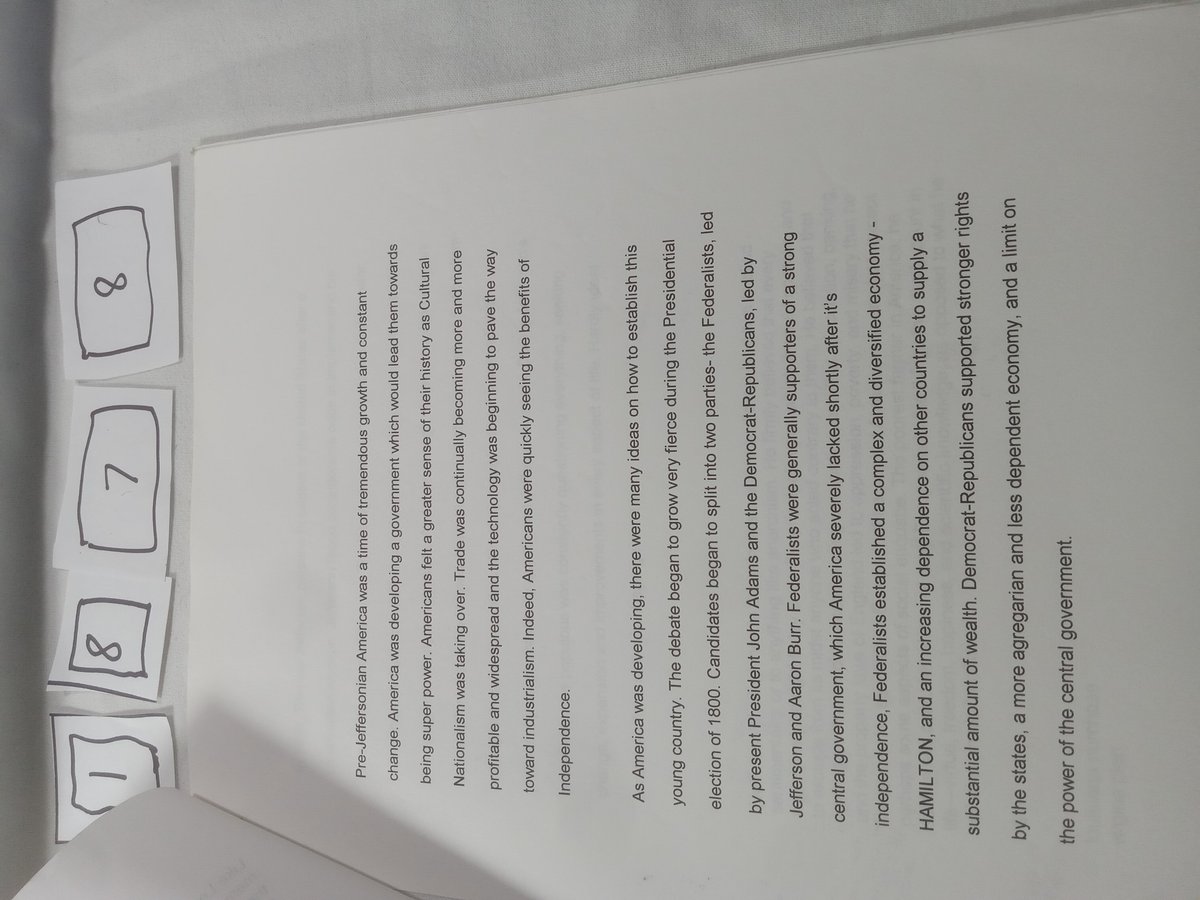
Pre-Jeffersonian America was a time of tremendous growth and constant
change. America was developing a government which would lead them towards
being super power. Americans felt a greater sense of their history as Cultural
Nationalism was taking over. Trade was continually becoming more and more
profitable and widespread and the technology was beginning to pave the way
toward industrialism. Indeed, Americans were quickly seeing the benefits of
Independence.
As America was developing, there were many ideas on how to establish this
young country. The debate began to grow very fierce during the Presidential
election of 1800. Candidates began to split into two parties- the Federalists, led
by present President John Adams and the Democrat-Republicans, led by
Jefferson and Aaron Burr. Federalists were generally supporters of a strong
central government, which America severely lacked shortly after it's
independence, Federalists established a complex and diversified economy -
HAMILTON, and an increasing dependence on other countries to supply a
substantial amount of wealth. Democrat-Republicans supported stronger rights
by the states, a more agregarian and less dependent economy, and a limit on
the power of the central government.
---
8
7
8
1
cut deficit
& legacy
---
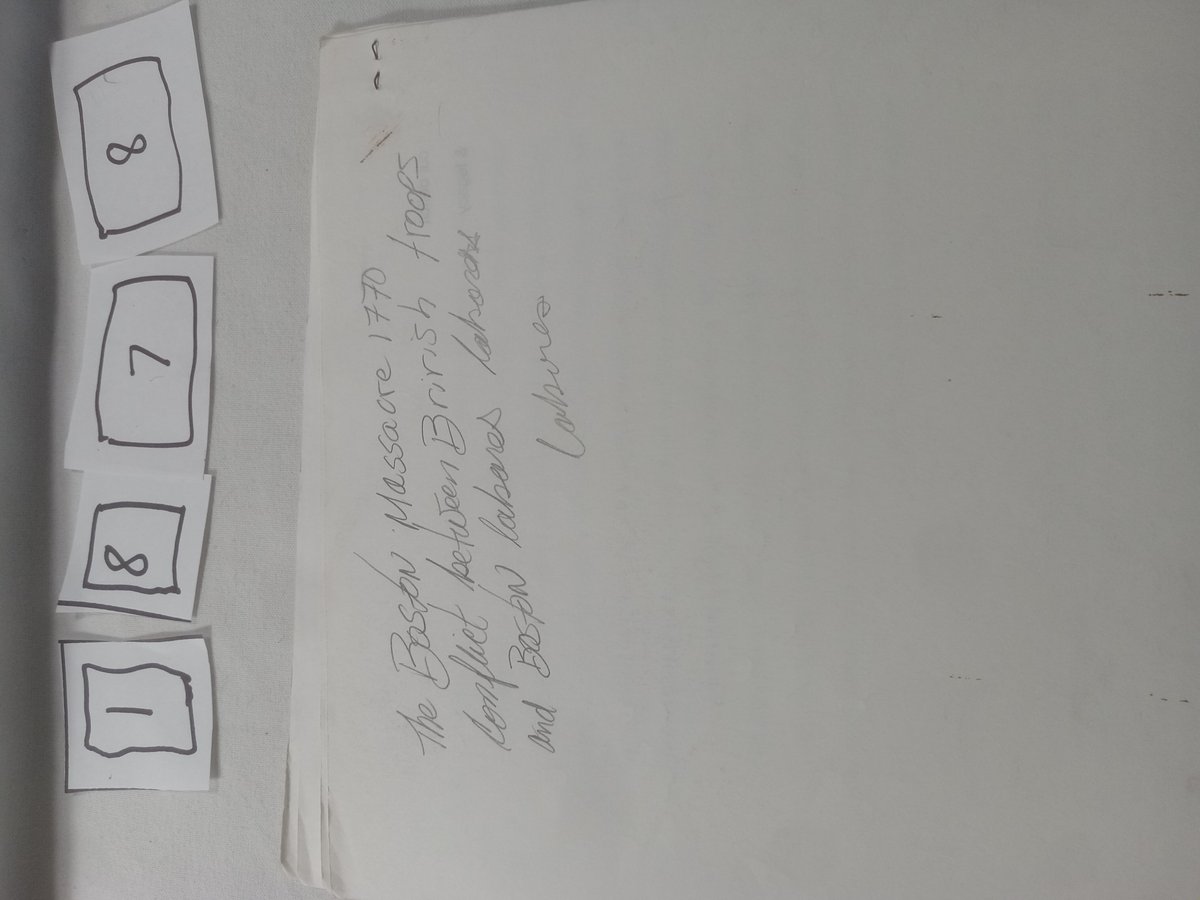
The Boson Massacre 1770
conflict between Brirish troops
and Boson labares labares
Labores
Item 1880
Tom Jensen
Printed text on standard white paper.
- Why it matters
- Tom writes this
- Type
- Printed page
- Collection
- Tom writes this
- Published in
- PREVIOUSLY UNPUBLISHEDSearched against the 34 albums, every book and Poems By Tom - found in none of them
Price · Tier · Tom fills these
Picture 1 of 5
Picture 2 of 5
Picture 3 of 5
Picture 4 of 5
Picture 5 of 5
The words on this page
Tom Jensen
Philosophy plays a major role in anyone's life and especially on the life of a teacher who is not only responsible for themselves but many other fragile young minds. Philosophy helps us use our intellectual skills along with our intellectual tools. Being a student of different philosophies provides alternative ways of thinking about the same problem. Philosophy dictates responses and actions which invariable dictates our lives. So when choosing a teaching philosophy you must usually do what we all must do in life...compromise. All or nothing will usually result in nothing. Philosophy is a map which helps us to see what we say and say what we see. Philosophic questioning does not guarantee that we will become wise it only provides direction in searching for wisdom.
No philosophical idea is more crucial to education than axiology. As everyone has their own ideas of what is important in life it is this axiology which sets the building blocks of education. Before you can try to get someone to learn they must know why it is important to do so. What is of value? I think that my first day of teaching will include a tangent, rant and rave on the declaration that "Knowledge is Power." It is on this premise that children will feel compelled to actively engage the material. Most of the time, fighting with words is more effective than fists.
In some ways, I definitely take on an idealist perspective. We are all thinking beings who are capable of seeking Truth through reasoning. I would definitely direct our thinking towards universal concepts opposed to mundane activities of living. We are all searching to raise the bar as a race and this can only be reached if we are all aware of worldly life as opposed to only our little brick school building. When children learn of widespread poverty, such as Africa or the Sudan, then they may look at all the "bad" in their world a little differently. The teacher is firmly believe in dialogue as the primary form of education. The teacher is
---
nothing more than a mediator between students and ideas and information. Ideas can change lives and it is my duty to relate these ideas and let the student make their own conclusions.
A large part of my philosophy in the classroom will include many
Existential beliefs. Experience, reality and purpose are pivotal within the lived
experience of both a student and a person. As can be seen throughout history,
to many, life has no meaning except what we ourselves give to our lives. It is up
to the student to discover the meaning of his own life. I can portray why I chose
my path and why I do what I do and hopefully the students can use their own
guide, or philosophy, to walk down their own road. From Hitler to MLK, from
Jackie Robinson to Mrs. Robinson - we all discover the meaning of life. I have
learned greatly the results of free choices I have made and contrastingly have
taken personal accountability. History has taught us throughout time that many
of the agreed upon laws and practices are wrong. Slavery was the product of
ignorance. I would pose the question of whether or not there is anything in life
worth dying for to change or make better. Many men have died in wars while
believing they were fighting for a just cause. The first step of education is
uncovering yourself, your beliefs and discovering what is inside your soul. These
values are individual decisions and are selected. We all enter this world without
meaning and it is up to us to give our life a meaning. My goal as a teacher is to
help students explore this world and try to help the students decide by
themselves where they fit in and what to do with their world. My teaching will
attempt to look at contrasts in order to realize that two things can both be good
and also be different. Individuality is a positive and not a negative.
Bordering on this idea is the value of Confucianism. I believe that
Confucius was correct when he expected his students to revolutionize any
government in which they might participate and to force the government to serve
the needs of its people. People can not be free if they follow somebody else's
---
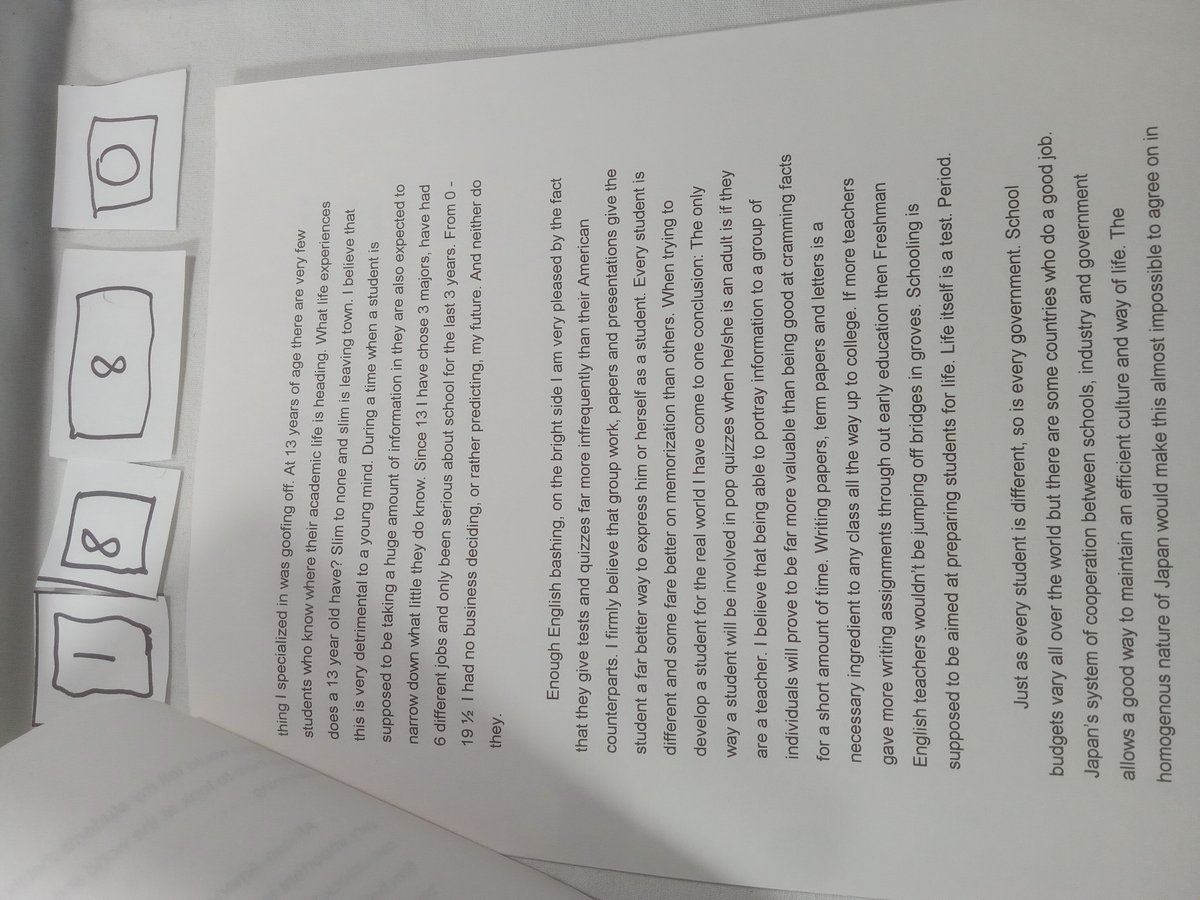
thing I specialized in was goofing off. At 13 years of age there are very few students who know where their academic life is heading. What life experiences does a 13 year old have? Slim to none and slim is leaving town. I believe that this is very detrimental to a young mind. During a time when a student is supposed to be taking a huge amount of information in they are also expected to narrow down what little they do know. Since 13 I have chose 3 majors, have had 6 different jobs and only been serious about school for the last 3 years. From 0 - 19 ½ I had no business deciding, or rather predicting, my future. And neither do they.
Enough English bashing, on the bright side I am very pleased by the fact that they give tests and quizzes far more infrequently than their American counterparts. I firmly believe that group work, papers and presentations give the student a far better way to express him or herself as a student. Every student is different and some fare better on memorization than others. When trying to develop a student for the real world I have come to one conclusion: The only way a student will be involved in pop quizzes when he/she is an adult is if they are a teacher. I believe that being able to portray information to a group of individuals will prove to be far more valuable than being good at cramming facts for a short amount of time. Writing papers, term papers and letters is a necessary ingredient to any class all the way up to college. If more teachers gave more writing assignments through out early education then Freshman English teachers wouldn't be jumping off bridges in groves. Schooling is supposed to be aimed at preparing students for life. Life itself is a test. Period.
Just as every student is different, so is every government. School budgets vary all over the world but there are some countries who do a good job. Japan's system of cooperation between schools, industry and government allows a good way to maintain an efficient culture and way of life. The homogenous nature of Japan would make this almost impossible to agree on in
---
America but it does work effectively there. Japan is also ahead of the times as it gives equal money to each school effectively giving every student an equal chance at excellence. Another positive aspect of a country's school system is in Mexico where the Ministry of Education provides free textbooks to its students. Unfortunately, many governments are unwilling to spend the amount of money needed to provide for the future of their country.
Item 1881
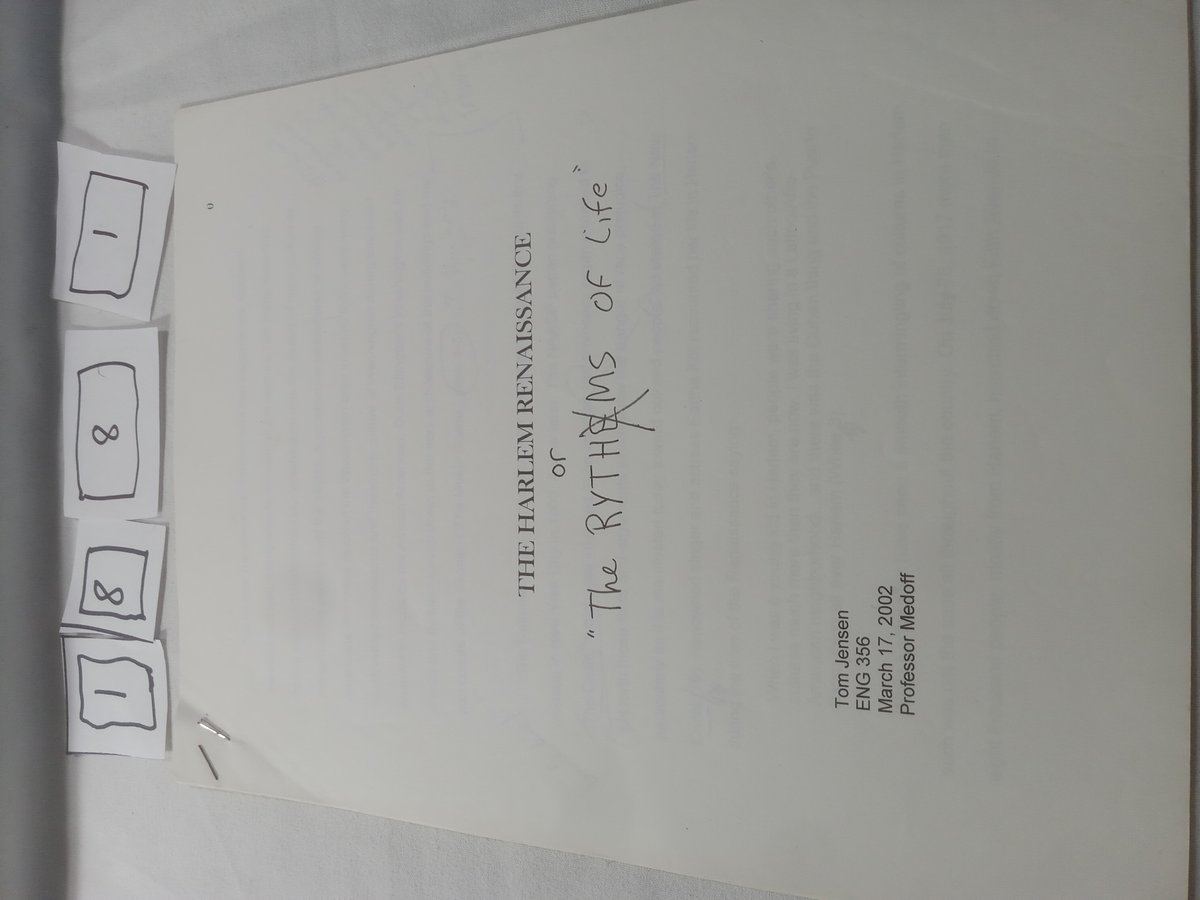
THE HARLEM RENAISSANCE or "The RYTHEMS OF Life"
White paper sheets, off-white paper, and lined notebook paper with printed text and handwritten notes in ink and pencil.
- Why it matters
- Tom writes this
- Type
- Printed page
- Collection
- Tom writes this
- Published in
- PREVIOUSLY UNPUBLISHEDSearched against the 34 albums, every book and Poems By Tom - found in none of them
Price · Tier · Tom fills these
Picture 1 of 11
Picture 2 of 11
Picture 3 of 11
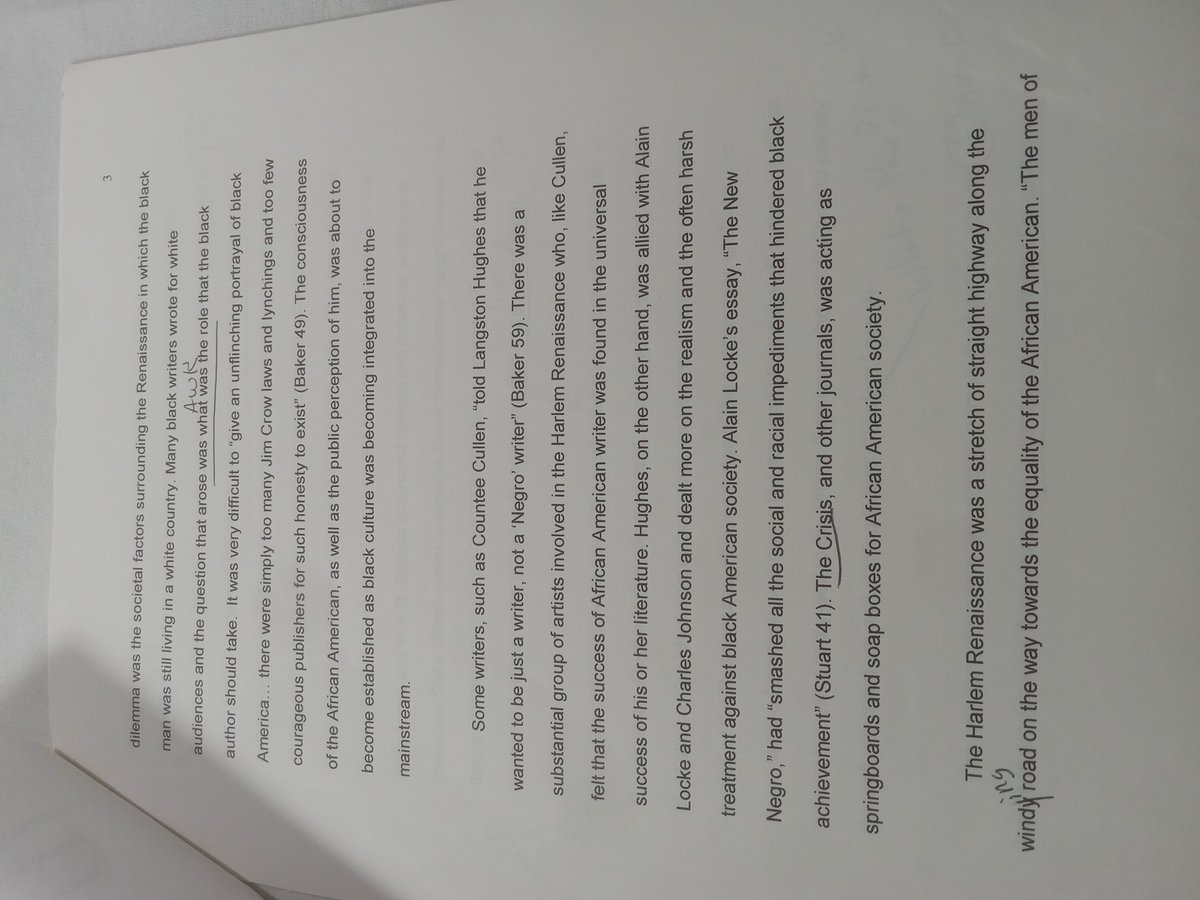
Picture 4 of 11
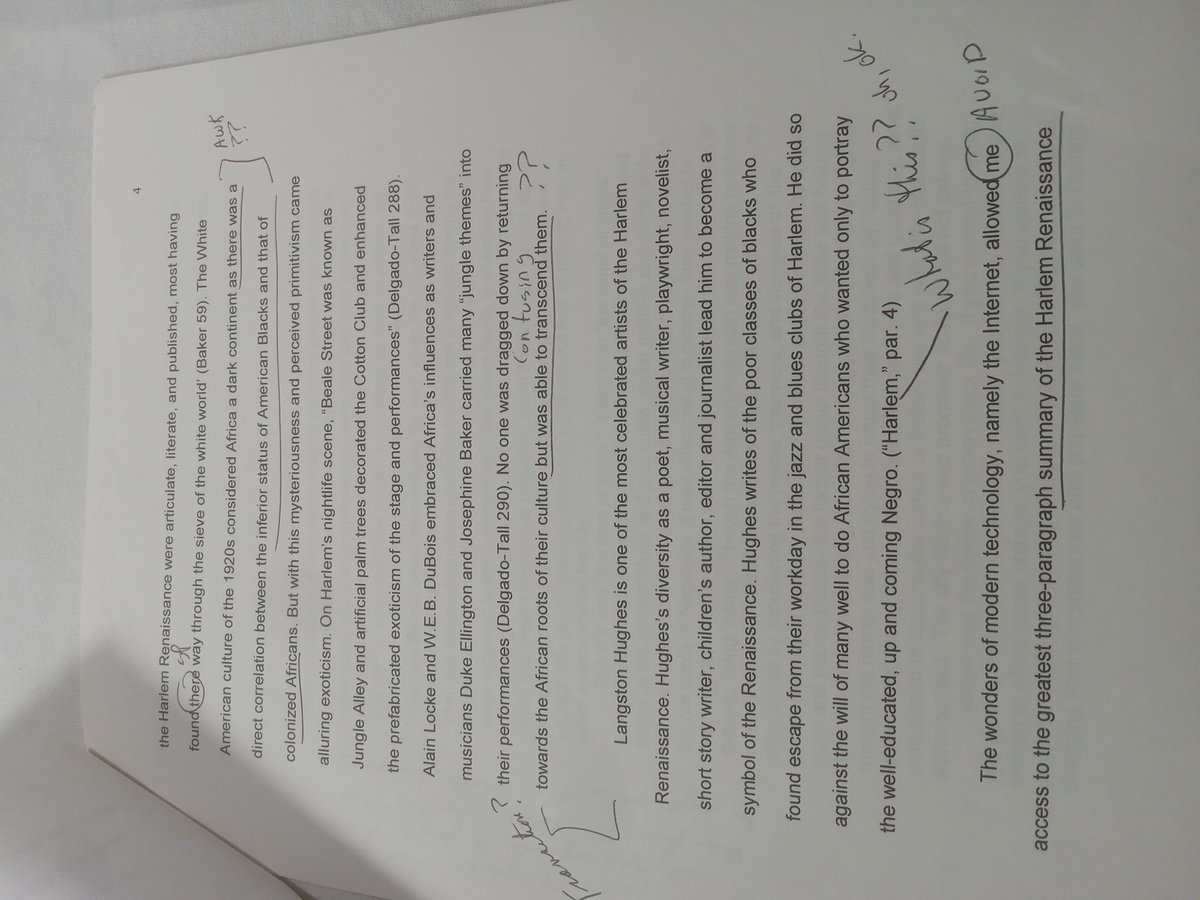
Picture 5 of 11
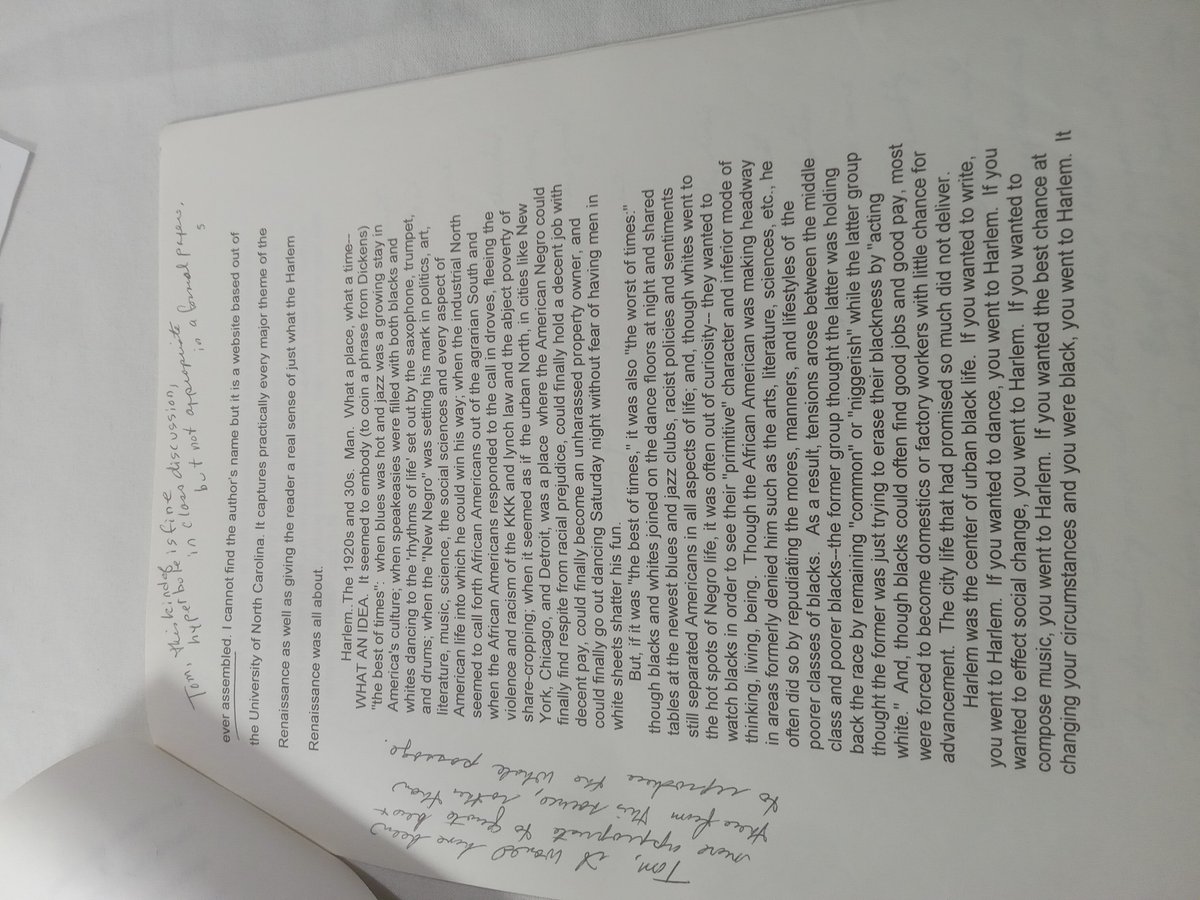
Picture 6 of 11
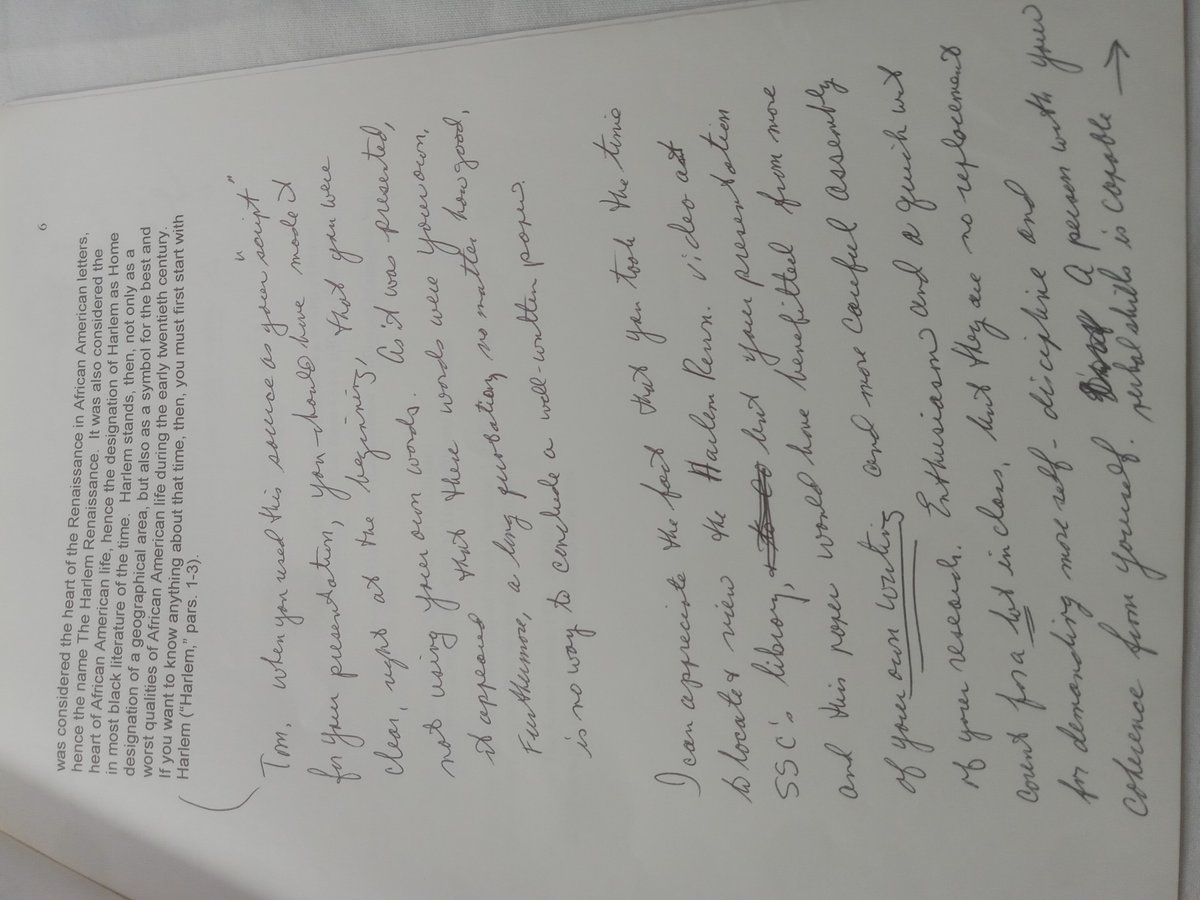
Picture 7 of 11
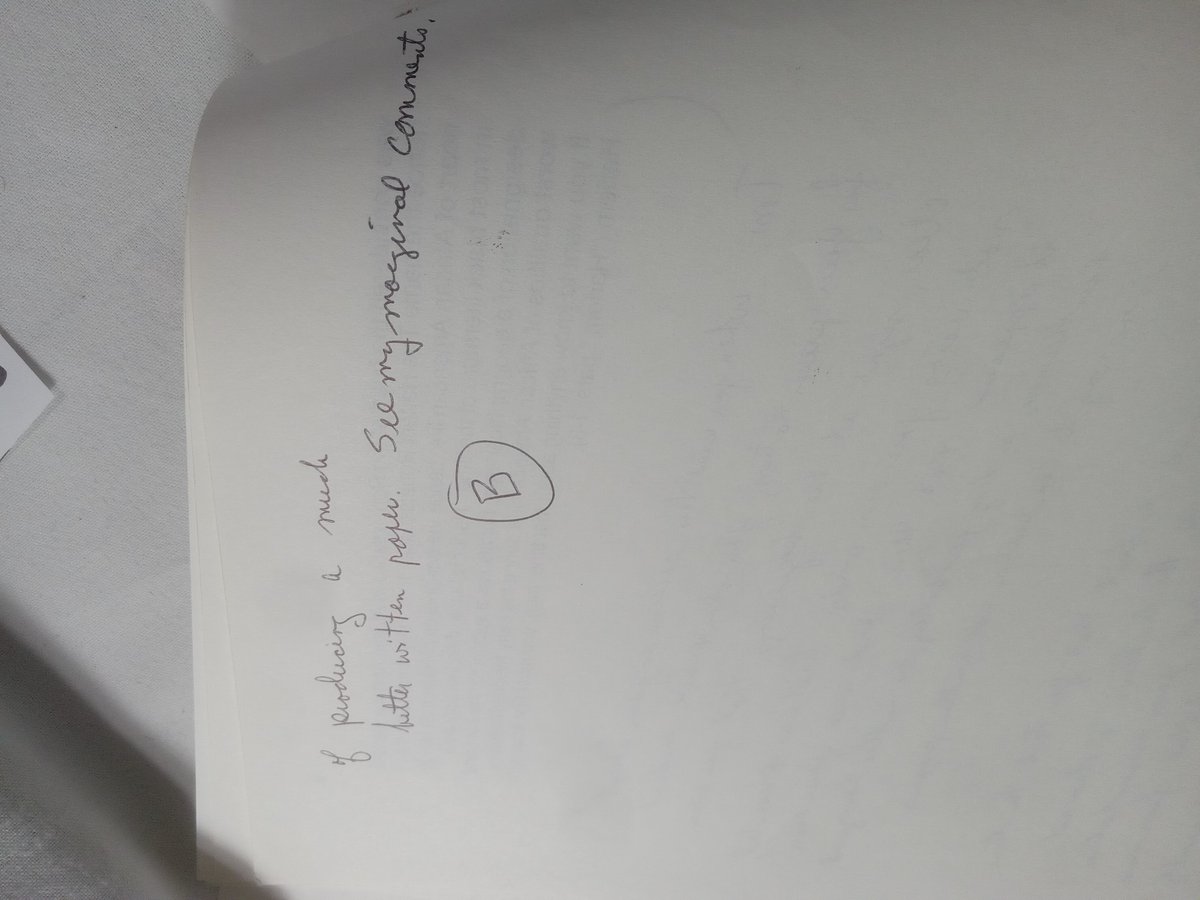
Picture 8 of 11
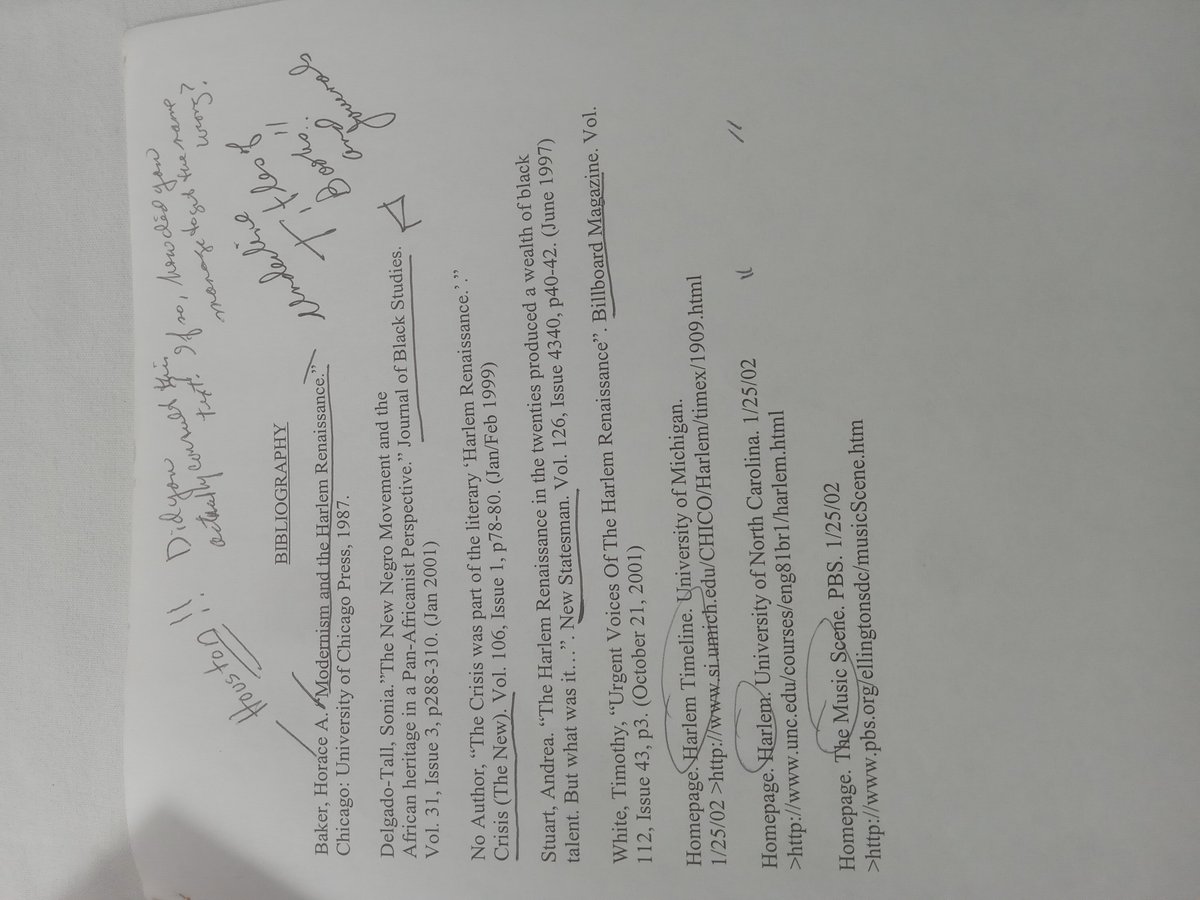
Picture 9 of 11
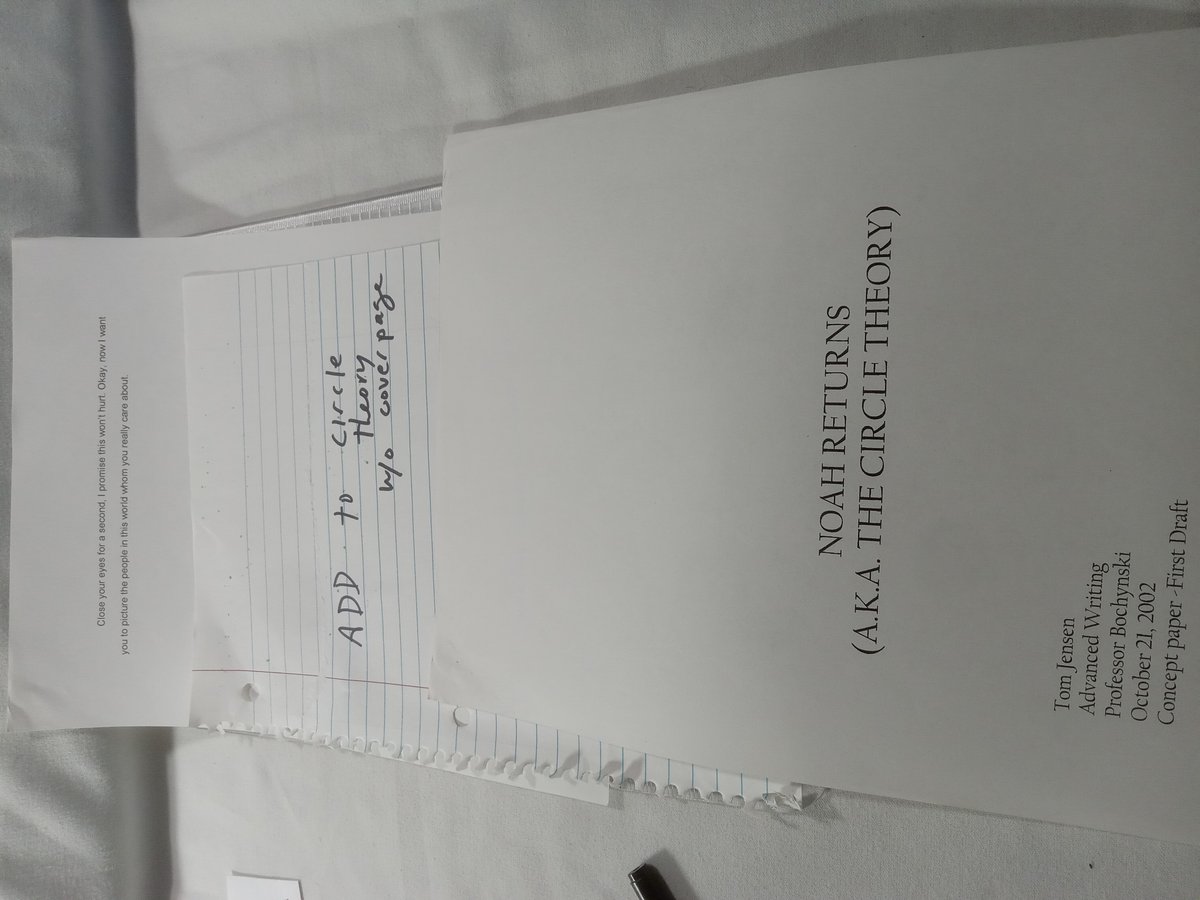
Picture 10 of 11
Picture 11 of 11
The words on this page
THE HARLEM RENAISSANCE
or
"The RYTHEMS OF Life"
Tom Jensen
ENG 356
March 17, 2002
Professor Medoff
or
"The RYTHEMS OF Life"
Tom Jensen
ENG 356
March 17, 2002
Professor Medoff
Item 1883
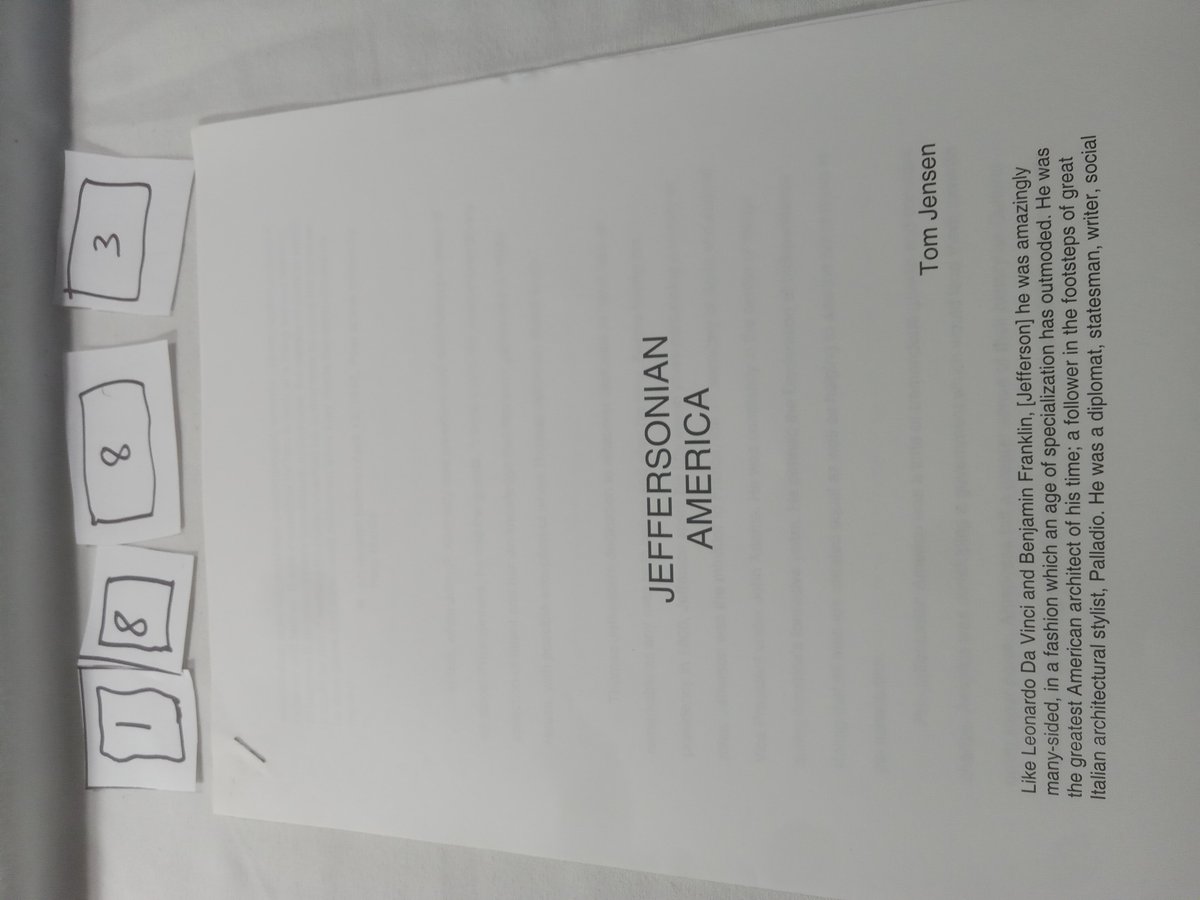
JEFFERSONIAN AMERICA
Printed text on white paper sheets with handwritten boxed numbers along the margin.
- Why it matters
- Tom writes this
- Type
- Printed page
- Collection
- Tom writes this
- Published in
- PREVIOUSLY UNPUBLISHEDSearched against the 34 albums, every book and Poems By Tom - found in none of them
- Copies
- 2 in the catalogue · also written out as number 1878matched on the words by machine - Tom confirms
Price · Tier · Tom fills these
Picture 1 of 6
Picture 2 of 6
Picture 3 of 6
Picture 4 of 6
Picture 5 of 6
Picture 6 of 6
The words on this page
JEFFERSONIAN
AMERICA
Tom Jensen
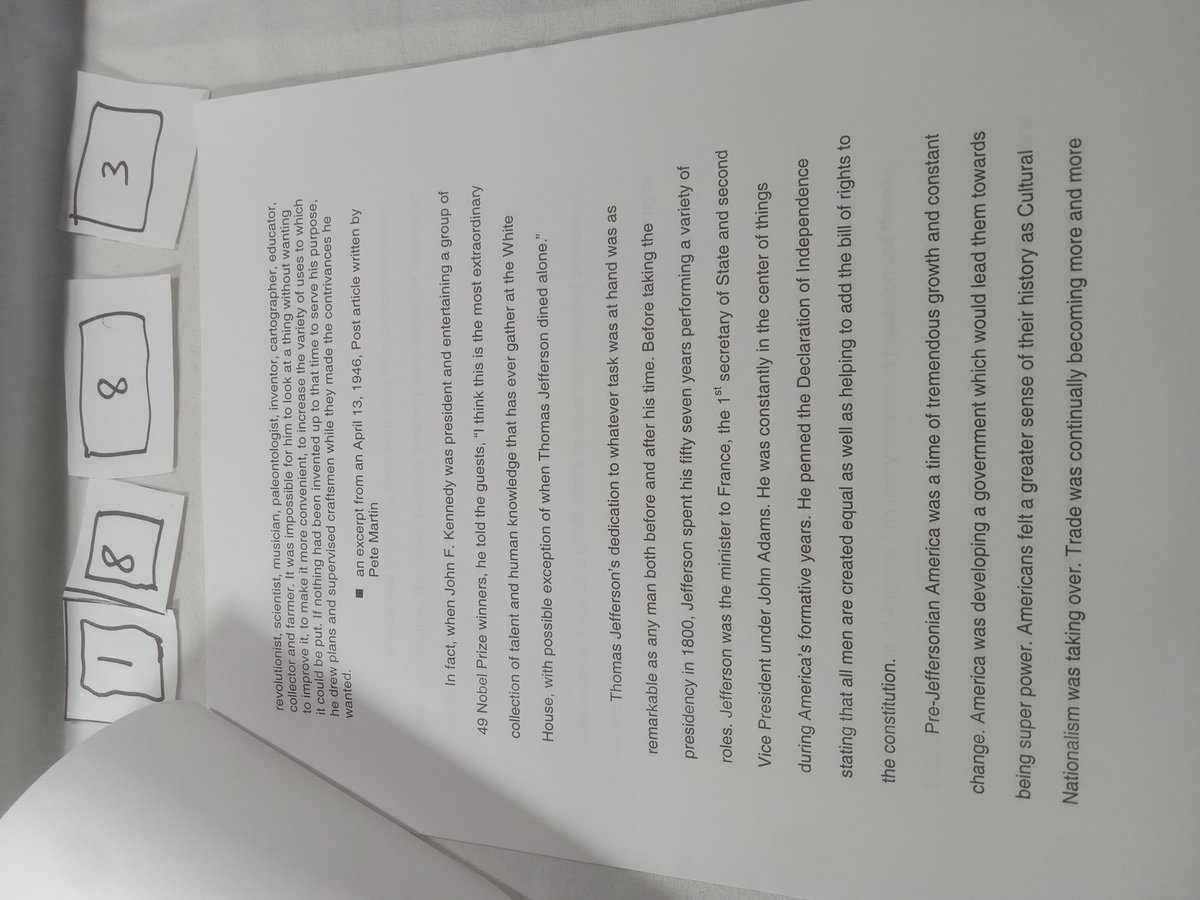
Like Leonardo Da Vinci and Benjamin Franklin, [Jefferson] he was amazingly many-sided, in a fashion which an age of specialization has outmoded. He was the greatest American architect of his time; a follower in the footsteps of great Italian architectural stylist, Palladio. He was a diplomat, statesman, writer, social
---
revolutionist, scientist, musician, paleontologist, inventor, cartographer, educator, collector and farmer. It was impossible for him to look at a thing without wanting to improve it, to make it more convenient, to increase the variety of uses to which it could be put. If nothing had been invented up to that time to serve his purpose, he drew plans and supervised craftsmen while they made the contrivances he wanted.
■ an excerpt from an April 13, 1946, Post article written by Pete Martin
In fact, when John F. Kennedy was president and entertaining a group of 49 Nobel Prize winners, he told the guests, "I think this is the most extraordinary collection of talent and human knowledge that has ever gather at the White House, with possible exception of when Thomas Jefferson dined alone."
Thomas Jefferson's dedication to whatever task was at hand was as remarkable as any man both before and after his time. Before taking the presidency in 1800, Jefferson spent his fifty seven years performing a variety of roles. Jefferson was the minister to France, the 1st secretary of State and second Vice President under John Adams. He was constantly in the center of things during America's formative years. He penned the Declaration of Independence stating that all men are created equal as well as helping to add the bill of rights to the constitution.
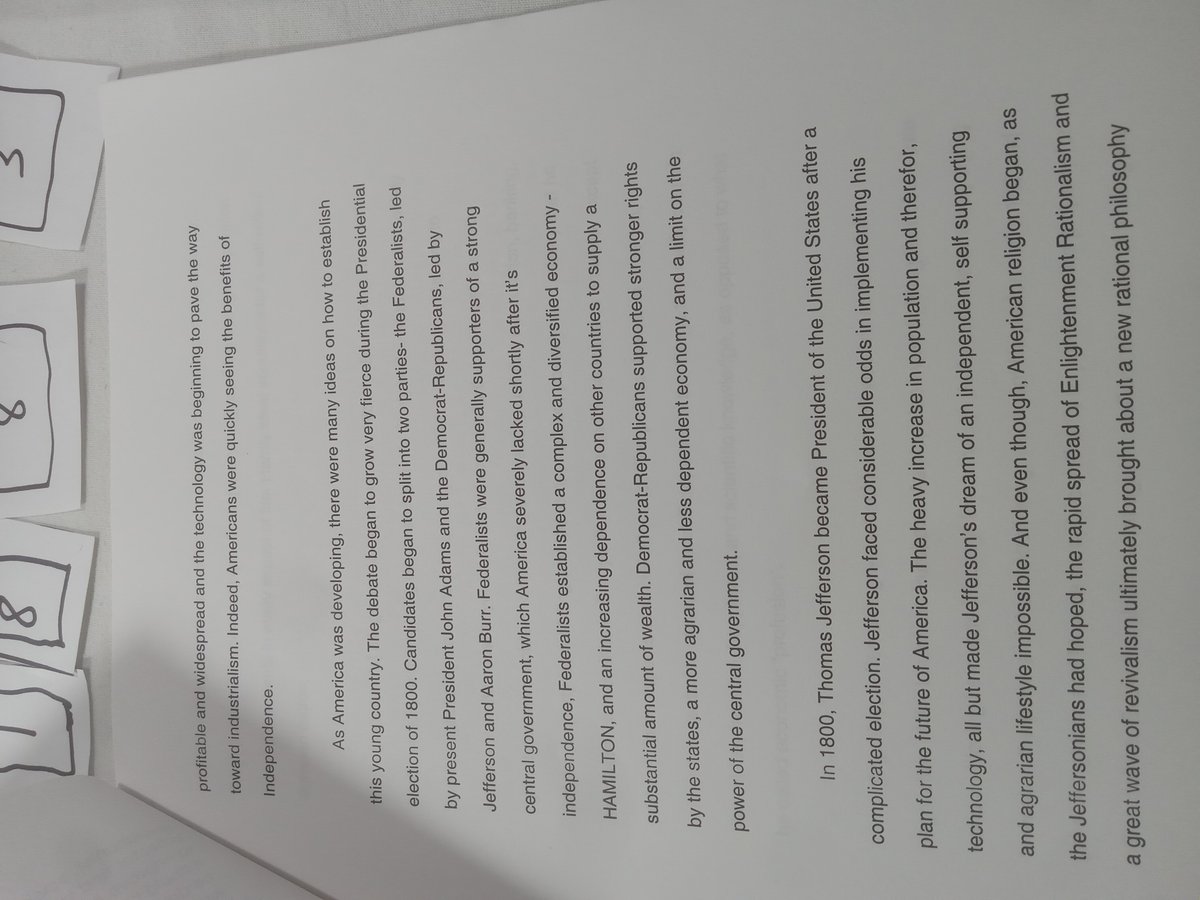
Pre-Jeffersonian America was a time of tremendous growth and constant change. America was developing a government which would lead them towards being super power. Americans felt a greater sense of their history as Cultural Nationalism was taking over. Trade was continually becoming more and more
---
profitable and widespread and the technology was beginning to pave the way
toward industrialism. Indeed, Americans were quickly seeing the benefits of
independence.
As America was developing, there were many ideas on how to establish
this young country. The debate began to grow very fierce during the Presidential
election of 1800. Candidates began to split into two parties- the Federalists, led
by present President John Adams and the Democrat-Republicans, led by
Jefferson and Aaron Burr. Federalists were generally supporters of a strong
central government, which America severely lacked shortly after it's
independence, Federalists established a complex and diversified economy -
HAMILTON, and an increasing dependence on other countries to supply a
substantial amount of wealth. Democrat-Republicans supported stronger rights
by the states, a more agrarian and less dependent economy, and a limit on the
power of the central government.
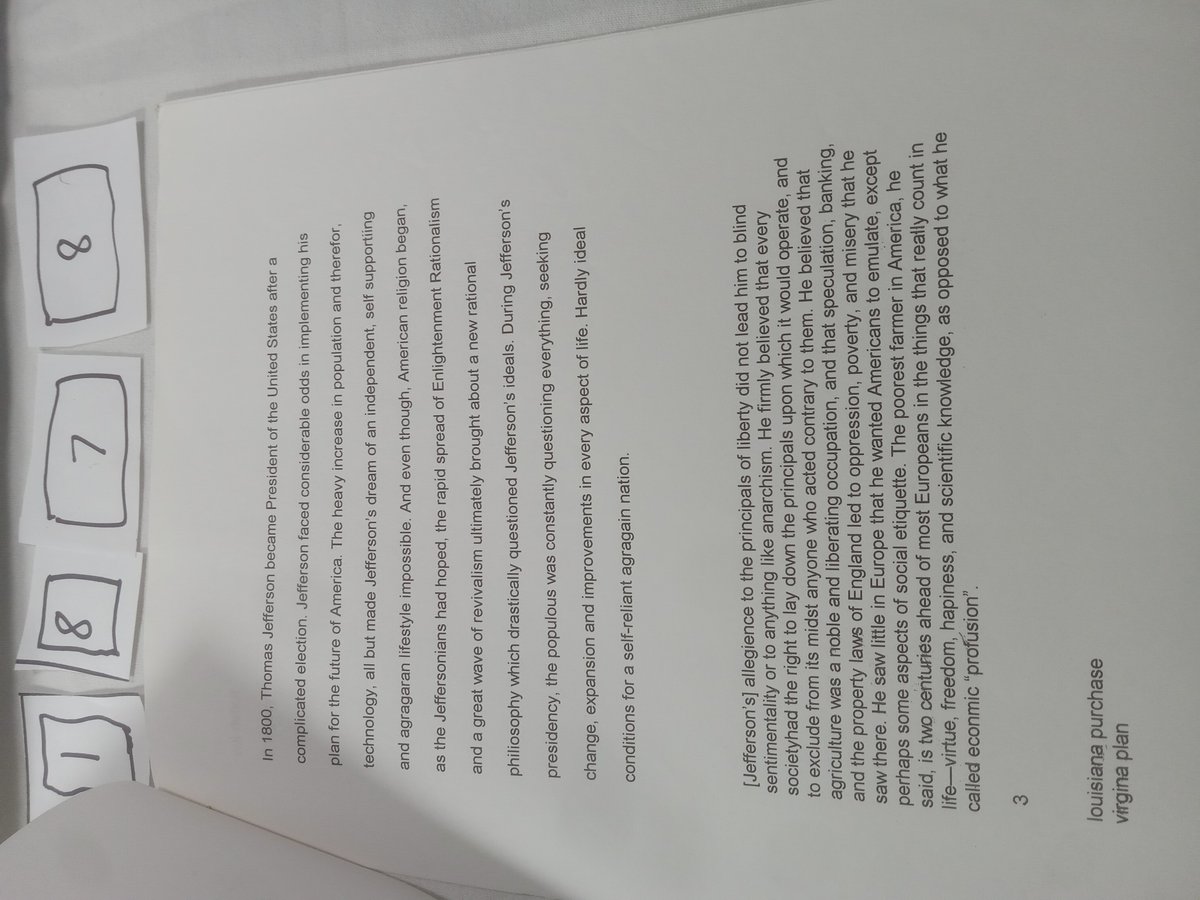
In 1800, Thomas Jefferson became President of the United States after a
complicated election. Jefferson faced considerable odds in implementing his
plan for the future of America. The heavy increase in population and therefor,
technology, all but made Jefferson's dream of an independent, self supporting
and agrarian lifestyle impossible. And even though, American religion began, as
the Jeffersonians had hoped, the rapid spread of Enlightenment Rationalism and
a great wave of revivalism ultimately brought about a new rational philosophy
---
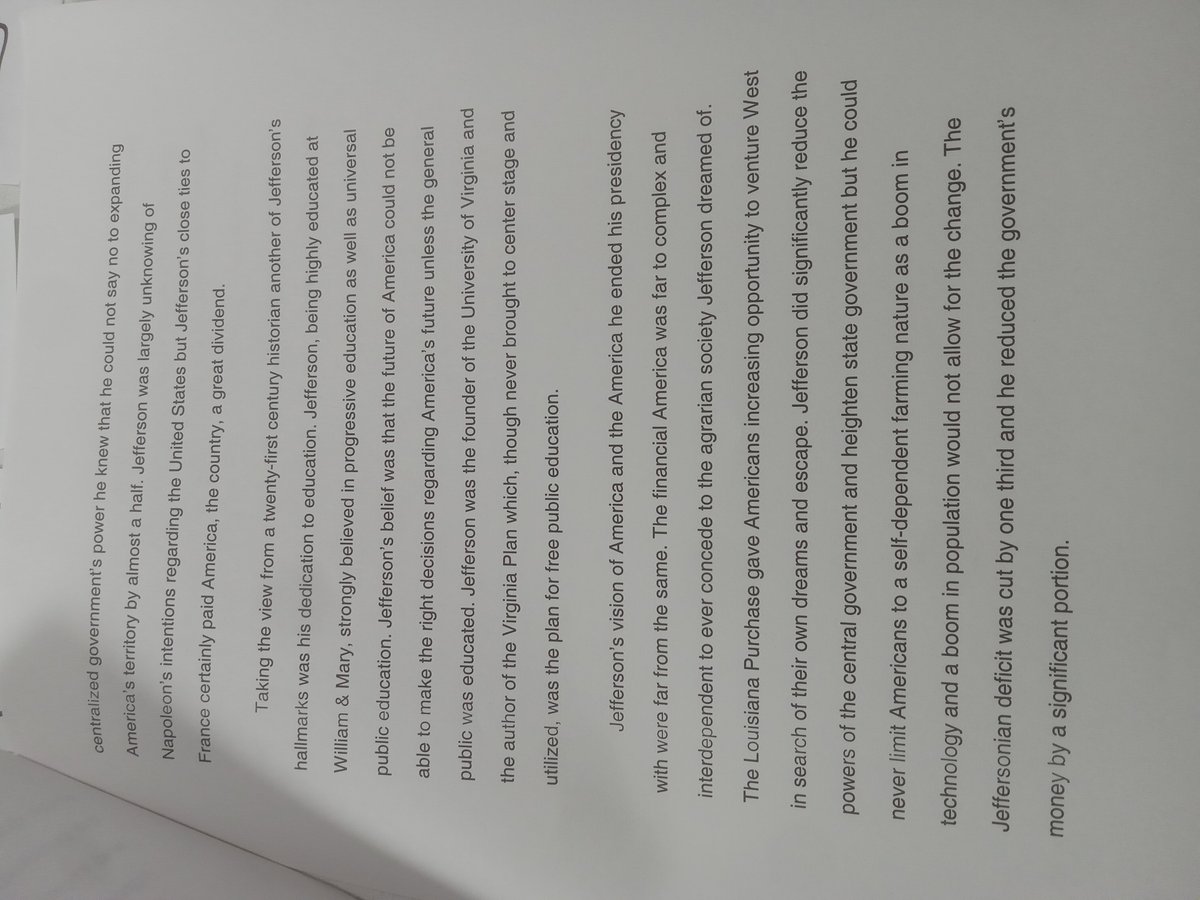
centralized government's power he knew that he could not say no to expanding
America's territory by almost a half. Jefferson was largely unknowing of
Napoleon's intentions regarding the United States but Jefferson's close ties to
France certainly paid America, the country, a great dividend.
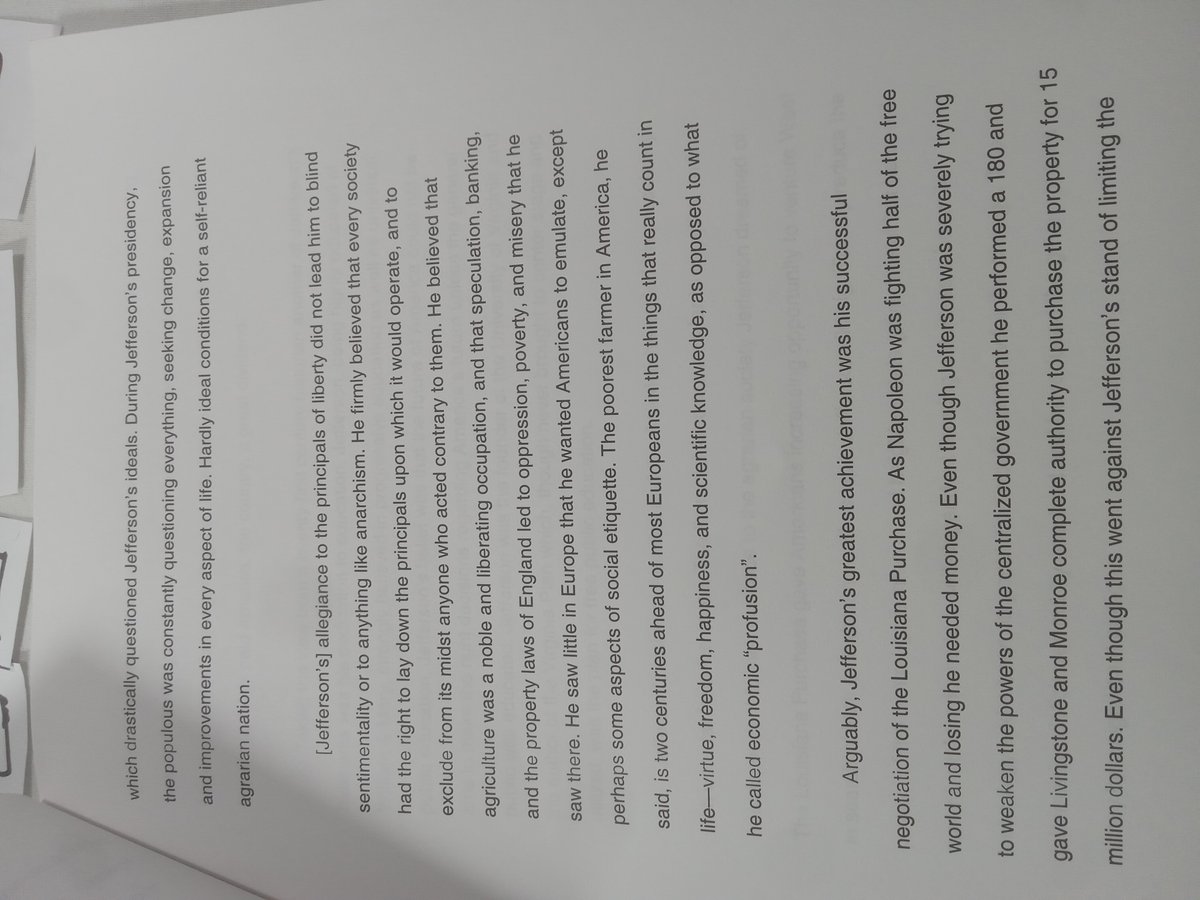
Taking the view from a twenty-first century historian another of Jefferson's
hallmarks was his dedication to education. Jefferson, being highly educated at
William & Mary, strongly believed in progressive education as well as universal
public education. Jefferson's belief was that the future of America could not be
able to make the right decisions regarding America's future unless the general
public was educated. Jefferson was the founder of the University of Virginia and
the author of the Virginia Plan which, though never brought to center stage and
utilized, was the plan for free public education.
Jefferson's vision of America and the America he ended his presidency
with were far from the same. The financial America was far to complex and
interdependent to ever concede to the agrarian society Jefferson dreamed of.
The Louisiana Purchase gave Americans increasing opportunity to venture West
in search of their own dreams and escape. Jefferson did significantly reduce the
powers of the central government and heighten state government but he could
never limit Americans to a self-dependent farming nature as a boom in
technology and a boom in population would not allow for the change. The
Jeffersonian deficit was cut by one third and he reduced the government's
money by a significant portion.
---
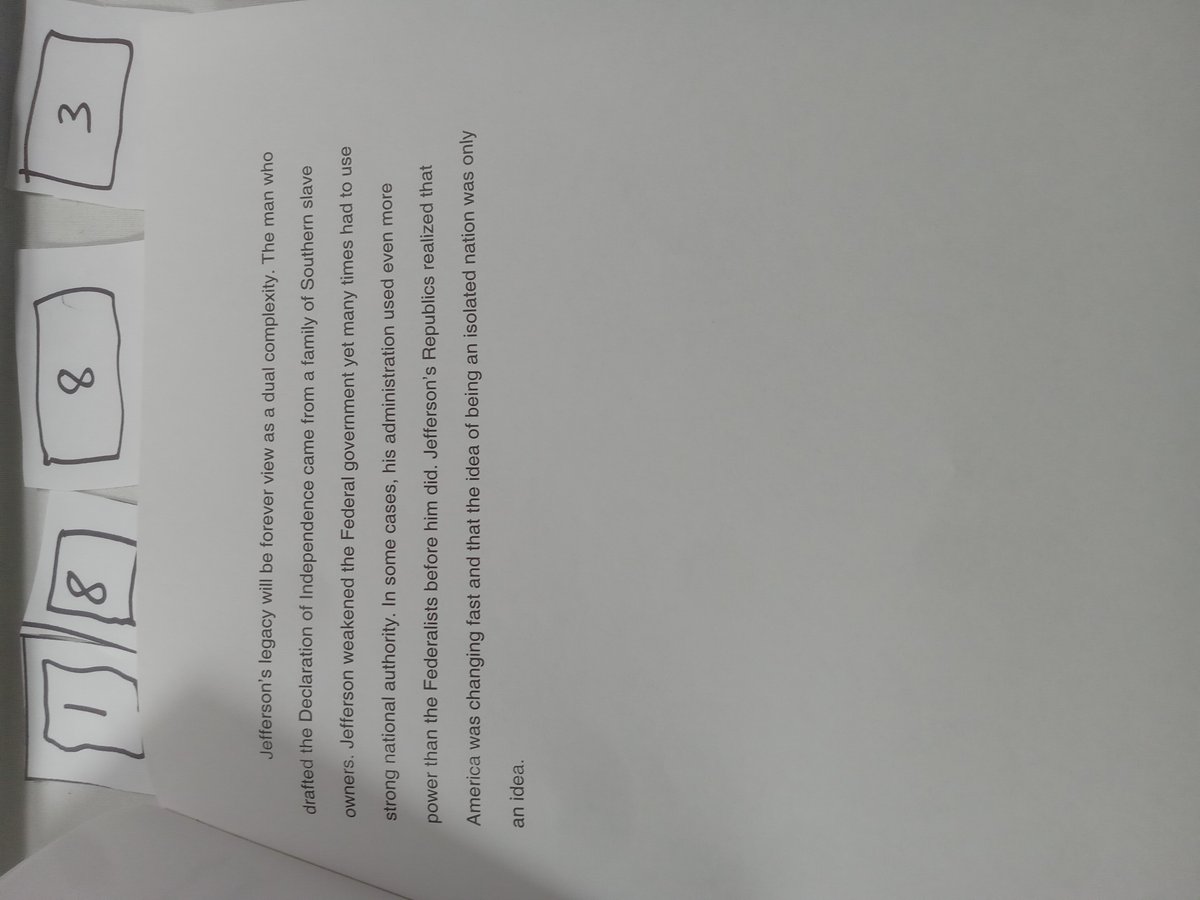
Jefferson's legacy will be forever view as a dual complexity. The man who drafted the Declaration of Independence came from a family of Southern slave owners. Jefferson weakened the Federal government yet many times had to use strong national authority. In some cases, his administration used even more power than the Federalists before him did. Jefferson's Republics realized that America was changing fast and that the idea of being an isolated nation was only an idea.
Item 1885
BACHELOR OF ARTS HISTORY APPLIED HISTORY CONCENTRATION PUBLIC HISTORY OPTION
Printed academic degree requirement worksheet and official transcript pages on standard white paper with handwritten annotations.
- Why it matters
- Tom writes this
- Type
- Printed page
- Collection
- Tom writes this
- Published in
- PREVIOUSLY UNPUBLISHEDSearched against the 34 albums, every book and Poems By Tom - found in none of them
Price · Tier · Tom fills these
Picture 1 of 3
Picture 2 of 3
Picture 3 of 3
The words on this page
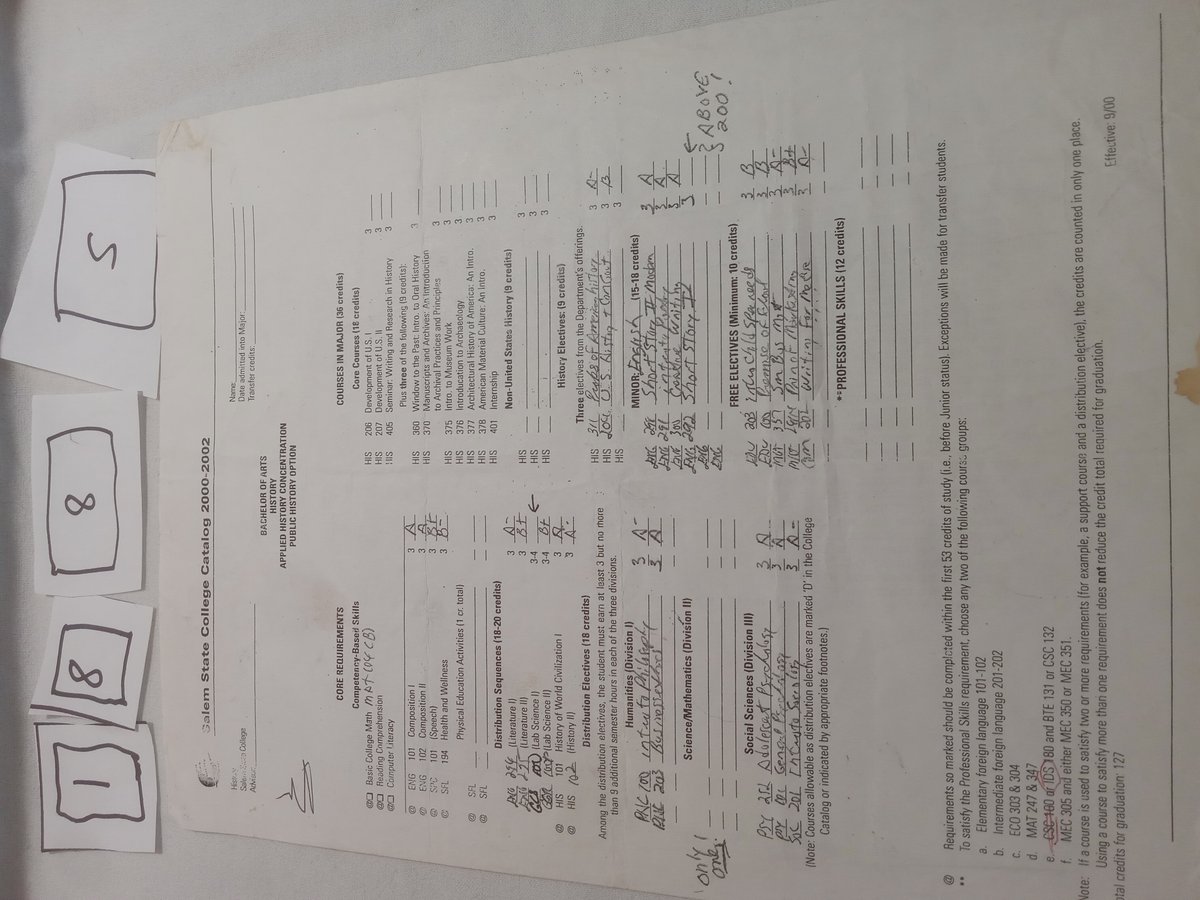
Salem State College Catalog 2000-2002
Name:
Date admitted into Major:
Transfer credits:
CORE REQUIREMENTS
Competency-Based Skills
@@ Basic College Math MAT 04CB
@ Reading Comprehension
@@ Computer Literacy
ENG 101 Composition I 3 A
ENG 102 Composition II 3 A
SPC 101 (Speech) 3 B+
SFL 194 Health and Wellness 3 B-
Physical Education Activities (1 cr. total)
Distribution Sequences (18-20 credits)
ENG 294 (Literature I) 3 A-
ENG 225 (Literature II) 3 B+
GSC 108 (Lab Science I) 3-4 B+
GSC 109 (Lab Science II) 3-4 B-
HIS 101 History of World Civilization I 3 A-
HIS 102 (History II) 3
Distribution Electives (18 credits)
Among the distribution electives, the student must earn at least 3 but no more
than 9 additional semester hours in each of the three divisions.
Humanities (Division I) (15-18 credits)
PHL 100 intro to Philosophy 3 A-
PHL 203 Business Ethics 3 A
[Handwritten: only 1 one]
[Handwritten above PHL 100/203]:
{ ABOVE 200?
HIS 311 Peoples of American history 3 A-
HIS 204 U.S. History + Govt 3 B
[Handwritten in Humanities section]:
ENG 291 Short Story II Modern 3 A
ENG 291 Creative Writing 3 A
ENG 300 Creative Writing 3 A
ENG 292 Short Story II 3 A
Science/Mathematics (Division II)
Social Sciences (Division III)
PSY 212 Adolescent Psychology 3 B
PSY 101 General Psychology 3 B
SOC 201 Intro to Sociology 3 B-
[Handwritten]:
(203) Child Spn needs 3 B
(357) Sm Bus Mgt 3 A-
(202) Writing for Media 3 A-
COURSES IN MAJOR (36 credits)
Core Courses (18 credits)
HIS 206 Development of U.S. I 3
HIS 207 Development of U.S. II 3
HIS 405 Seminar: Writing and Research in History 3
Plus three of the following (9 credits):
HIS 360 Window to the Past: Intro. to Oral History 3
HIS 370 Manuscripts and Archives: An Introduction 3
to Archival Practices and Principles 3
HIS 375 Health and Museum Work 3
HIS 376 Introduction to Archaeology 3
HIS 377 Architectural History of America: An Intro. 3
HIS 378 American Material Culture: An intro. 3
HIS 401 Internship 3
Non-United States History (9 credits)
HIS
HIS
HIS
History Electives: (9 credits)
Three electives from the Department's offerings.
FREE ELECTIVES (Minimum: 10 credits)
EDN 203 Child Spn needs 3 B
EDU 305 Psychology of Child 3 B
MGT 357 Sm Bus Mgt 3 A-
MGT 202 Writing for Media 3 A-
*=*PROFESSIONAL SKILLS (12 credits)
@ Requirements so marked should be completed within the first 53 credits of study (i.e., before Junior status). Exceptions will be made for transfer students.
To satisfy the Professional Skills requirement, choose any two of the following course groups:
a. Elementary foreign language 101-102
b. Intermediate foreign language 201-202
c. ECO 303 & 304
d. MAT 247 & 347
e. CSC 100 or IDS 180 and BTE 131 or CSC 132
f. MEC 305 and either MEC 350 or MEC 351.
Note: If a course is used to satisfy two or more requirements (for example, a support course and a distribution elective), the credits are counted in only one place.
Using a course to satisfy more than one requirement does not reduce the credit total required for graduation.
Total credits for graduation: 127
Effective: 9/00
---
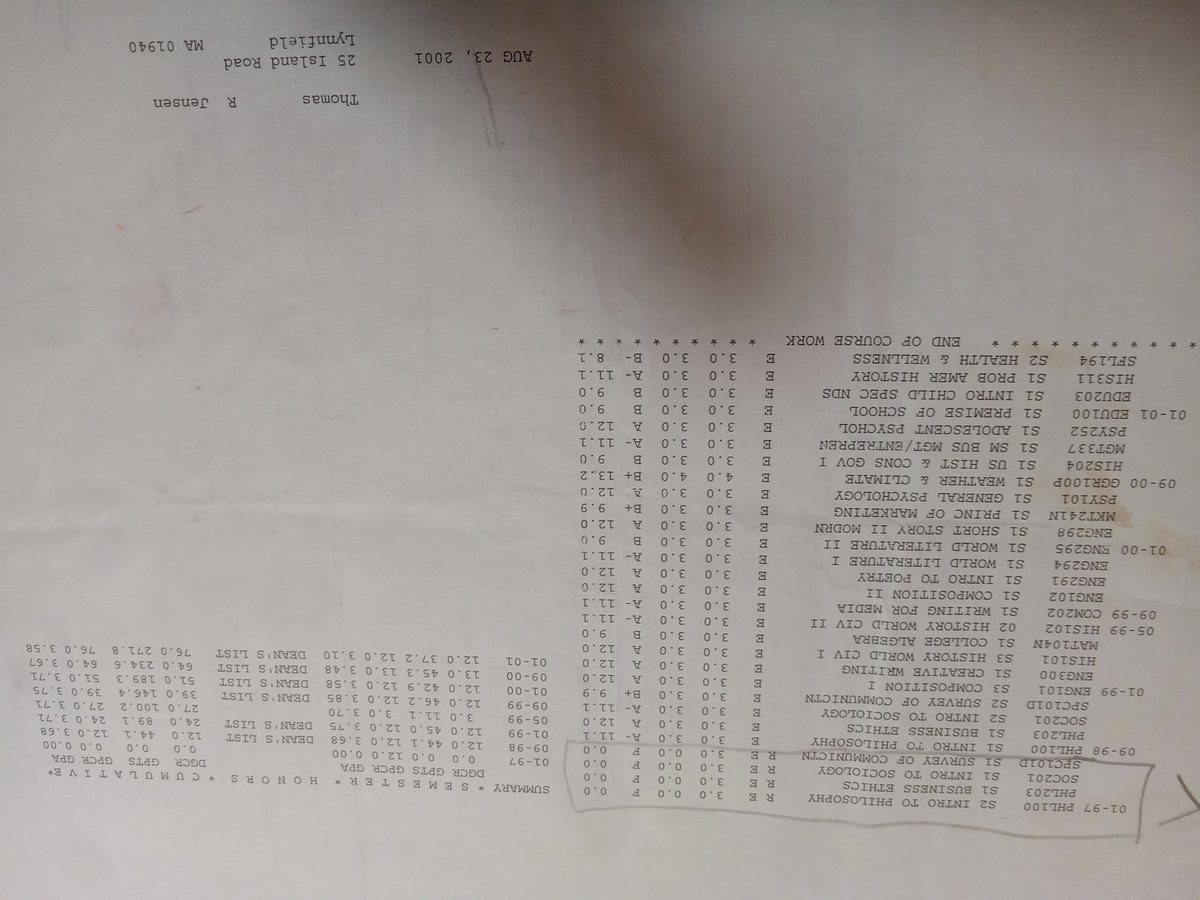
AUG 23, 2001
Thomas R. Jensen
25 Island Road
Lynnfield, MA 01940
S2 INTRO TO PHILOSOPHY PHL100 01-97 3.0 0.0 F R E
S1 BUSINESS ETHICS PHL203 01-97 3.0 0.0 F R E
S1 INTRO TO SOCIOLOGY SOC201 01-97 3.0 0.0 F R E
S1 SURVEY OF COMMUNICTN SPC101D 01-97 3.0 0.0 F R E
S1 BUSINESS ETHICS PHL203 09-98 3.0 3.0 A- 11.1
S2 INTRO TO SOCIOLOGY SOC201 09-98 3.0 3.0 A 12.0
S2 SURVEY OF COMMUNICTN SPC101D 09-98 3.0 3.0 A- 11.1
S3 COMPOSITION I ENG300 05-99 3.0 3.0 A 12.0
S1 CREATIVE WRITING ENG101 05-99 3.0 3.0 A 12.0
S3 HISTORY WORLD CIV I HIS101 05-99 3.0 3.0 A 12.0
S1 COLLEGE ALGEBRA MAT104N 09-99 3.0 3.0 A 12.0
S2 HISTORY WORLD CIV II HIS102 09-99 3.0 3.0 B 9.0
S1 WRITING FOR MEDIA COM202 09-99 3.0 3.0 A- 11.1
S1 COMPOSITION II ENG102 09-99 3.0 3.0 A- 11.1
S1 INTRO TO POETRY ENG291 01-00 3.0 3.0 A 12.0
S1 WORLD LITERATURE I ENG294 01-00 3.0 3.0 A 12.0
S1 WORLD LITERATURE II ENG295 01-00 3.0 3.0 A- 11.1
S1 SHORT STORY II MODRN ENG298 01-00 3.0 3.0 B 9.0
S1 PRINC OF MARKETING MKT241N 01-00 3.0 3.0 A 12.0
S1 GENERAL PSYCHOLOGY PSY101 01-00 3.0 3.0 A 12.0
S1 WEATHER & CLIMATE GGR100P 01-00 4.0 4.0 B+ 13.2
S1 US HIST & CONS GOV I HIS204 01-00 3.0 3.0 B 9.0
S1 SM BUS MGT/ENTREPREN MGT337 01-00 3.0 3.0 A 12.0
S1 ADOLESCENT PSYCHOL PSY252 01-00 3.0 3.0 A- 11.1
S1 PREMISE OF SCHOOL EDU100 01-00 3.0 3.0 A 12.0
S1 INTRO CHILD SPEC NDS EDU203 01-00 3.0 3.0 B 9.0
S1 PROB AMER HISTORY HIS311 01-00 3.0 3.0 A- 11.1
S2 HEALTH & WELLNESS SFL194 01-00 3.0 3.0 B- 8.1
* * * * * * * * * * * * * * END OF COURSE WORK * * * * * * * * * * * * * *
SUMMARY * S E M E S T E R * * C U M U L A T I V E *
DGCR GPTS GPCR GPA HONORS DGCR GPTS GPCR GPA
0.0 0.0 12.0 0.00 0.0 0.0 12.0 3.68
0.0 0.0 12.0 0.00 0.0 44.1 12.0 3.68
12.0 44.1 12.0 3.68 DEAN'S LIST 24.0 89.1 24.0 3.71
12.0 45.0 12.0 3.75 DEAN'S LIST 39.0 146.4 27.0 3.71
3.0 11.1 3.0 3.70 51.0 189.3 51.0 3.75
12.0 46.2 12.0 3.85 DEAN'S LIST 39.0 100.2 27.0 3.71
12.0 42.9 12.0 3.58 DEAN'S LIST 51.0 189.3 51.0 3.75
13.0 45.3 13.0 3.48 DEAN'S LIST 64.0 234.6 64.0 3.67
12.0 37.2 12.0 3.10 DEAN'S LIST 76.0 271.8 76.0 3.58
---
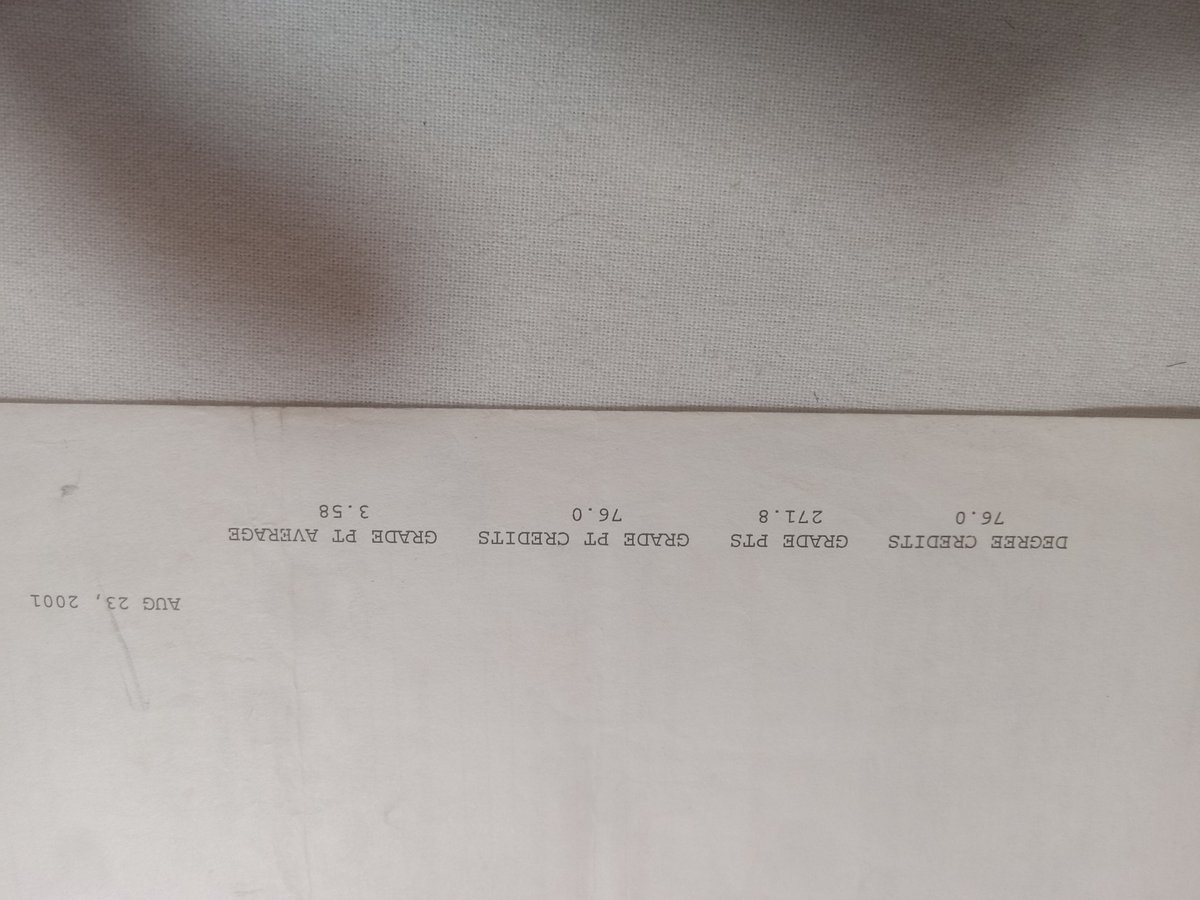
DEGREE CREDITS
76.0
GRADE PTS
271.8
GRADE PT CREDITS
76.0
GRADE PT AVERAGE
3.58
AUG 23, 2001
Item 1886
QUESTION...
Printed document on white paper.
- Why it matters
- Tom writes this
- Type
- Printed page
- Collection
- Tom writes this
- Published in
- PREVIOUSLY UNPUBLISHEDSearched against the 34 albums, every book and Poems By Tom - found in none of them
- Age when written
- written by age 29 at the latestdated from the earliest book it appears in - the sheet itself may be older
Price · Tier · Tom fills these
Picture 1 of 2
Picture 2 of 2
The words on this page
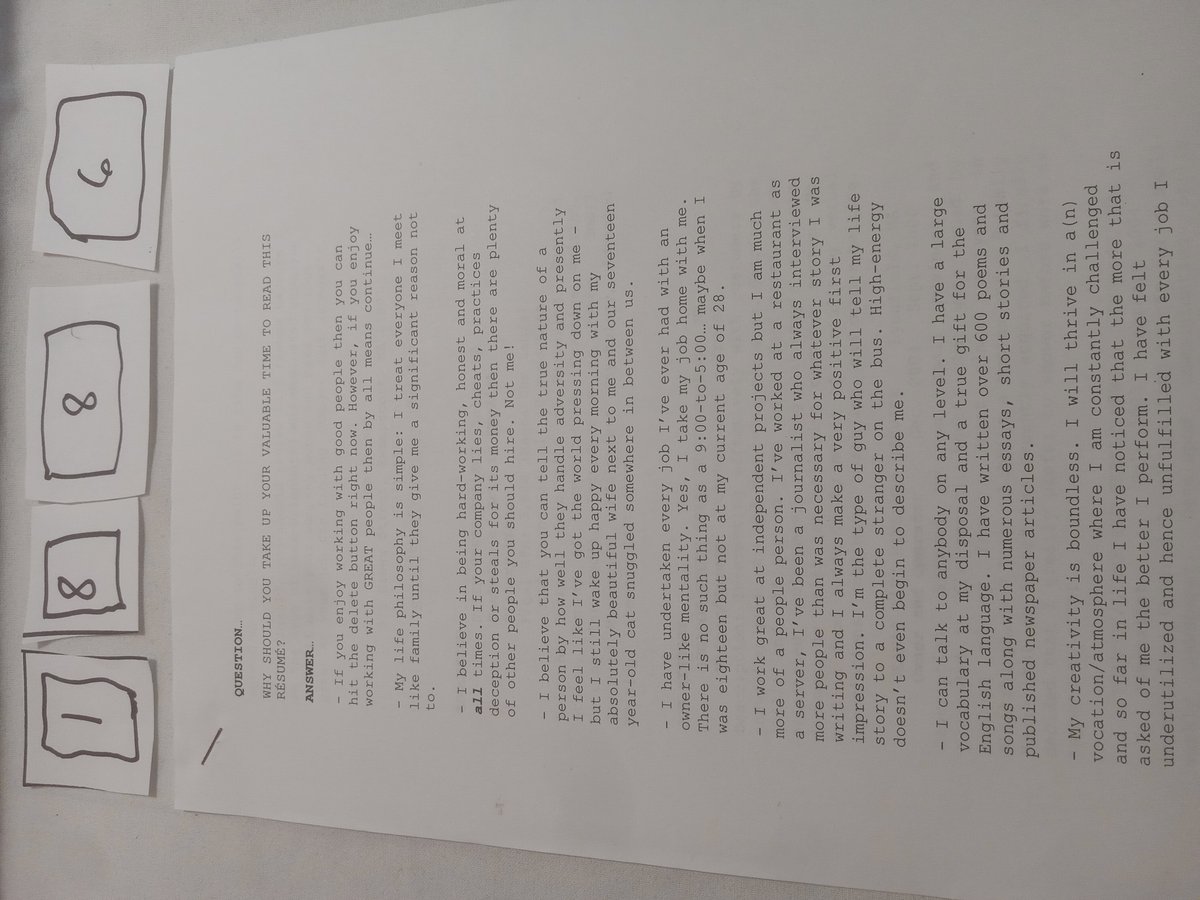
QUESTION...
WHY SHOULD YOU TAKE UP YOUR VALUABLE TIME TO READ THIS RÉSUMÉ?
ANSWER...
- If you enjoy working with good people then you can hit the delete button right now. However, if you enjoy working with GREAT people then by all means continue...
- My life philosophy is simple: I treat everyone I meet like family until they give me a significant reason not to.
- I believe in being hard-working, honest and moral at all times. If your company lies, cheats, practices deception or steals for its money then there are plenty of other people you should hire. Not me!
- I believe that you can tell the true nature of a person by how well they handle adversity and presently I feel like I've got the world pressing down on me - but I still wake up happy every morning with my absolutely beautiful wife next to me and our seventeen year-old cat snuggled somewhere in between us.
- I have undertaken every job I've ever had with an owner-like mentality. Yes, I take my job home with me. There is no such thing as a 9:00-to-5:00... maybe when I was eighteen but not at my current age of 28.
- I work great at independent projects but I am much more of a people person. I've worked at a restaurant as a server, I've been a journalist who always interviewed more people than was necessary for whatever story I was writing and I always make a very positive first impression. I'm the type of guy who will tell my life story to a complete stranger on the bus. High-energy doesn't even begin to describe me.
- I can talk to anybody on any level. I have a large vocabulary at my disposal and a true gift for the English language. I have written over 600 poems and songs along with numerous essays, short stories and published newspaper articles.
- My creativity is boundless. I will thrive in a(n) vocation/atmosphere where I am constantly challenged and so far in life I have noticed that the more that is asked of me the better I perform. I have felt underutilized and hence unfulfilled with every job I
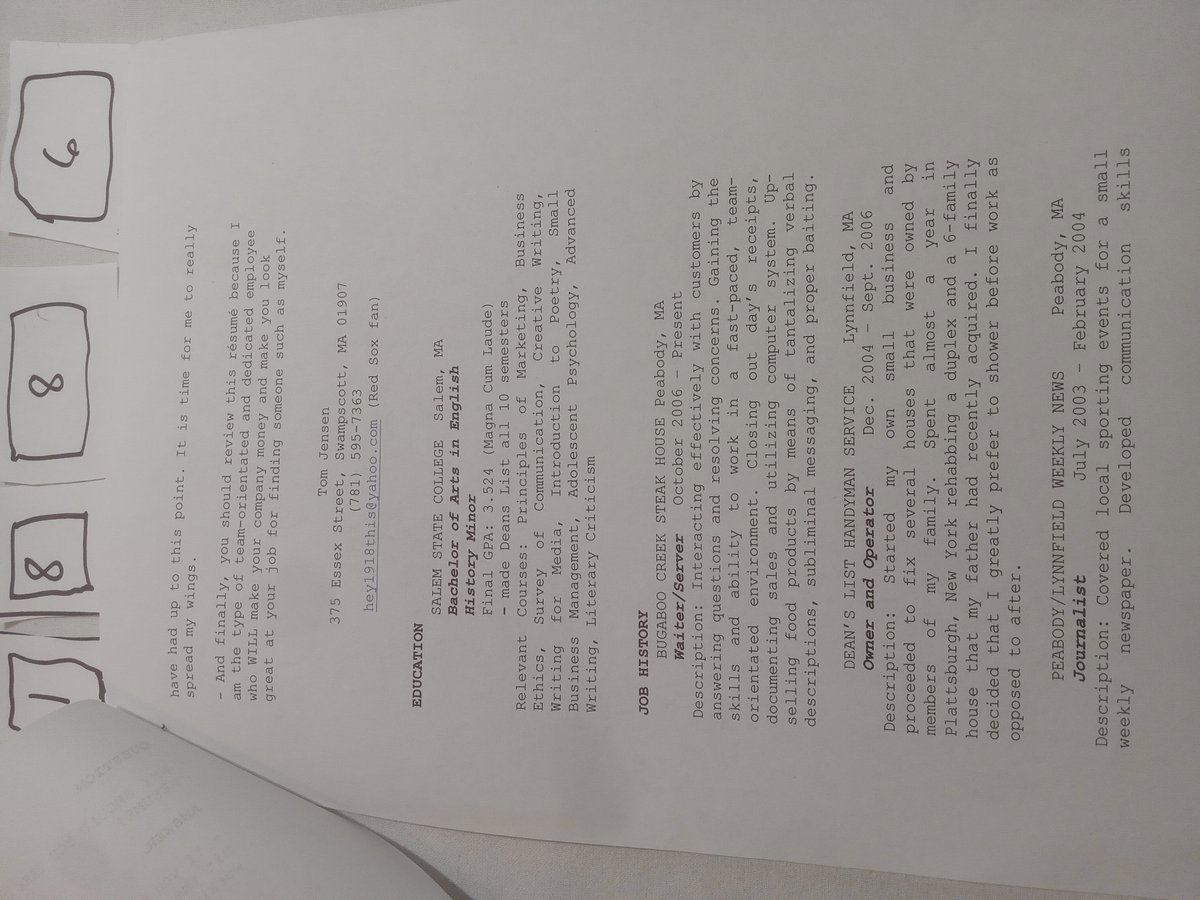
---
have had up to this point. It is time for me to really spread my wings.
- And finally, you should review this résumé because I am the type of team-orientated and dedicated employee who WILL make your company money and make you look great at your job for finding someone such as myself.
Tom Jensen
375 Essex Street, Swampscott, MA 01907
(781) 595-7363
hey1918this@yahoo.com (Red Sox fan)
EDUCATION
SALEM STATE COLLEGE Salem, MA
Bachelor of Arts in English
History Minor
Final GPA: 3.524 (Magna Cum Laude)
- made Deans List all 10 semesters
Relevant Courses: Principles of Marketing, Business Ethics, Survey of Communication, Creative Writing, Writing for Media, Introduction to Poetry, Small Business Management, Adolescent Psychology, Advanced Writing, Literary Criticism
JOB HISTORY
BUGABOO CREEK STEAK HOUSE Peabody, MA
Waiter/Server October 2006 - Present
Description: Interacting effectively with customers by answering questions and resolving concerns. Gaining the skills and ability to work in a fast-paced, team-orientated environment. Closing out day's receipts, documenting sales and utilizing computer system. Up-selling food products by means of tantalizing verbal descriptions, subliminal messaging, and proper baiting.
DEAN'S LIST HANDYMAN SERVICE Lynnfield, MA
Owner and Operator Dec. 2004 - Sept. 2006
Description: Started my own small business and proceeded to fix several houses that were owned by members of my family. Spent almost a year in Plattsburgh, New York rehabbing a duplex and a 6-family house that my father had recently acquired. I finally decided that I greatly prefer to shower before work as opposed to after.
PEABODY/LYNNFIELD WEEKLY NEWS Peabody, MA
Journalist July 2003 - February 2004
Description: Covered local sporting events for a small weekly newspaper. Developed communication skills
Item 1887
Salem State College Catalog 2002-2004
Printed form and handwritten note on white paper.
- Why it matters
- Tom writes this
- Type
- Printed page
- Collection
- Tom writes this
- Published in
- PREVIOUSLY UNPUBLISHEDSearched against the 34 albums, every book and Poems By Tom - found in none of them
Price · Tier · Tom fills these
Picture 1 of 2
Picture 2 of 2
The words on this page
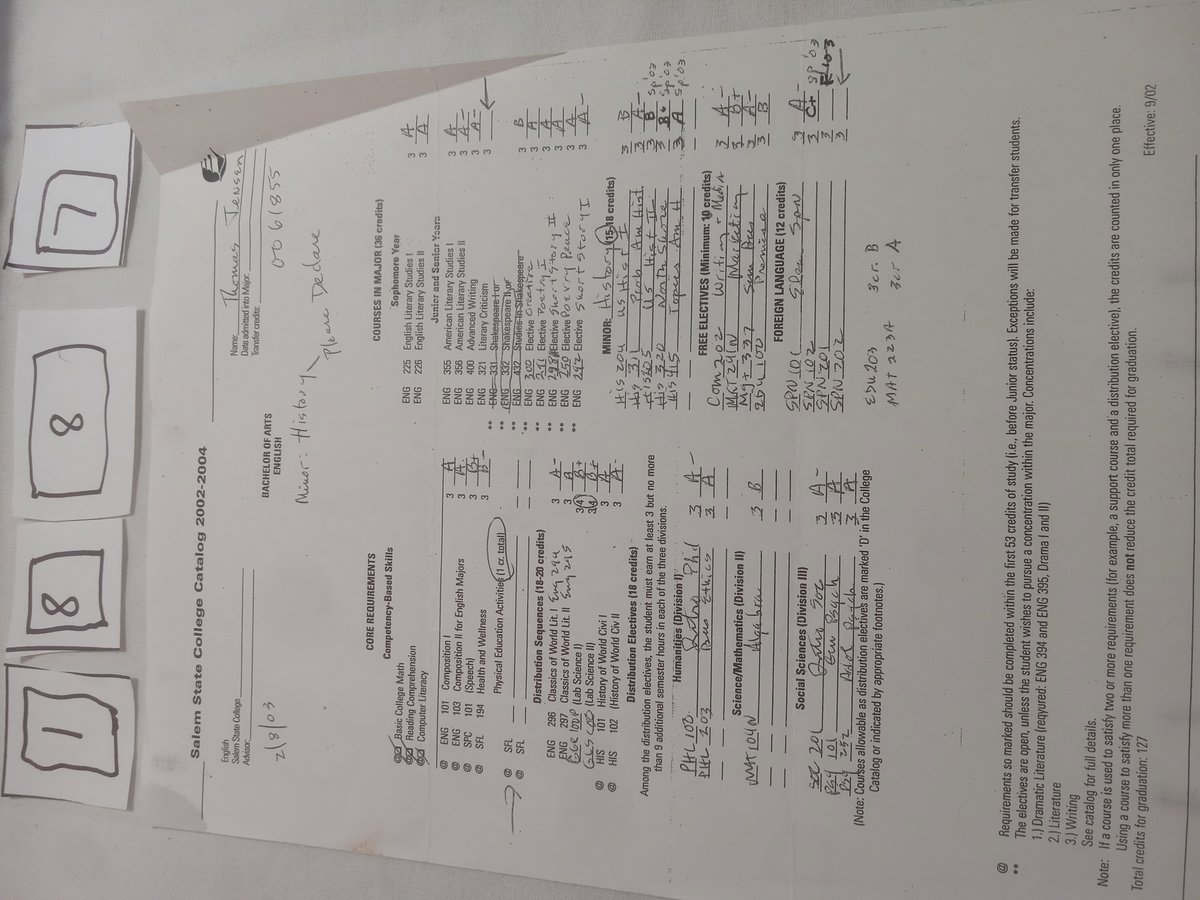
Salem State College Catalog 2002-2004
Name: Thomas Jensen
Date admitted into Major:
Transfer credits: 0061855
BACHELOR OF ARTS
ENGLISH
Minor: History - Please Declare
CORE REQUIREMENTS
Competency-Based Skills
@ [check] Basic College Math
@ [check] Reading Comprehension
@ [check] Computer Literacy
ENG 101 Composition I 3 A
ENG 103 Composition II for English Majors 3 A
SPC 101 (Speech) 3 B-
SFL 194 Health and Wellness 3 -
Physical Education Activities (1 cr. total)
@ SFL - -
@ SFL - -
Distribution Sequences (18-20 credits)
ENG 296 Classics of World Lit. I Eng 294 3 A-
ENG 297 Classics of World Lit. II Eng 295 3 A
GLS 100 (Lab Science I) 3(4) B+
GLS 100 (Lab Science II) 3(4) B+
HIS 101 History of World Civil I 3 A
HIS 102 History of World Civil II 3 A-
Distribution Electives (18 credits)
Among the distribution electives, the student must earn at least 3 but no more than 9 additional semester hours in each of the three divisions.
Humanities (Division I)
PHL 108 Intro Phil 3 A-
PHL 203 Bus Ethics 3 A
Science/Mathematics (Division II)
MAT 104N Algebra 3 B
Social Sciences (Division III)
SOC 201 Intro Soc 3 A-
PSY 101 Gen Psych 3 A
PSY 252 Abnormal Psych 3 A
COURSES IN MAJOR (36 credits)
Sophomore Year
ENG 225 English Literary Studies I 3 A
ENG 226 English Literary Studies II 3 A
Junior and Senior Years
ENG 355 American Literary Studies I 3 A
ENG 356 American Literary Studies II 3 A
ENG 400 Advanced Writing 3 A-
ENG 321 Literary Criticism 3 A-
ENG 331 Shakespeare I - -
ENG 332 Shakespeare II - -
ENG 432 Studies in Shakespeare - -
ENG 300 Elective Creative 3 B
ENG 211 Elective Poetry I 3 A
ENG 298 Elective History II 3 A
ENG 250 Elective Poetry Peace 3 A
ENG 292 Elective Short Story I 3 A
MINOR: History (15-18 credits)
HIS 204 US Hist I 3 B
HIS 205 US Hist II 3 B+
HIS 320 North Shore 3 A-
HIS 415 Topics Am H 3 A
[Handwritten arrow pointing to "sp 03" and "fl 03"]
FREE ELECTIVES (Minimum: 10 credits)
Com 202 Writing + Media 3 A-
MGT 241N Marketing 3 B+
MGT 337 Son Bus 3 A-
EDU 100 Premise 3 B
FOREIGN LANGUAGE (12 credits)
SPN 101 Elem Spn 3 C+ sp 03
SPN 102 3 -
SPN 201 3 -
SPN 202 3 -
EDU 203 3cr B
MAT 223A 3cr A
(Note: Courses allowable as distribution electives are marked 'D' in the College Catalog or indicated by appropriate footnotes.)
@ Requirements so marked should be completed within the first 53 credits of study (i.e., before Junior status). Exceptions will be made for transfer students.
** The electives are open, unless the student wishes to pursue a concentration within the major. Concentrations include:
1.) Dramatic Literature (required: ENG 394 and ENG 395, Drama I and II)
2.) Literature
3.) Writing
See catalog for full details.
Note: If a course is used to satisfy two or more requirements (for example, a support course and a distribution elective), the credits are counted in only one place.
Total credits for graduation: 127
Effective: 9/02
---
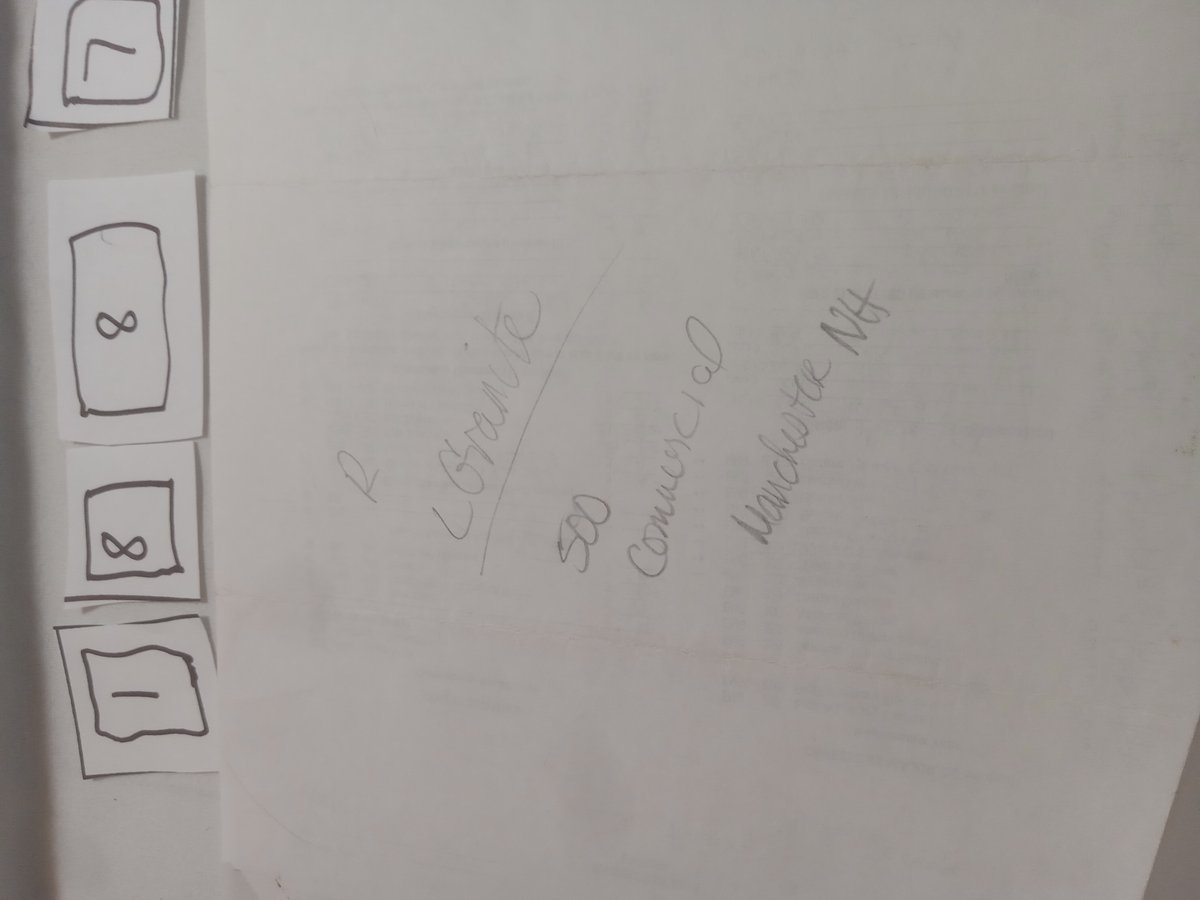
R
Granite
500
Commercial
Manchester NH
Item 1888
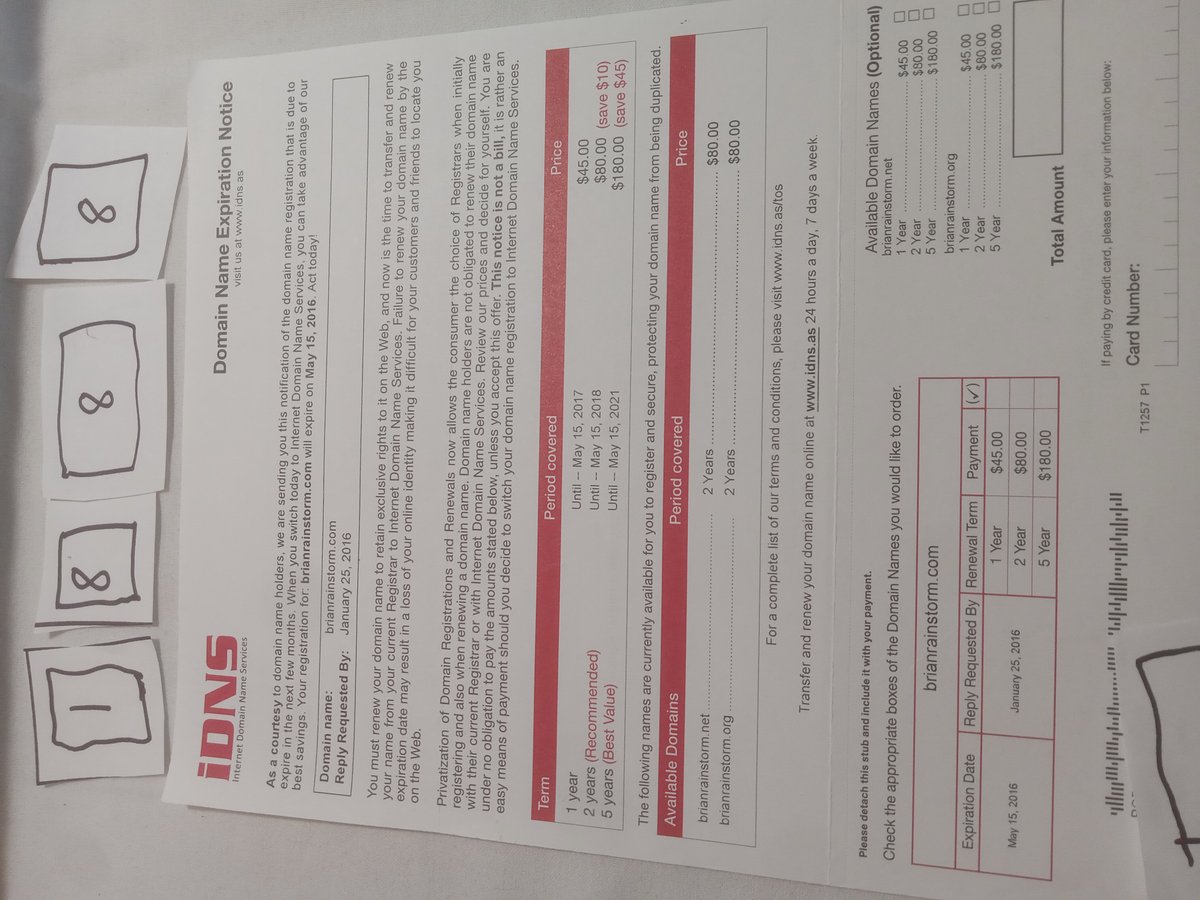
Domain Name Expiration Notice
Standard white paper printed document.
- Why it matters
- Tom writes this
- Type
- Printed page
- Collection
- Tom writes this
- Published in
- PREVIOUSLY UNPUBLISHEDSearched against the 34 albums, every book and Poems By Tom - found in none of them
Price · Tier · Tom fills these
The only picture of this piece
The words on this page
IDNS
Internet Domain Name Services
Domain Name Expiration Notice
visit us at www.idns.as
As a courtesy to domain name holders, we are sending you this notification of the domain name registration that is due to expire in the next few months. When you switch today to Internet Domain Name Services, you can take advantage of our best savings. Your registration for: brianrainstorm.com will expire on May 15, 2016. Act today!
Domain name: brianrainstorm.com
Reply Requested By: January 25, 2016
You must renew your domain name to retain exclusive rights to it on the Web, and now is the time to transfer and renew your name from your current Registrar to Internet Domain Name Services. Failure to renew your domain name by the expiration date may result in a loss of your online identity making it difficult for your customers and friends to locate you on the Web.
Privatization of Domain Registrations and Renewals now allows the consumer the choice of Registrars when initially registering and also when renewing a domain name. Domain name holders are not obligated to renew their domain name with their current Registrar or with Internet Domain Name Services. Review our prices and decide for yourself. You are under no obligation to pay the amounts stated below, unless you accept this offer. This notice is not a bill, it is rather an easy means of payment should you decide to switch your domain name registration to Internet Domain Name Services.
Term | Period covered | Price
--- | --- | ---
1 year | Until -- May 15, 2017 | $45.00
2 years (Recommended) | Until -- May 15, 2018 | $80.00 (save $10)
5 years (Best Value) | Until -- May 15, 2021 | $180.00 (save $45)
The following names are currently available for you to register and secure, protecting your domain name from being duplicated.
Available Domains | Period covered | Price
--- | --- | ---
brianrainstorm.net | 2 Years | $80.00
brianrainstorm.org | 2 Years | $80.00
For a complete list of our terms and conditions, please visit www.idns.as/tos
Transfer and renew your domain name online at www.idns.as 24 hours a day, 7 days a week.
Please detach this stub and include it with your payment.
Check the appropriate boxes of the Domain Names you would like to order.
brianrainstorm.com
Expiration Date | Reply Requested By | Renewal Term | Payment (✓)
--- | --- | --- | ---
May 15, 2016 | January 25, 2016 | 1 Year | $45.00
| | 2 Year | $80.00
| | 5 Year | $180.00
Available Domain Names (Optional)
brianrainstorm.net | 1 Year $45.00 □ | 2 Year $80.00 □ | 5 Year $180.00 □
brianrainstorm.org | 1 Year $45.00 □ | 2 Year $80.00 □ | 5 Year $180.00 □
Total Amount ___________________
If paying by credit card, please enter your information below:
Card Number: ________________________________
T1257 P1
Item 1890
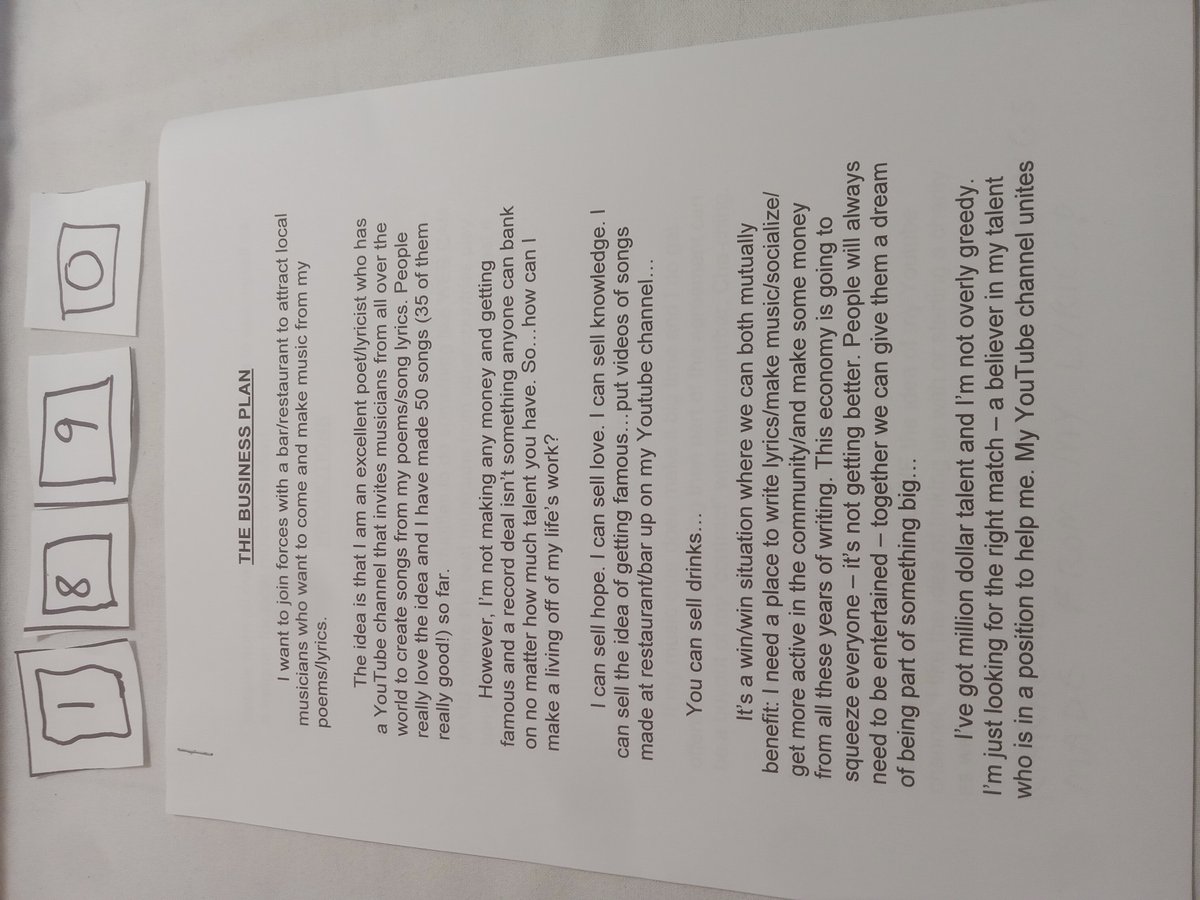
THE BUSINESS PLAN
Printed document on white paper with handwritten notes.
- Why it matters
- Tom writes this
- Type
- Printed page
- Collection
- Tom writes this
- Published in
- PREVIOUSLY UNPUBLISHEDSearched against the 34 albums, every book and Poems By Tom - found in none of them
Price · Tier · Tom fills these
Picture 1 of 2
Picture 2 of 2
The words on this page
THE BUSINESS PLAN
I want to join forces with a bar/restaurant to attract local musicians who want to come and make music from my poems/lyrics.
The idea is that I am an excellent poet/lyricist who has a YouTube channel that invites musicians from all over the world to create songs from my poems/song lyrics. People really love the idea and I have made 50 songs (35 of them really good!) so far.
However, I'm not making any money and getting famous and a record deal isn't something anyone can bank on no matter how much talent you have. So...how can I make a living off of my life's work?
I can sell hope. I can sell love. I can sell knowledge. I can sell the idea of getting famous...put videos of songs made at restaurant/bar up on my Youtube channel...
You can sell drinks...
It's a win/win situation where we can both mutually benefit: I need a place to write lyrics/make music/socialize/ get more active in the community/and make some money from all these years of writing. This economy is going to squeeze everyone - it's not getting better. People will always need to be entertained - together we can give them a dream of being part of something big...
I've got million dollar talent and I'm not overly greedy. I'm just looking for the right match - a believer in my talent who is in a position to help me. My YouTube channel unites
---
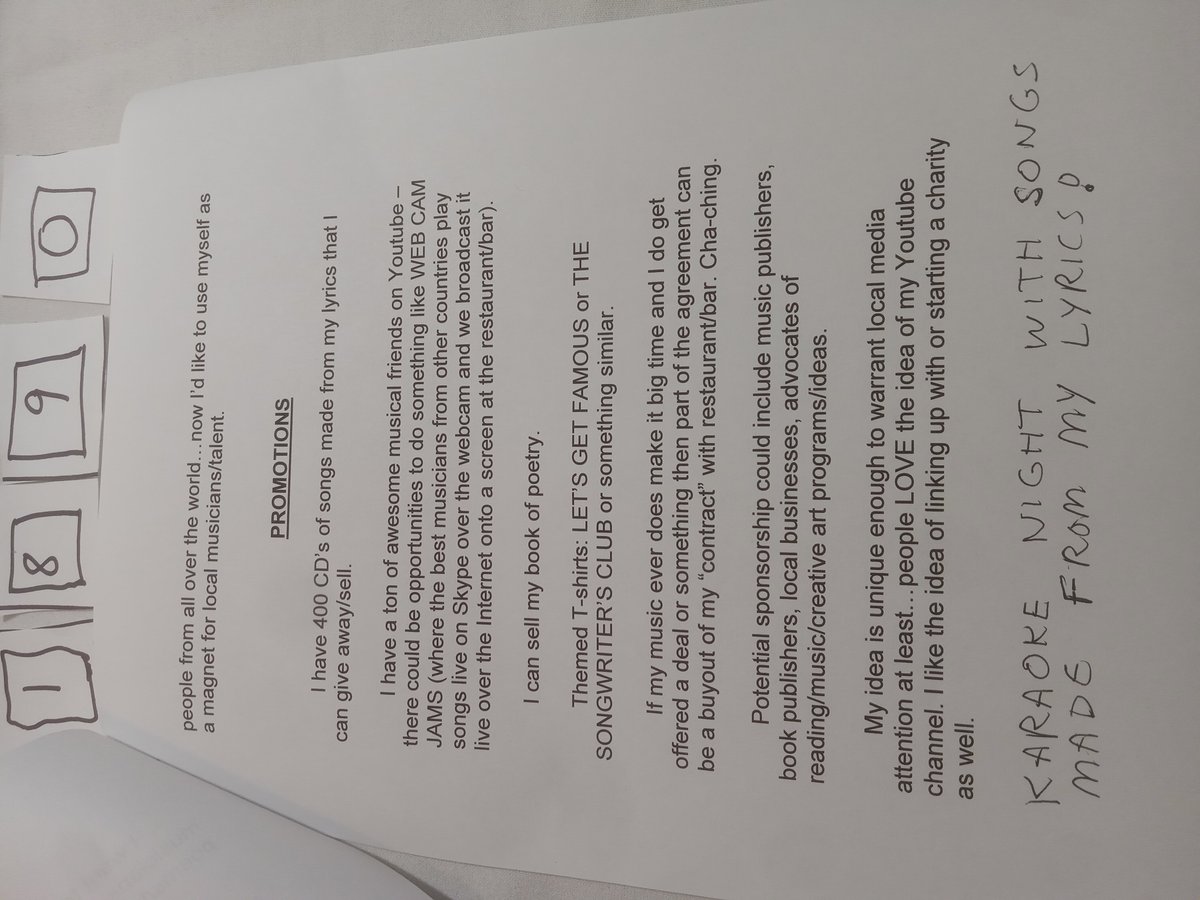
people from all over the world...now I'd like to use myself as
a magnet for local musicians/talent.
PROMOTIONS
I have 400 CD's of songs made from my lyrics that I
can give away/sell.
I have a ton of awesome musical friends on Youtube -
there could be opportunities to do something like WEB CAM
JAMS (where the best musicians from other countries play
songs live on Skype over the webcam and we broadcast it
live over the Internet onto a screen at the restaurant/bar).
I can sell my book of poetry.
Themed T-shirts: LET'S GET FAMOUS or THE
SONGWRITER'S CLUB or something similar.
If my music ever does make it big time and I do get
offered a deal or something then part of the agreement can
be a buyout of my "contract" with restaurant/bar. Cha-ching.
Potential sponsorship could include music publishers,
book publishers, local businesses, advocates of
reading/music/creative art programs/ideas.
My idea is unique enough to warrant local media
attention at least...people LOVE the idea of my Youtube
channel. I like the idea of linking up with or starting a charity
as well.
KARAOKE NIGHT WITH SONGS
MADE FROM MY LYRICS !
Item 1891
The Free Career Test Report for timmy timm: Your Workplace Fit Graph
A printed document on a white sheet of paper.
- Why it matters
- Tom writes this
- Type
- Printed page
- Collection
- Tom writes this
- Published in
- IN A BOOKThe Laima Dedication Anthology (2011)
- Age when written
- written by age 33 at the latestdated from the earliest book it appears in - the sheet itself may be older
Price · Tier · Tom fills these
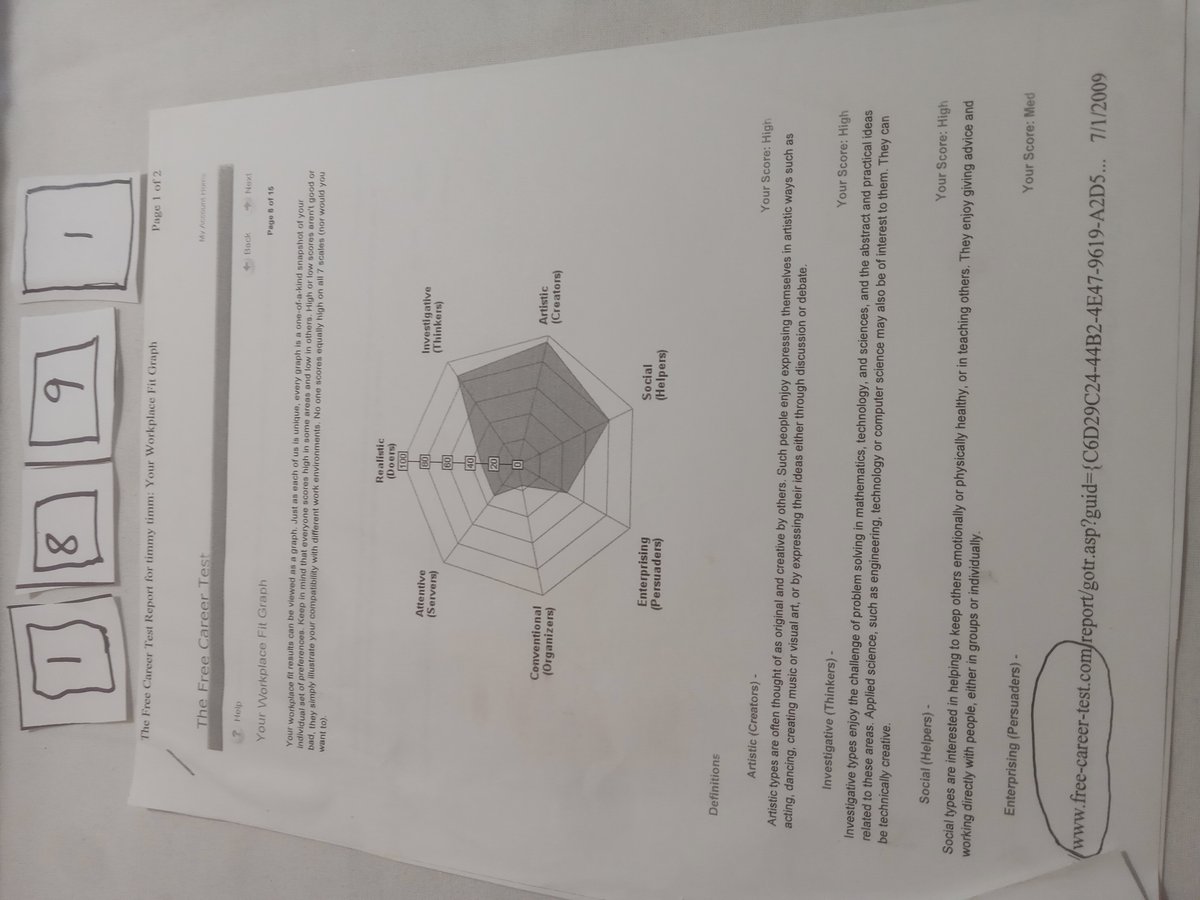
Picture 1 of 3
Picture 2 of 3
Picture 3 of 3
The words on this page
The Free Career Test Report for timmy timm: Your Workplace Fit Graph
Page 1 of 2
? Help
Back
Next
Page 8 of 15
The Free Career Test
Your Workplace Fit Graph
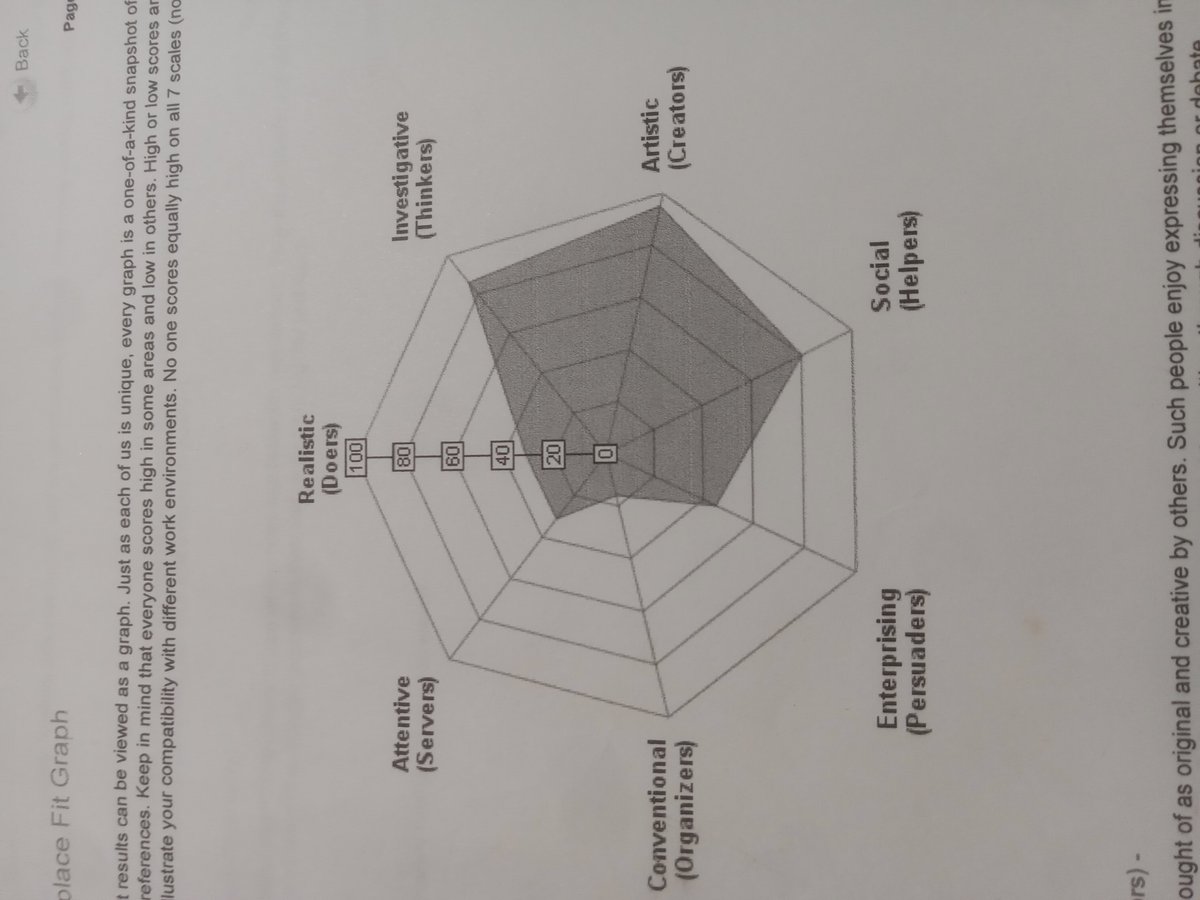
Your workplace fit results can be viewed as a graph. Just as each of us is unique, every graph is a one-of-a-kind snapshot of your individual set of preferences. Keep in mind that everyone scores high in some areas and low in others. High or low scores aren't good or bad, they simply illustrate your compatibility with different work environments. No one scores equally high on all 7 scales (nor would you want to).
[Graph labels clockwise starting from top: Investigative (Thinkers), Artistic (Creators), Social (Helpers), Enterprising (Persuaders), Conventional (Organizers), Attentive (Servers), Realistic (Doers)]
Definitions
Artistic (Creators) -
Your Score: High
Artistic types are often thought of as original and creative by others. Such people enjoy expressing themselves in artistic ways such as acting, dancing, creating music or visual art, or by expressing their ideas either through discussion or debate.
Investigative (Thinkers) -
Your Score: High
Investigative types enjoy the challenge of problem solving in mathematics, technology, and sciences, and the abstract and practical ideas related to these areas. Applied science, such as engineering, technology or computer science may also be of interest to them. They can be technically creative.
Social (Helpers) -
Your Score: High
Social types are interested in helping to keep others emotionally or physically healthy, or in teaching others. They enjoy giving advice and working directly with people, either in groups or individually.
Enterprising (Persuaders) -
Your Score: Med
www.free-career-test.com/report/gotr.asp?guid={C6D29C24-44B2-4E47-9619-A2D5... 7/1/2009
---
Workplace Fit Graph
[text along the left edge, read vertically]
t results can be viewed as a graph. Just as each of us is unique, every graph is a one-of-a-kind snapshot of preferences. Keep in mind that everyone scores high in some areas and low in others. High or low scores ar illustrate your compatibility with different work environments. No one scores equally high on all 7 scales (no
[text within the chart]
Realistic
(Doers)
100
80
60
40
20
0
Investigative
(Thinkers)
Artistic
(Creators)
Social
(Helpers)
Enterprising
(Persuaders)
Conventional
(Organizers)
Attentive
(Servers)
[text along the bottom right edge, read vertically]
rs) -
ought of as original and creative by others. Such people enjoy expressing themselves in
[text in the upper right corner]
Page
---
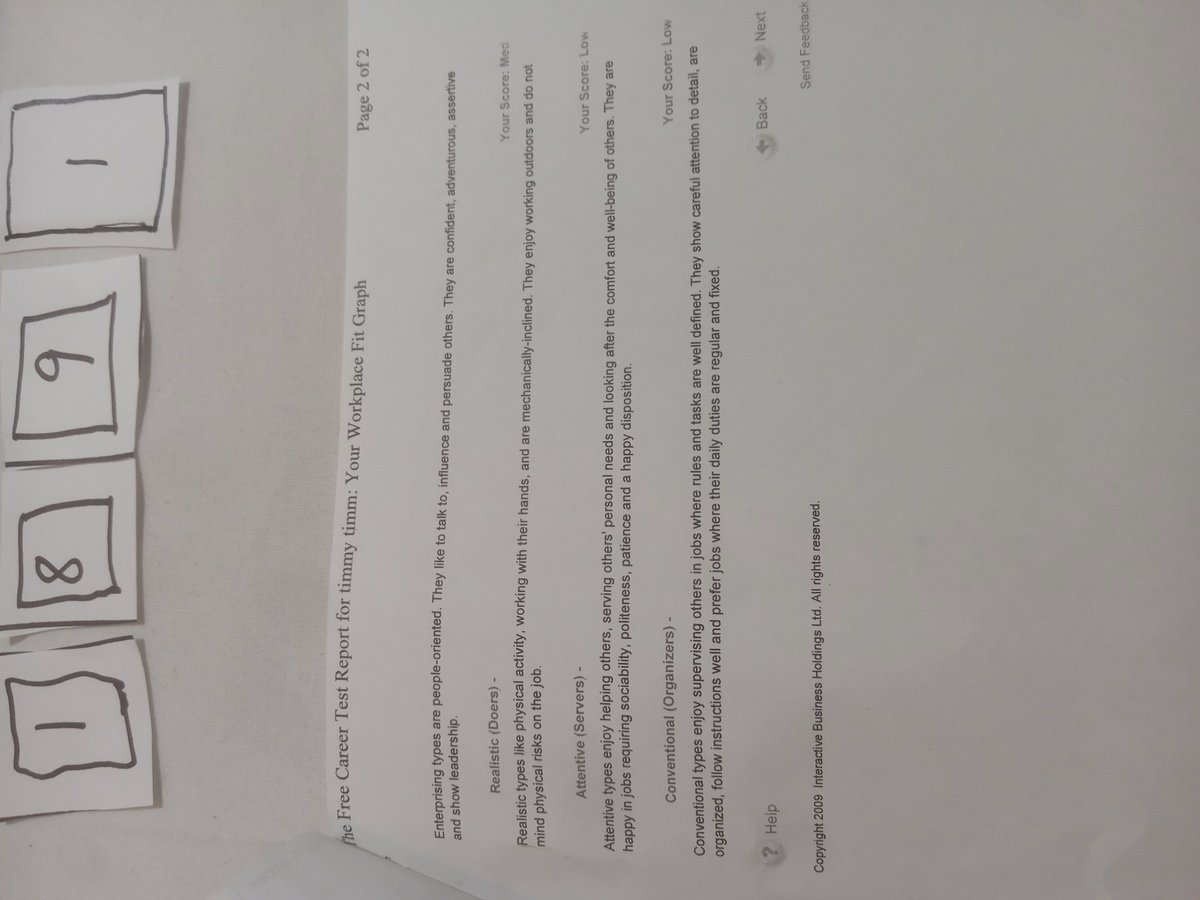
The Free Career Test Report for Timmy Timm: Your Workplace Fit Graph
Page 2 of 2
Enterprising types are people-oriented. They like to talk to, influence and persuade others. They are confident, adventurous, and show leadership.
Your Score: Med
Realistic (Doers) -
Realistic types like physical activity, working with their hands, and are mechanically-inclined. They enjoy working outdoors and do not mind physical risks on the job.
Your Score: Low
Attentive (Servers) -
Attentive types enjoy helping others, serving others' personal needs and looking after the comfort and well-being of others. They are happy in jobs requiring sociability, politeness, patience and a happy disposition.
Your Score: Low
Conventional (Organizers) -
Conventional types enjoy supervising others in jobs where rules and tasks are well defined. They show careful attention to detail, are organized, follow instructions well and prefer jobs where their daily duties are regular and fixed.
Help
Back
Next
Send Feedback
Copyright 2009 Interactive Business Holdings Ltd. All rights reserved.
---
THIS IS MY WAY OF TAKING BACK WHAT ONCE WAS MINE
FIRST MY BOSS JOE, I TOLD HIM GET DOWN ON HIS KNEE
I GUESS IT WASN'T SUCH A HOT IDEA, FIRING ME
NOTHING YOU CAN SAY EXCEPT HELLO, GOODBYE
TRY SENDIN' ME A POSTCARD AFTER YOU DIE
ITS ABOUT TIME I PUT A STAMP ON YOUR HEAD
I THINK I'LL USE THE ELVIS ONE 'CAUSE YOU'RE BOTH DEAD
SAM'S NEXT, THE ONE I'LL SHOOT
THIS IS WHAT HE GETS FOR TAKING MY ROUTE
HIS TURN TO MEET G.O.D.
SENDIN' HIM TO HEAVEN ON A C.O.D.
YES I AM BITTER, AND HOMICIDAL? WELL THAT MAY BE
BUY I DIDN'T COME HERE TO START A KILLING SPREE
THINK OF ME AS ONE WHO IS OWED COMING TO COLLECT A FEE
BUT I WON'T BE TAINTED BY INNOCENT BLOOD: THE REST OF YOU ARE FREE
YOU MAY THINK I'M CRAZY BUT I'M NOT THE ONE
ITS THE GUY AT THE STORE WHO SOLD A POSTAL WORKER A GUN
AFTER THE LAST BODY DROPS ITS TIME FOR ME TO RUN
SLIP OUTTA HERE QUICK BEFORE THE COPS SEEN WHAT I'VE DONE
YOU MAY THINK I'M CRAZY BUT I'M NOT THE ONE
ITS THE GUY AT THE STORE WHO SOLD A POSTAL WORKER A GUN
Item 1892
UNTITLED - first line: My book of songs and poetry weights exactly thirteen pounds. What just that number mean in real life? Well, for example a pretty good-sized house c...
Printed document on white paper.
- Why it matters
- Tom writes thison file: muse MAINE|WIFE
- Type
- Printed page
- Collection
- Tom writes this
- Published in
- PREVIOUSLY UNPUBLISHEDSearched against the 34 albums, every book and Poems By Tom - found in none of them
Price · Tier · Tom fills these
Picture 1 of 3
Picture 2 of 3
Picture 3 of 3
The words on this page
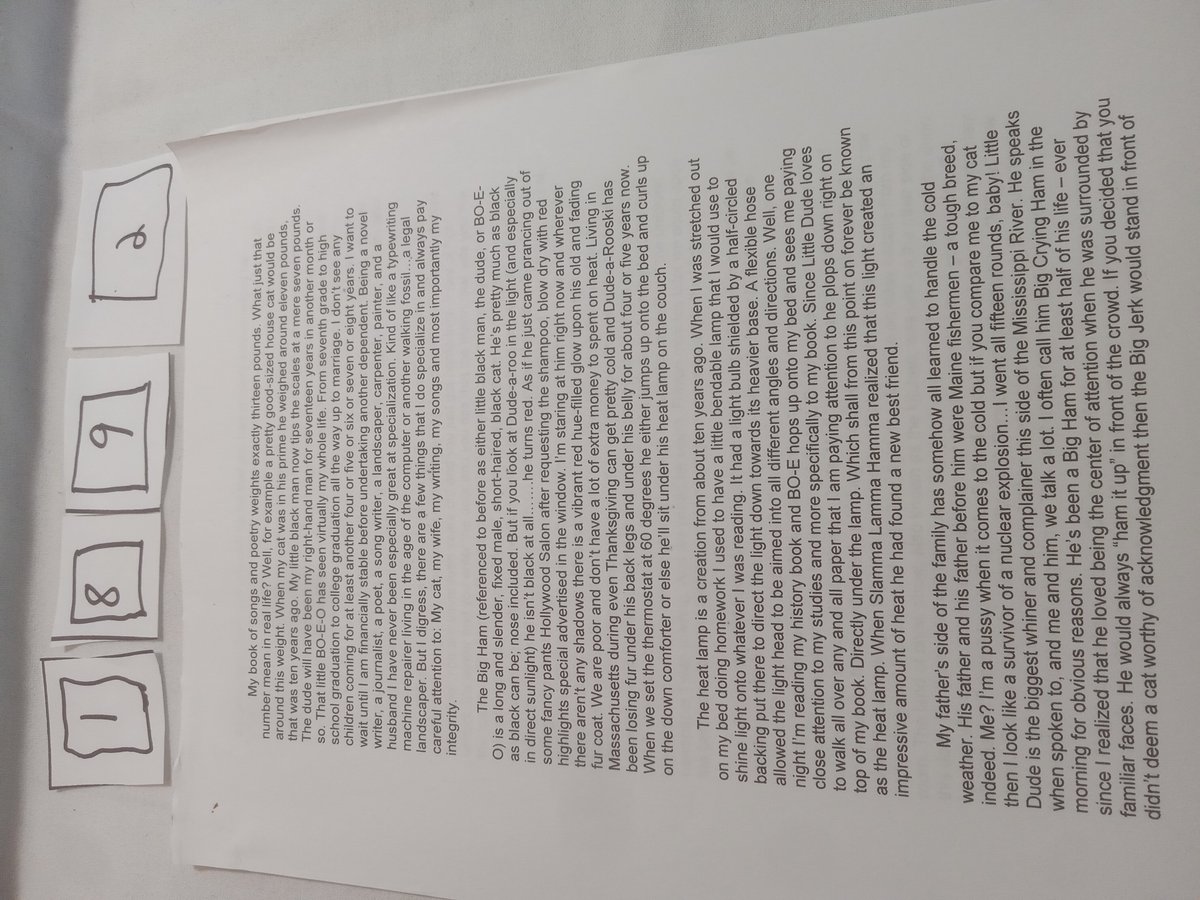
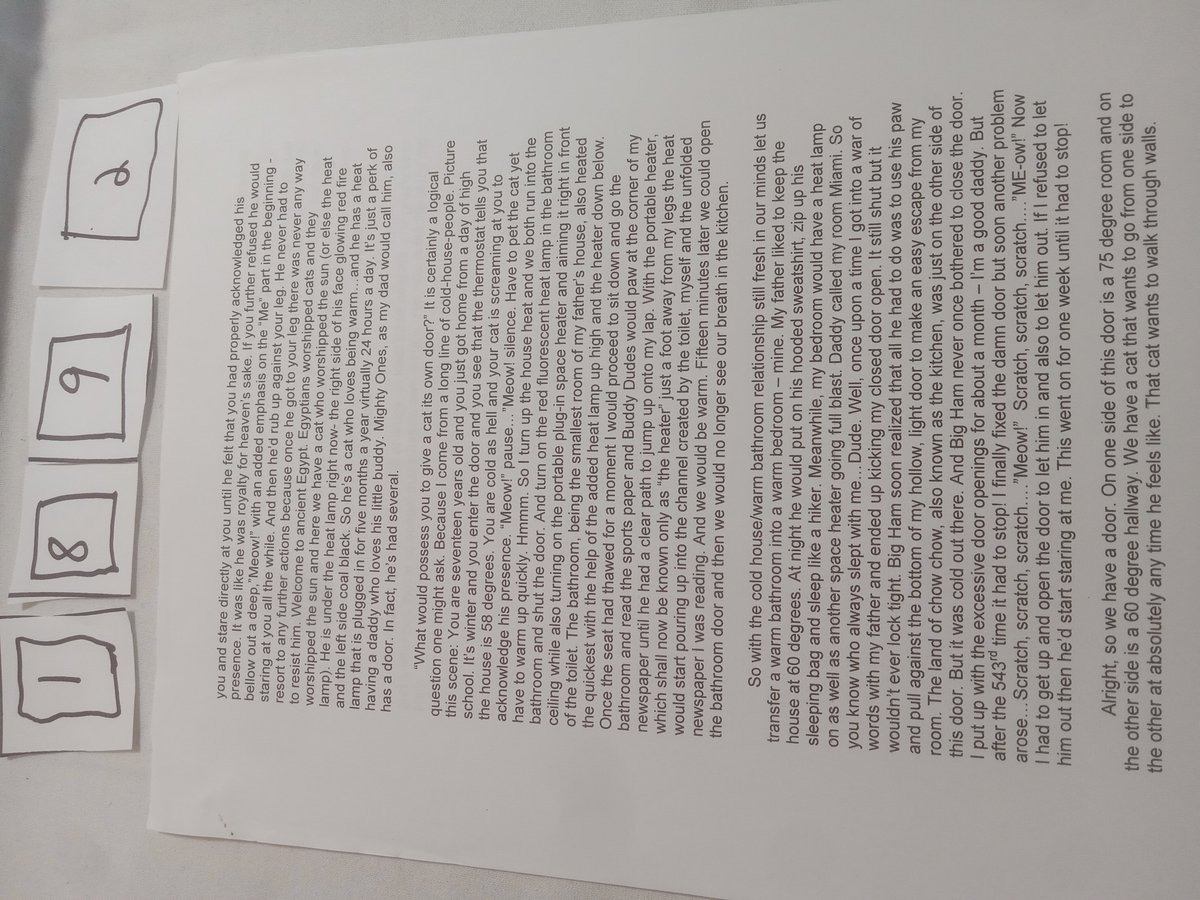
My book of songs and poetry weights exactly thirteen pounds. What just that number mean in real life? Well, for example a pretty good-sized house cat would be around this weight. When my cat was in his prime he weighed around eleven pounds, that was ten years ago. My little black man now tips the scales at a mere seven pounds. The dude will have been my right-hand man for seventeen years in another month or so. That little BO-E-O has seen virtually my whole life. From seventh grade to high school graduation to college graduation all the way up to marriage. I don't see any children coming for at least another four or five six or seven or eight years. I want to wait until I am financially stable before undertaking another dependent. Being a novel writer, a journalist, a poet, a song writer, a landscaper, carpenter, painter, and a husband I have never been especially great at specialization. Kind of like a typewriter machine repairer living in the age of the computer or another walking fossil... a legal landscaper. But I digress, there are a few things that I do specialize in and always pay careful attention to: My cat, my wife, my writing, my songs and most importantly my integrity.
The Big Ham (referenced to before as either little black man, the dude, or BO-E-O) is a long and slender, fixed male, short-haired, black cat. He's pretty much as black as black can be; nose included. But if you look at Dude-a-roo in the light (and especially in direct sunlight) he isn't black at all...... he turns red. As if he just came prancing out of some fancy pants Hollywood Salon after requesting the shampoo, blow dry with red highlights special advertised in the window. I'm staring at him right now and wherever there aren't any shadows there is a vibrant red hue-filled glow upon his old and fading fur coat. We are poor and don't have a lot of extra money to spent on heat. Living in Massachusetts during even Thanksgiving can get pretty cold and Dude-a-Rooski has been losing fur under his back legs and under his belly for about four or five years now. When we set the thermostat at 60 degrees he either jumps up onto the bed and curls up on the down comforter or else he'll sit under his heat lamp on the couch.
The heat lamp is a creation from about ten years ago. When I was stretched out on my bed doing homework I used to have a little bendable lamp that I would use to shine light onto whatever I was reading. It had a light bulb shielded by a half-circled backing put there to direct the light down towards its heavier base. A flexible hose allowed the light head to be aimed into all different angles and directions. Well, one night I'm reading my history book and BO-E hops up onto my bed and sees me paying close attention to my studies and more specifically to my book. Since Little Dude loves to walk all over any and all paper that I am paying attention to he plops down right on top of my book. Directly under the lamp. Which shall from this point on forever be known as the heat lamp. When Slamma Lamma Hamma realized that this light created an impressive amount of heat he had found a new best friend.
My father's side of the family has somehow all learned to handle the cold weather. His father and his father before him were Maine fishermen - a tough breed, indeed. Me? I'm a pussy when it comes to the cold but if you compare me to my cat then I look like a survivor of a nuclear explosion... I went all fifteen rounds, baby! Little Dude is the biggest whiner and complainer this side of the Mississippi River. He speaks when spoken to, and me and him, we talk a lot. I often call him Big Crying Ham in the morning for obvious reasons. He's been a Big Ham for at least half of his life - ever since I realized that he loved being the center of attention when he was surrounded by familiar faces. He would always "ham it up" in front of the crowd. If you decided that you didn't deem a cat worthy of acknowledgment then the Big Jerk would stand in front of
---
you and stare directly at you until he felt that you had properly acknowledged his presence. It was like he was royalty for heaven's sake. If you further refused he would bellow out a deep, "Meow!" with an added emphasis on the "Me" part in the beginning - staring at you all the while. And then he'd rub up against your leg. He never had to resort to any further actions because once he got to your leg there was never any way to resist him. Welcome to ancient Egypt. Egyptians worshipped cats and they worshipped the sun and here we have a cat who worshipped the sun (or else the heat lamp). He is under the heat lamp right now- the right side of his face glowing red fire and the left side coal black. So he's a cat who loves being warm...and he has a heat lamp that is plugged in for five months a year virtually 24 hours a day. It's just a perk of having a daddy who loves his little buddy. Mighty Ones, as my dad would call him, also has a door. In fact, he's had several.
"What would possess you to give a cat its own door?" It is certainly a logical question one might ask. Because I come from a long line of cold-house-people. Picture this scene: You are seventeen years old and you just got home from a day of high school. It's winter and you enter the door and you see that the thermostat tells you that the house is 58 degrees. You are cold as hell and your cat is screaming at you to acknowledge his presence. "Meow!" pause... "Meow!" silence. Have to pet the cat yet have to warm up quickly. Hmmm. So I turn up the house heat and we both run into the bathroom and shut the door. And turn on the red fluorescent heat lamp in the bathroom ceiling while also turning on the portable plug-in space heater and aiming it right in front of the toilet. The bathroom, being the smallest room of my father's house, also heated the quickest with the help of the added heat lamp up high and the heater down below. Once the seat had thawed for a moment I would proceed to sit down and go the bathroom and read the sports paper and Buddy Dudes would paw at the corner of my newspaper until he had a clear path to jump onto my lap. With the portable heater, which shall now be known only as "the heater" just a foot away from my legs the heat would start pouring up into the channel created by the toilet, myself and the unfolded newspaper I was reading. And we would be warm. Fifteen minutes later we could open the bathroom door and then we would no longer see our breath in the kitchen.
So with the cold house/warm bathroom relationship still fresh in our minds let us transfer a warm bathroom into a warm bedroom - mine. My father liked to keep the house at 60 degrees. At night he would put on his hooded sweatshirt, zip up his sleeping bag and sleep like a hiker. Meanwhile, my bedroom would have a heat lamp on as well as another space heater going full blast. Daddy called my room Miami. So you know who always slept with me...Dude. Well, once upon a time I got into a war of words with my father and ended up kicking my closed door open. It still shut but it wouldn't ever lock tight. Big Ham soon realized that all he had to do was to use his paw and pull against the bottom of my hollow, light door to make an easy escape from my room. The land of chow chow, also known as the kitchen, was just on the other side of this door. But it was cold out there. And Big Ham never once bothered to close the door. I put up with the excessive door openings for about a month - I'm a good daddy. But after the 543rd time it had to stop! I finally fixed the damn door but soon another problem arose...Scratch, scratch, scratch...."Meow!" Scratch, scratch, scratch..."ME-ow!" Now I had to get up and open the door to let him in and also to let him out. If I refused to let him out then he'd start staring at me. This went on for one week until it had to stop!
Alright, so we have a door. On one side of this door is a 75 degree room and on the other side is a 60 degree hallway. We have a cat that wants to go from one side to the other at absolutely any time he feels like. That cat wants to walk through walls.
---
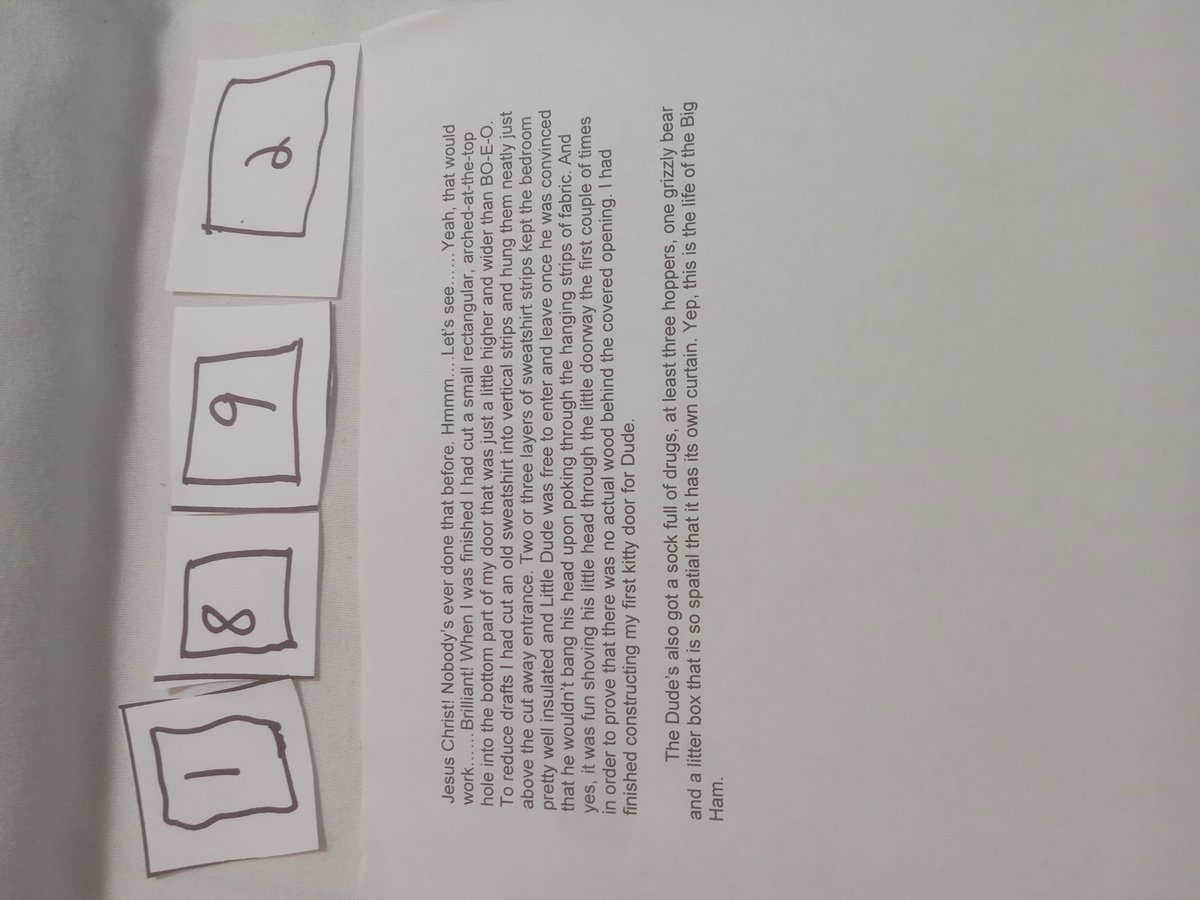
Jesus Christ! Nobody's ever done that before. Hmmm... Let's see... Yeah, that would work... Brilliant! When I was finished I had cut a small rectangular, arched-at-the-top hole into the bottom part of my door that was just a little higher and wider than BO-E-O. To reduce drafts I had cut an old sweatshirt into vertical strips and hung them neatly just above the cut away entrance. Two or three layers of sweatshirt strips kept the bedroom pretty well insulated and Little Dude was free to enter and leave once he was convinced that he wouldn't bang his head upon poking through the hanging strips of fabric. And yes, it was fun shoving his little head through the little doorway the first couple of times in order to prove that there was no actual wood behind the covered opening. I had finished constructing my first kitty door for Dude.
The Dude's also got a sock full of drugs, at least three hoppers, one grizzly bear and a litter box that is so spatial that it has its own curtain. Yep, this is the life of the Big Ham.
Item 1896
UNTITLED - first line: Hello,
A printed piece of paper.
- Why it matters
- Tom writes this
- Type
- Printed page
- Collection
- Tom writes this
- Published in
- PREVIOUSLY UNPUBLISHEDSearched against the 34 albums, every book and Poems By Tom - found in none of them
Price · Tier · Tom fills these
The only picture of this piece
The words on this page
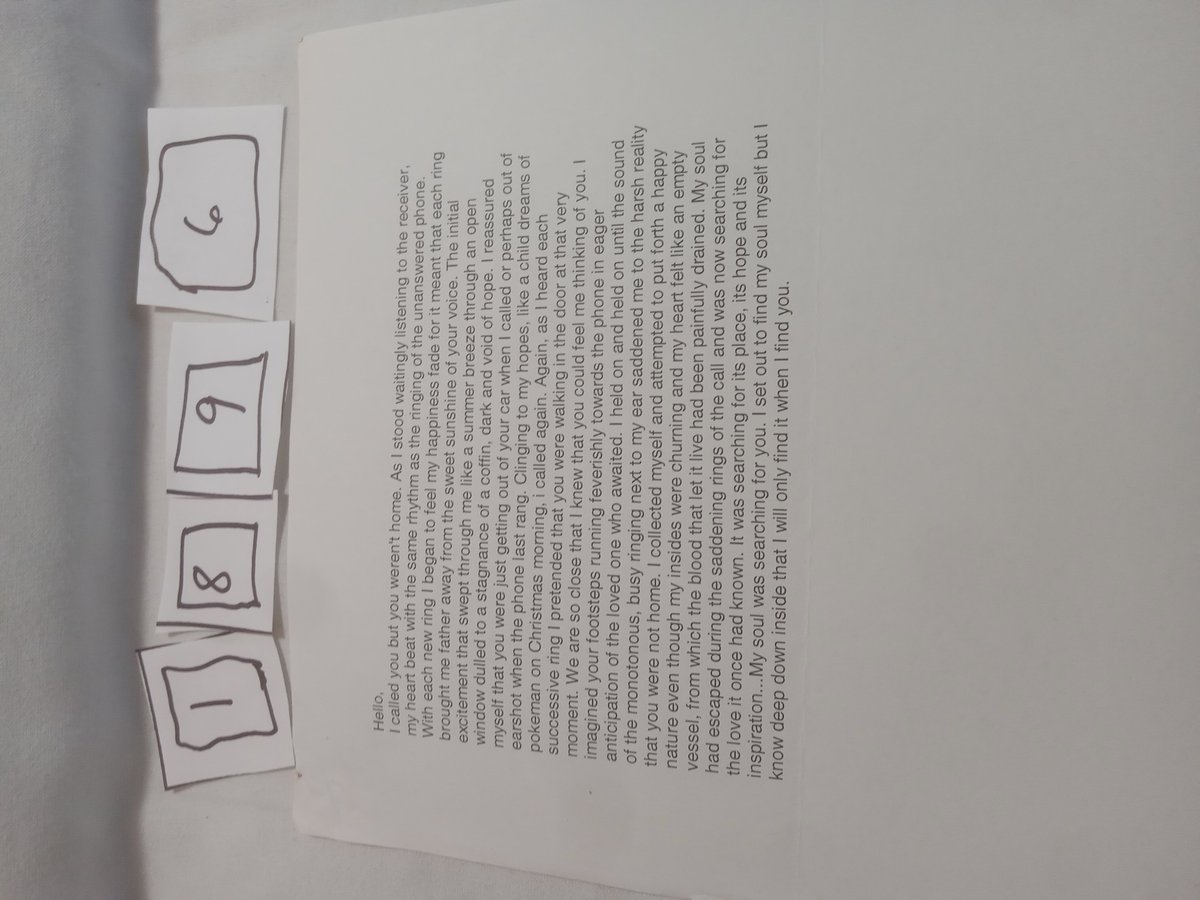
Hello,
I called you but you weren't home. As I stood waitingly listening to the receiver, my heart beat with the same rhythm as the ringing of the unanswered phone. With each new ring I began to feel my happiness fade for it meant that each ring brought me father away from the sweet sunshine of your voice. The initial excitement that swept through me like a summer breeze through an open window dulled to a stagnance of a coffin, dark and void of hope. I reassured myself that you were just getting out of your car when I called or perhaps out of earshot when the phone last rang. Clinging to my hopes, like a child dreams of pokemon on Christmas morning, i called again. Again, as I heard each successive ring I pretended that you were walking in the door at that very moment. We are so close that I knew that you could feel me thinking of you. I imagined your footsteps running feverishly towards the phone in eager anticipation of the loved one who awaited. I held on and held on until the sound of the monotonous, busy ringing next to my ear saddened me to the harsh reality that you were not home. I collected myself and attempted to put forth a happy nature even though my insides were churning and my heart felt like an empty vessel, from which the blood that let it live had been painfully drained. My soul had escaped during the saddening rings of the call and was now searching for the love it once had known. It was searching for its place, its hope and its inspiration...My soul was searching for you. I set out to find my soul myself but I know deep down inside that I will only find it when I find you.
I called you but you weren't home. As I stood waitingly listening to the receiver, my heart beat with the same rhythm as the ringing of the unanswered phone. With each new ring I began to feel my happiness fade for it meant that each ring brought me father away from the sweet sunshine of your voice. The initial excitement that swept through me like a summer breeze through an open window dulled to a stagnance of a coffin, dark and void of hope. I reassured myself that you were just getting out of your car when I called or perhaps out of earshot when the phone last rang. Clinging to my hopes, like a child dreams of pokemon on Christmas morning, i called again. Again, as I heard each successive ring I pretended that you were walking in the door at that very moment. We are so close that I knew that you could feel me thinking of you. I imagined your footsteps running feverishly towards the phone in eager anticipation of the loved one who awaited. I held on and held on until the sound of the monotonous, busy ringing next to my ear saddened me to the harsh reality that you were not home. I collected myself and attempted to put forth a happy nature even though my insides were churning and my heart felt like an empty vessel, from which the blood that let it live had been painfully drained. My soul had escaped during the saddening rings of the call and was now searching for the love it once had known. It was searching for its place, its hope and its inspiration...My soul was searching for you. I set out to find my soul myself but I know deep down inside that I will only find it when I find you.
Item 1902
music and vocals by
Printed blue paper insert.
- Why it matters
- Tom writes this
- Type
- Printed page
- Collection
- Tom writes this
- Published in
- PREVIOUSLY UNPUBLISHEDSearched against the 34 albums, every book and Poems By Tom - found in none of them
- Age when written
- written by age 36 at the latestdated from the earliest book it appears in - the sheet itself may be older
Price · Tier · Tom fills these
The only picture of this piece
The words on this page
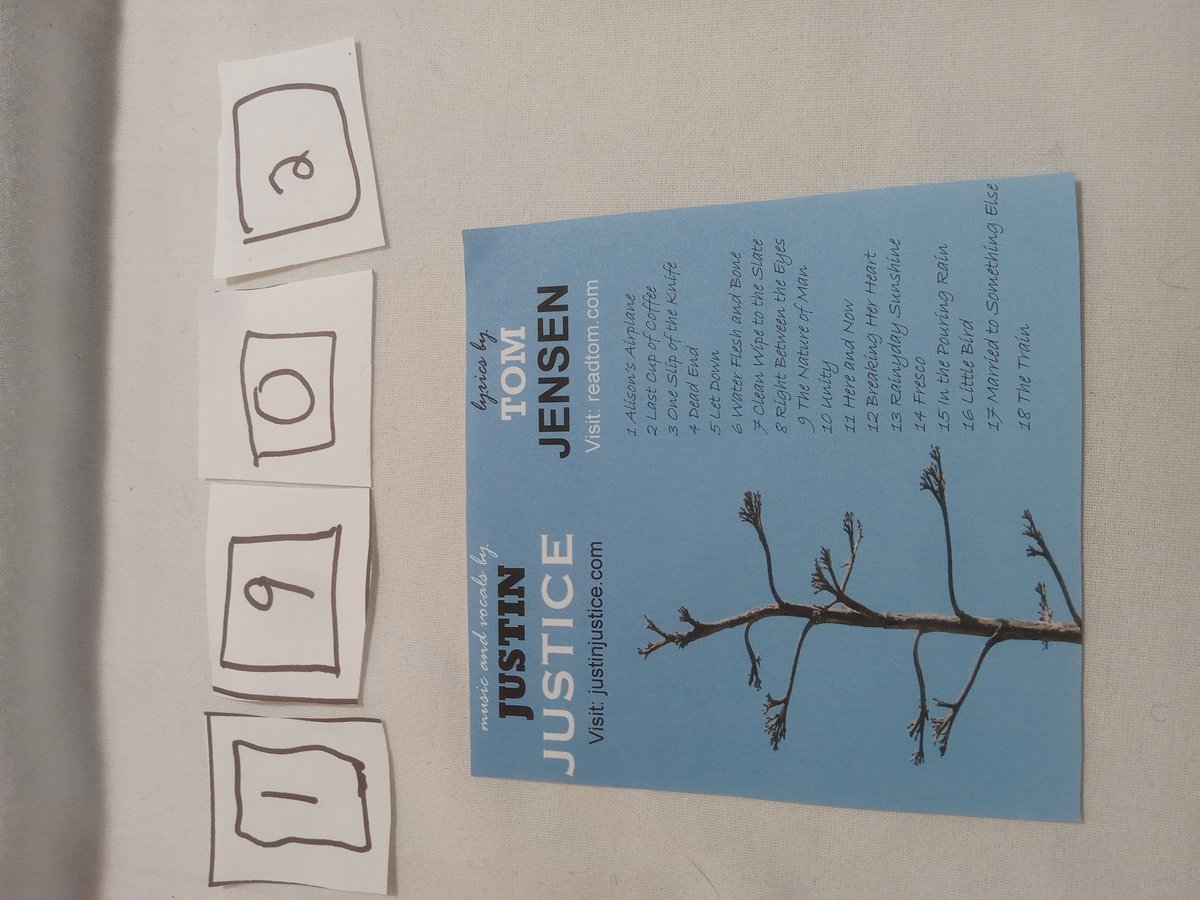
music and vocals by
JUSTIN
JUSTICE
Visit: justinjustice.com
lyrics by
TOM
JENSEN
Visit: readtom.com
1 Alison's Airplane
2 Last Cup of coffee
3 One Slip of the Knife
4 Dead End
5 Let Down
6 Water Flesh and Bone
7 Clean Wipe to the Slate
8 Right Between the Eyes
9 The Nature of Man
10 Unity
11 Here and Now
12 Breaking Her Heart
13 Rainyday Sunshine
14 Fresco
15 In the Pouring Rain
16 Little Bird
17 Married to Something Else
18 The Train
Item 1903
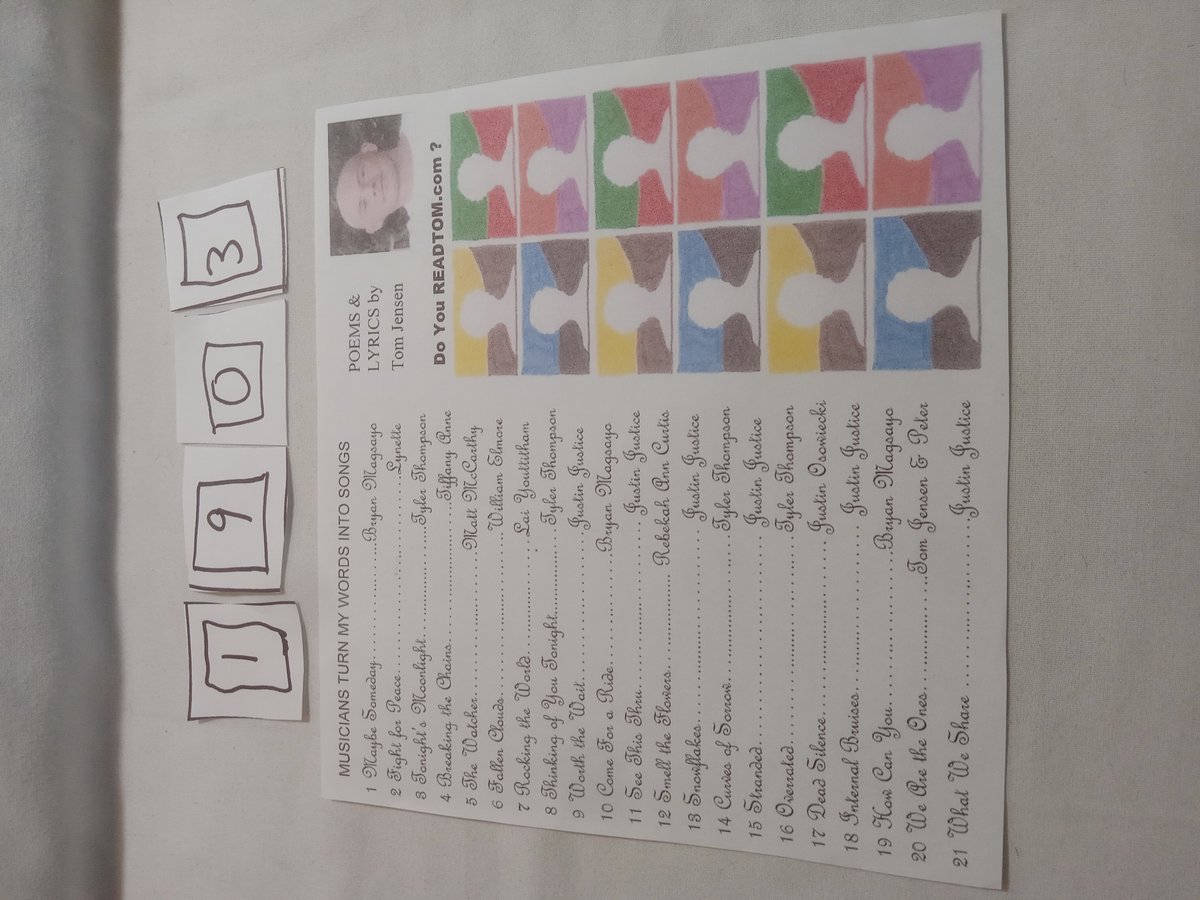
MUSICIANS TURN MY WORDS INTO SONGS
A printed paper document shown alongside four hand-drawn paper number cards.
- Why it matters
- Tom writes this
- Type
- Printed page
- Collection
- Tom writes this
- Published in
- PREVIOUSLY UNPUBLISHEDSearched against the 34 albums, every book and Poems By Tom - found in none of them
- Copies
- 2 in the catalogue · also written out as number 1900matched on the words by machine - Tom confirms
Price · Tier · Tom fills these
The only picture of this piece
The words on this page
MUSICIANS TURN MY WORDS INTO SONGS
1 Maybe Someday .......................... Bryan Magsayo
2 Fight for Peace ........................... Lynette
3 Tonight's Moonlight ................... Tyler Thompson
4 Breaking the Chains .................. Tiffany Anne
5 The Watcher ............................... Matt McCarthy
6 Fallen Clouds ............................. William Elmore
7 Rocking the World ..................... Lai Youlttham
8 Thinking of You Tonight ............ Tyler Thompson
9 Worth the Wait ........................... Justin Justice
10 Come For a Ride ....................... Bryan Magsayo
11 See This Thru ........................... Justin Justice
12 Smell the Flowers ..................... Rebekah Ann Curtis
13 Snowflakes ................................ Justin Justice
14 Curios of Sorrow ....................... Tyler Thompson
15 Stranded ................................... Justin Justice
16 Overrated .................................. Tyler Thompson
17 Dead Silence ............................. Justin Osowiecki
18 Internal Bruises ........................ Justin Justice
19 How Can You ............................. Bryan Magsayo
20 We Are the Ones ....................... Tom Jensen & Peter
21 What We Share ......................... Justin Justice
POEMS &
LYRICS by
Tom Jensen
Do You READTOM.com?
Item 1904
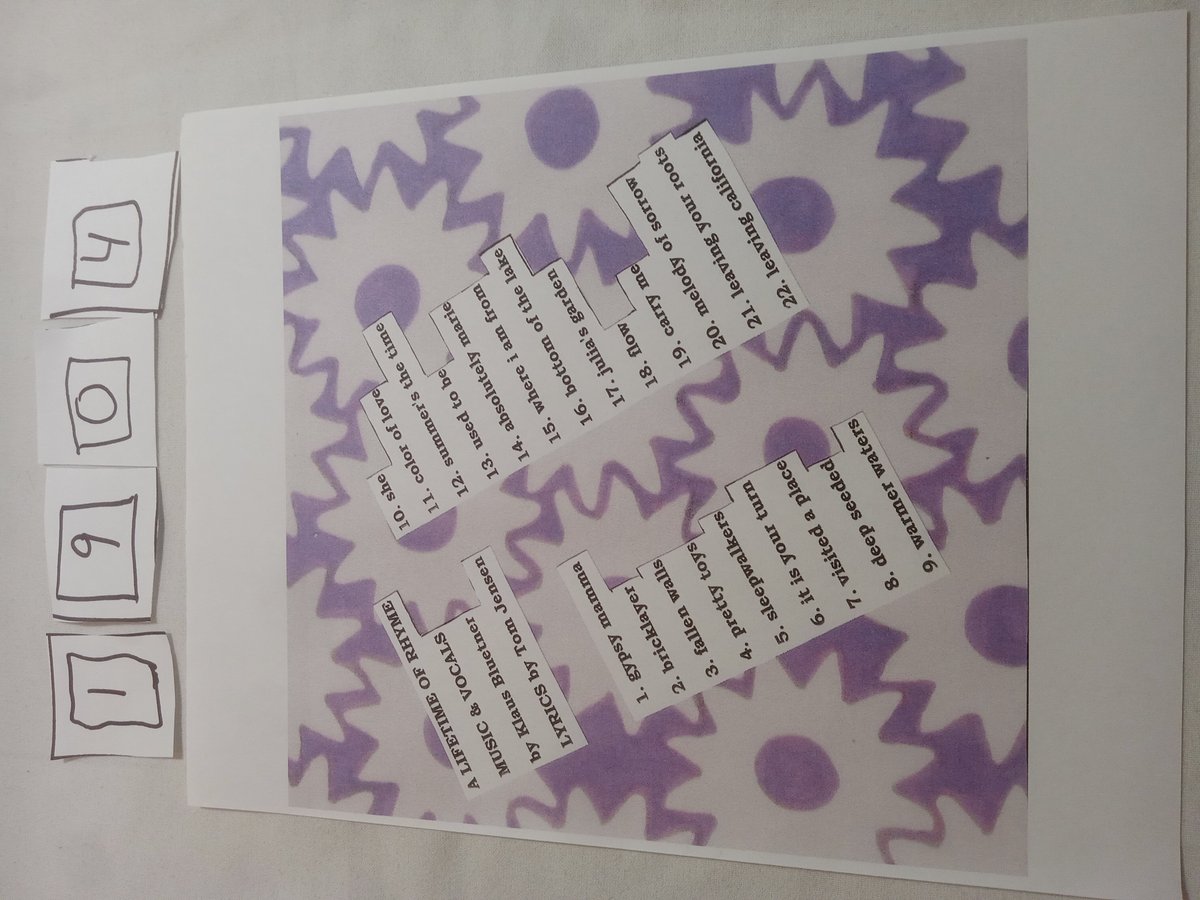
A LIFETIME OF RHYME
Printed CD insert on a white sheet: A LIFETIME OF RHYME, music and vocals by Klaus Bluetner, lyrics by Tom Jensen, 22 song titles on a purple sunburst pattern.
- Why it matters
- Tom writes this
- Type
- Printed page
- Collection
- Tom writes this
Price · Tier · Tom fills these
The only picture of this piece
The words on this page
Not typed up yet.
Item 1905
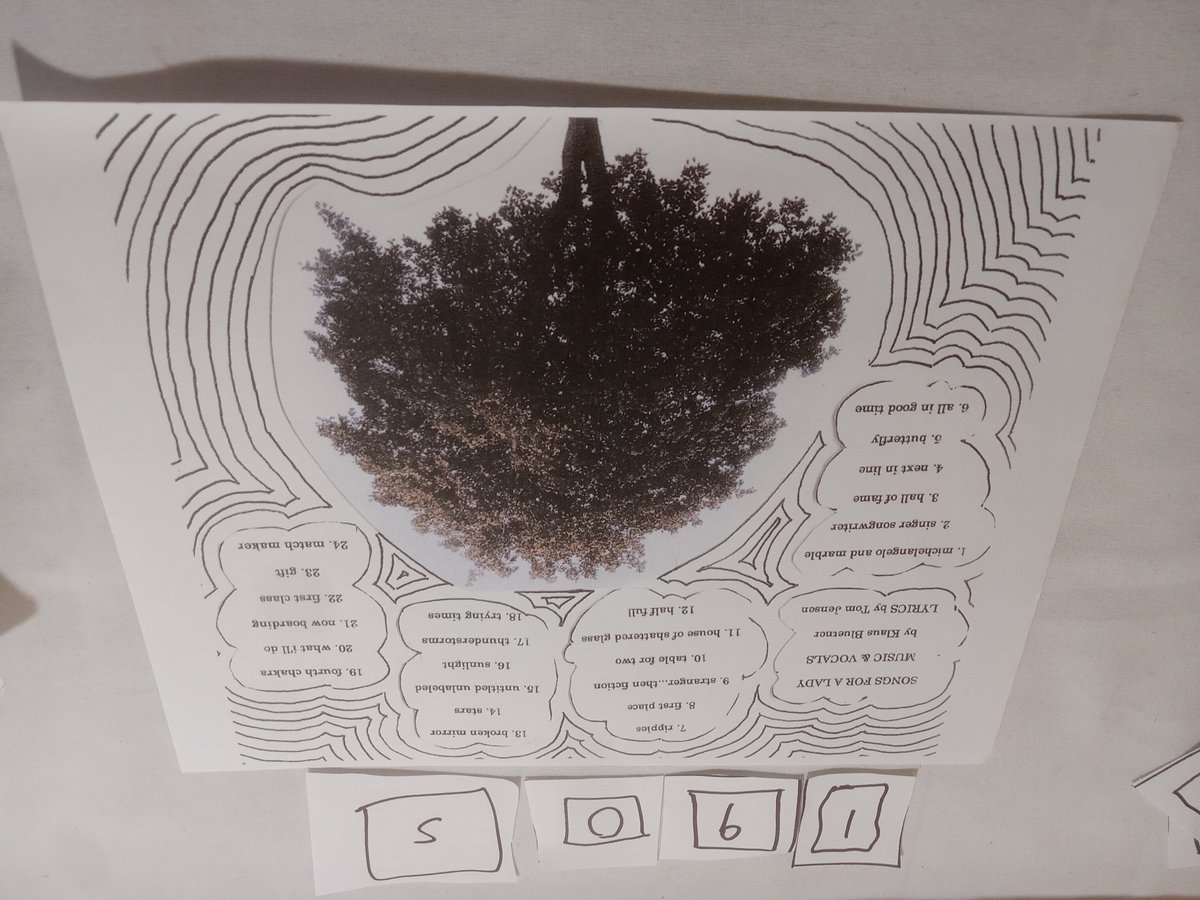
SONGS FOR A LADY
A printed paper sheet featuring an upside-down tree image and decorative line art.
- Why it matters
- Tom writes this
- Type
- Printed page
- Collection
- Tom writes this
- Published in
- PREVIOUSLY UNPUBLISHEDSearched against the 34 albums, every book and Poems By Tom - found in none of them
Price · Tier · Tom fills these
The only picture of this piece
The words on this page
SONGS FOR A LADY
MUSIC & VOCALS
by Klaus Bluetner
LYRICS by Tom Jensen
1. michelangelo and marble
2. singer songwriter
3. hall of fame
4. next in line
5. butterfly
6. all in good time
7. ripples
8. first place
9. stranger...then fiction
10. table for two
11. house of shattered glass
12. half full
13. broken mirror
14. stars
15. untitled unlabeled
16. sunlight
17. thunderstorms
18. trying times
19. fourth chakra
20. what i'll do
21. now boarding
22. first class
23. gift
24. match maker
Item 1906
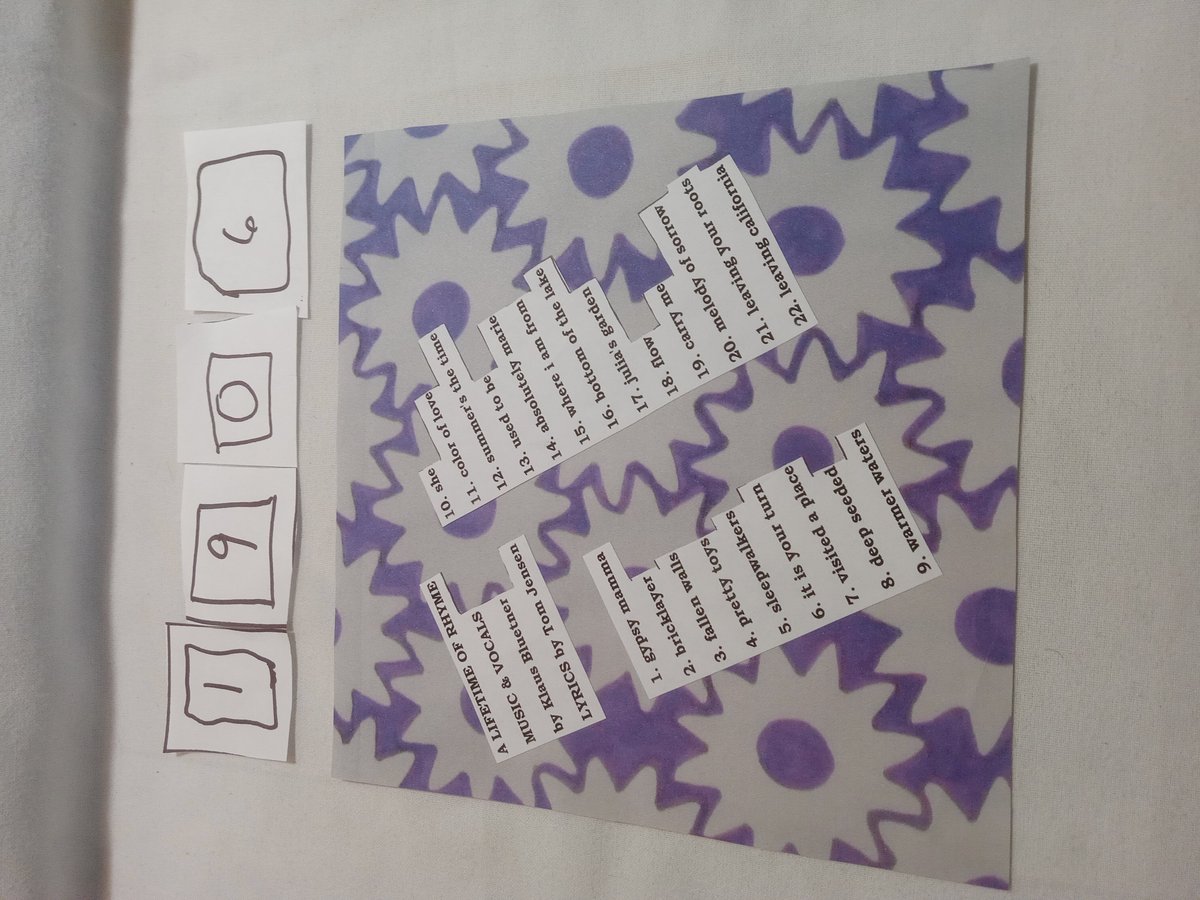
A LIFETIME OF RHYME
What it is - Tom writes this
- Why it matters
- Tom writes this
- Type
- Printed page
- Collection
- Tom writes this
Price · Tier · Tom fills these
The only picture of this piece
The words on this page
Not typed up yet.
Item 1907
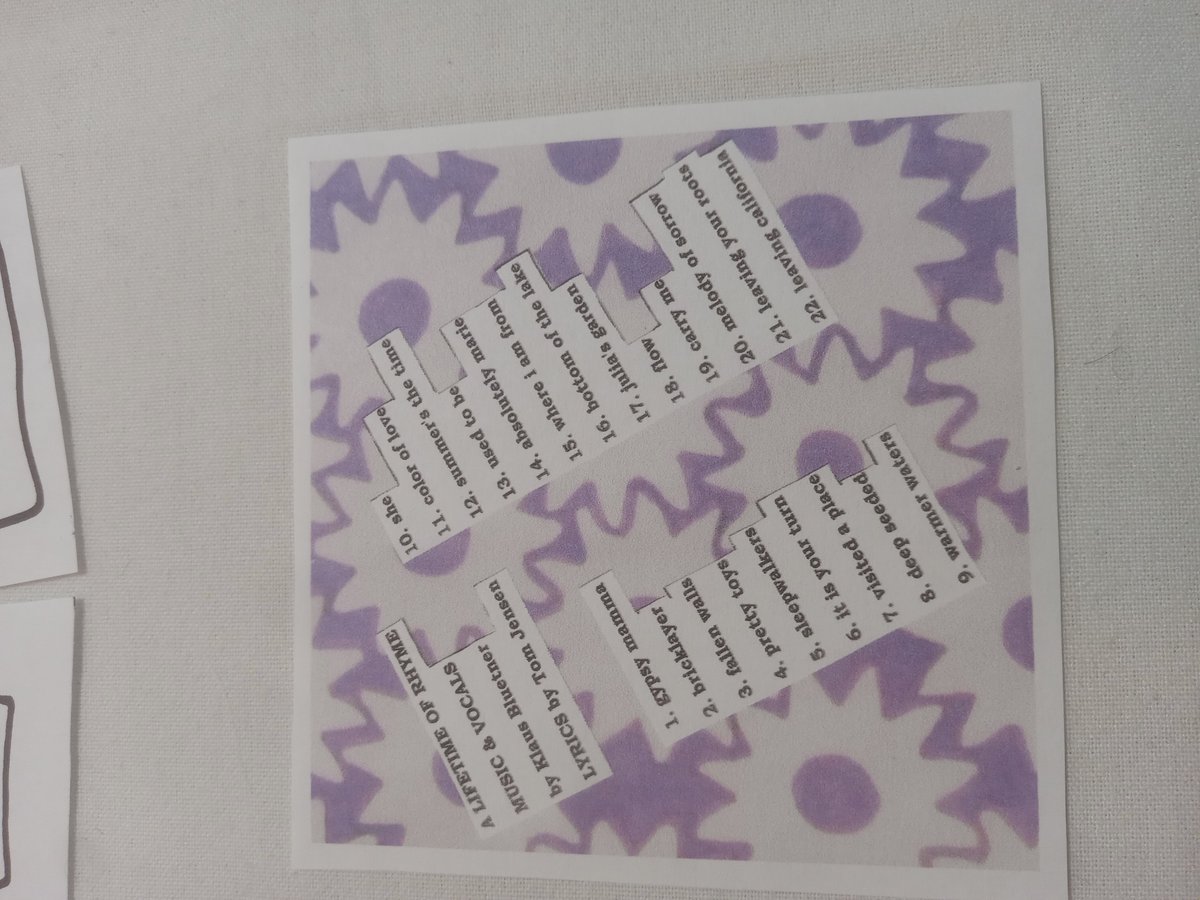
A LIFETIME OF RHYME
Two separate printed paper inserts, likely for a music album case, in excellent condition.
- Why it matters
- Tom writes this
- Type
- Printed page
- Collection
- Tom writes this
- Published in
- PREVIOUSLY UNPUBLISHEDSearched against the 34 albums, every book and Poems By Tom - found in none of them
Price · Tier · Tom fills these
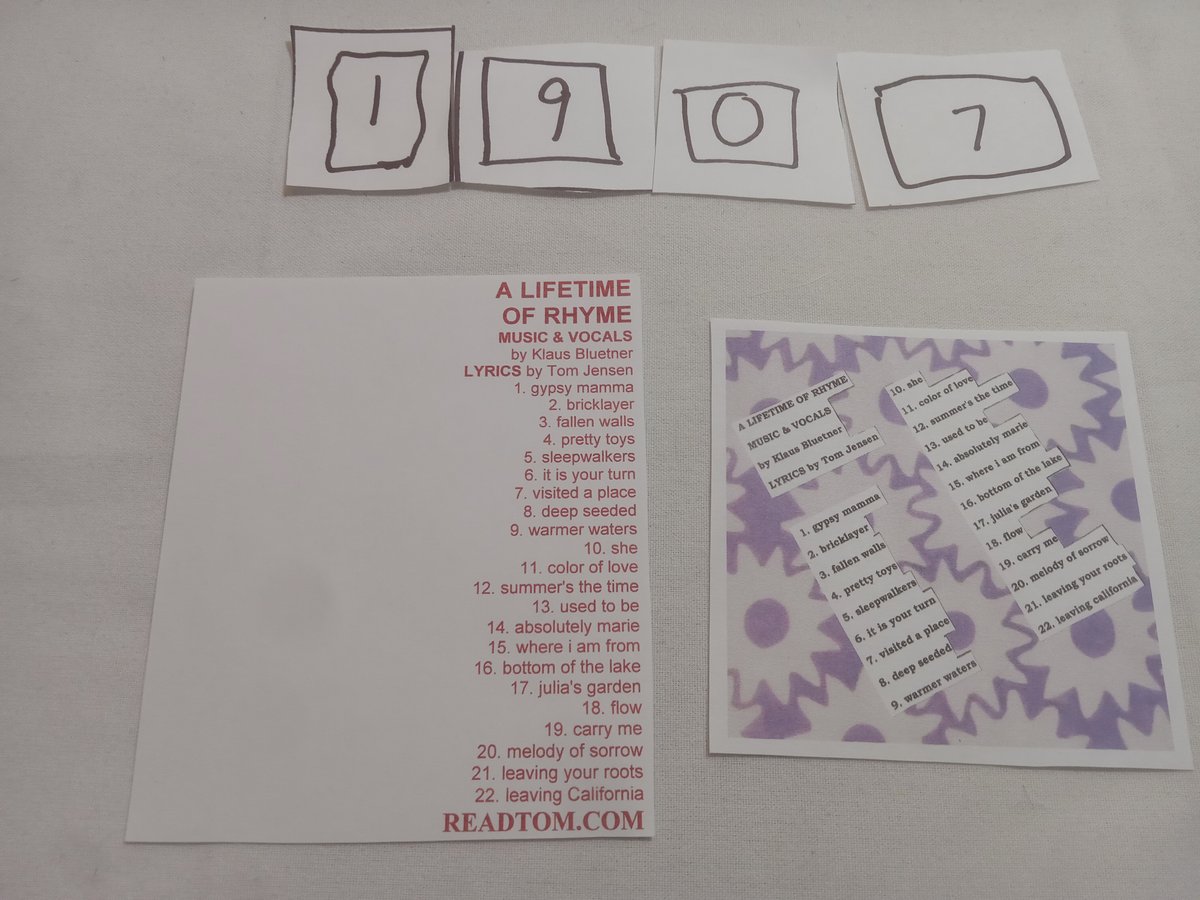
Picture 1 of 2
Picture 2 of 2
The words on this page
[Left Paper]
A LIFETIME
OF RHYME
MUSIC & VOCALS
by Klaus Bluetner
LYRICS by Tom Jensen
1. gypsy mamma
2. bricklayer
3. fallen walls
4. pretty toys
5. sleepwalkers
6. it is your turn
7. visited a place
8. deep seeded
9. warmer waters
10. she
11. color of love
12. summer's the time
13. used to be
14. absolutely marie
15. where i am from
16. bottom of the lake
17. julia's garden
18. flow
19. carry me
20. melody of sorrow
21. leaving your roots
22. leaving California
READTOM.COM
[Right Paper]
A LIFETIME OF RHYME
MUSIC & VOCALS
by Klaus Bluetner
LYRICS by Tom Jensen
1. gypsy mamma
2. bricklayer
3. fallen walls
4. pretty toys
5. sleepwalkers
6. it is your turn
7. visited a place
8. deep seeded
9. warmer waters
10. she
11. color of love
12. summer's the time
13. used to be
14. absolutely marie
15. where i am from
16. bottom of the lake
17. julia's garden
18. flow
19. carry me
20. melody of sorrow
21. leaving your roots
22. leaving California
---
A LIFETIME OF RHYME
MUSIC & VOCALS
by Klaus Bluetner
LYRICS by Tom Jensen
1. gypsy mamma
2. bricklayer
3. fallen walls
4. pretty toys
5. sleepwalkers
6. it is your turn
7. visited a place
8. deep seeded
9. warmer waters
10. she
11. color of love
12. summer's the time
13. used to be
14. absolutely marie
15. where i am from
16. bottom of the lake
17. julia's garden
18. flow
19. carry me
20. melody of sorrow
21. leaving your roots
22. leaving california
Item 1908
A LIFETIME OF RHYME
Printed CD insert cut square: A LIFETIME OF RHYME, music and vocals by Klaus Bluetner, lyrics by Tom Jensen, 22 song titles on a purple sunburst pattern.
- Why it matters
- Tom writes this
- Type
- Printed page
- Collection
- Tom writes this
Price · Tier · Tom fills these
The only picture of this piece
The words on this page
Not typed up yet.
Item 1909
A LIFETIME OF RHYME
What it is - Tom writes this
- Why it matters
- Tom writes this
- Type
- Printed page
- Collection
- Tom writes this
Price · Tier · Tom fills these
The only picture of this piece
The words on this page
Not typed up yet.
Item 1910
A LIFETIME OF RHYME
What it is - Tom writes this
- Why it matters
- Tom writes this
- Type
- Printed page
- Collection
- Tom writes this
Price · Tier · Tom fills these
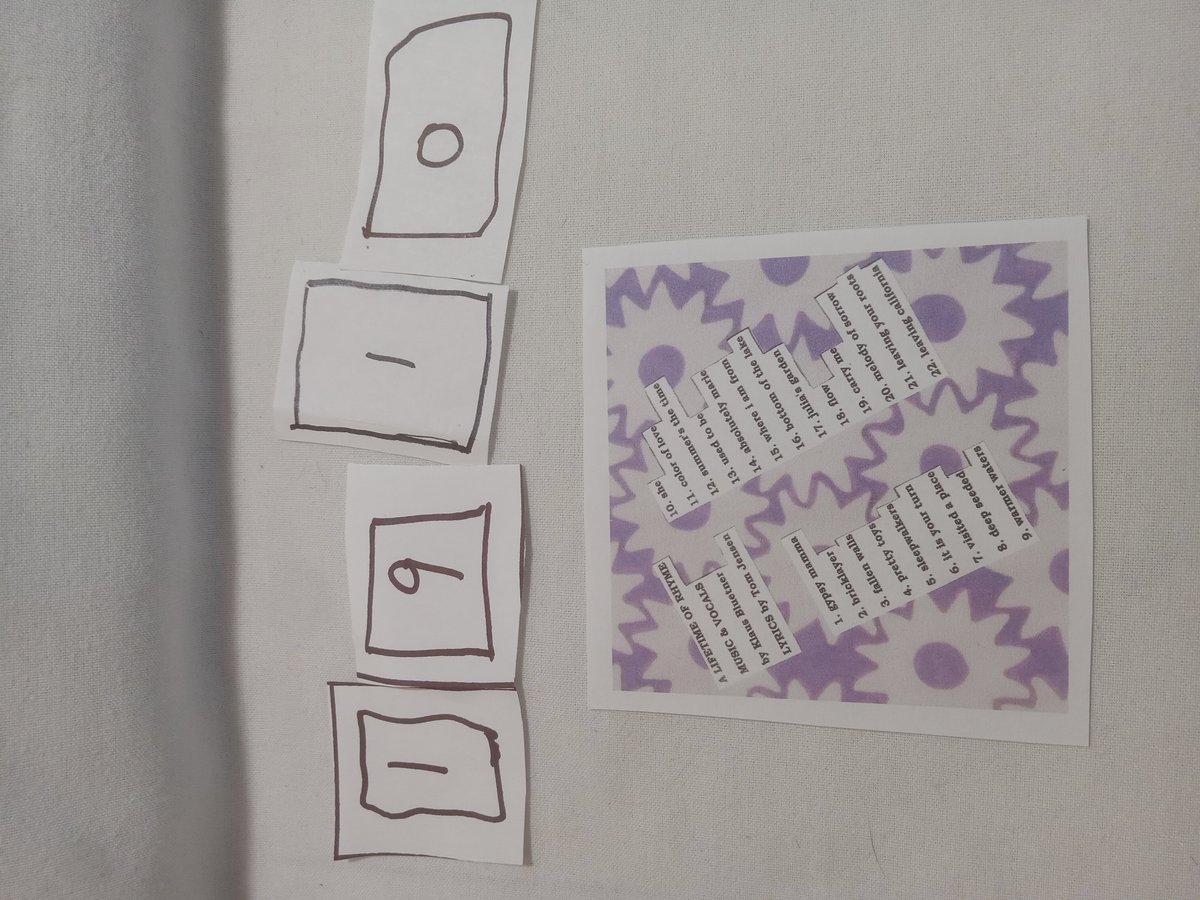
The only picture of this piece
The words on this page
Not typed up yet.
Item 1911
DON'T WORRY, I WILL SAVE THE WORLD FROM EVIL !!!
What it is - Tom writes this
- Why it matters
- Tom writes this
- Type
- Printed page
- Collection
- Tom writes this
- Published in
- PREVIOUSLY UNPUBLISHEDSearched against the 34 albums, every book and Poems By Tom - found in none of them
- Copies
- 2 in the catalogue · also written out as number 1161matched on the words by machine - Tom confirms
Price · Tier · Tom fills these
The only picture of this piece
The words on this page
DON'T WORRY,
I WILL SAVE THE WORLD
FROM EVIL !!!
my website is:
READTOM.COM
Telephone: 978.317.8769
Email: tomjensenlyrics@yahoo.com
Tom Jensen
Thinker, Writer, Poet,
Songwriter and Activist
I WILL SAVE THE WORLD
FROM EVIL !!!
my website is:
READTOM.COM
Telephone: 978.317.8769
Email: tomjensenlyrics@yahoo.com
Tom Jensen
Thinker, Writer, Poet,
Songwriter and Activist
Item 1921
✓candy rapper superstar
Printed white paper rolls, sheets, and taped strips featuring handwritten checkmarks and text annotations.
- Why it matters
- Tom writes this
- Type
- Printed page
- Collection
- Tom writes this
- Published in
- IN A BOOKTom Jensen Poem Anthology (2013)
Brian Rainstorm: Poetry Not Dead (2014)
The Laima Dedication Anthology (2011)
34 Albums, Books 1 and 2 (2026) - Age when written
- written by age 33 at the latestdated from the earliest book it appears in - the sheet itself may be older
Price · Tier · Tom fills these
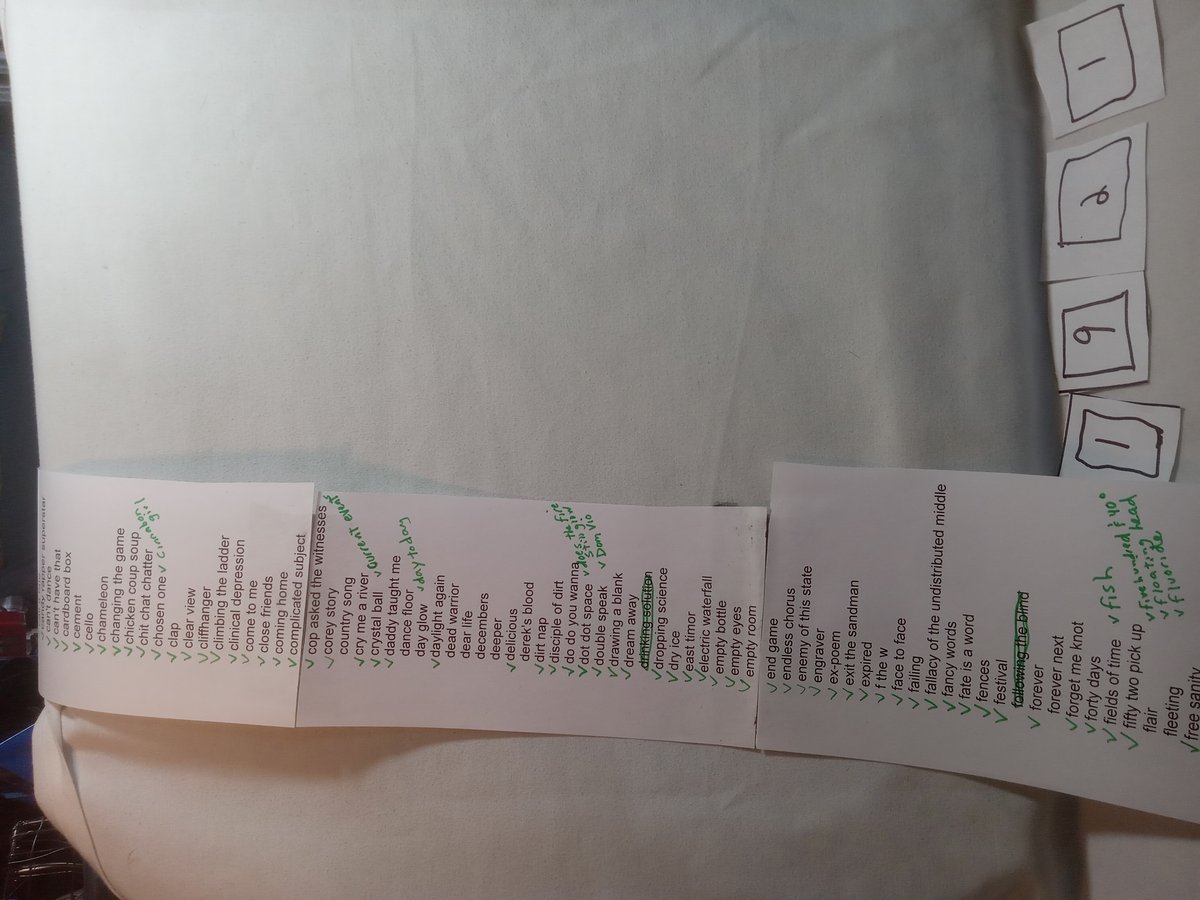
Picture 1 of 6
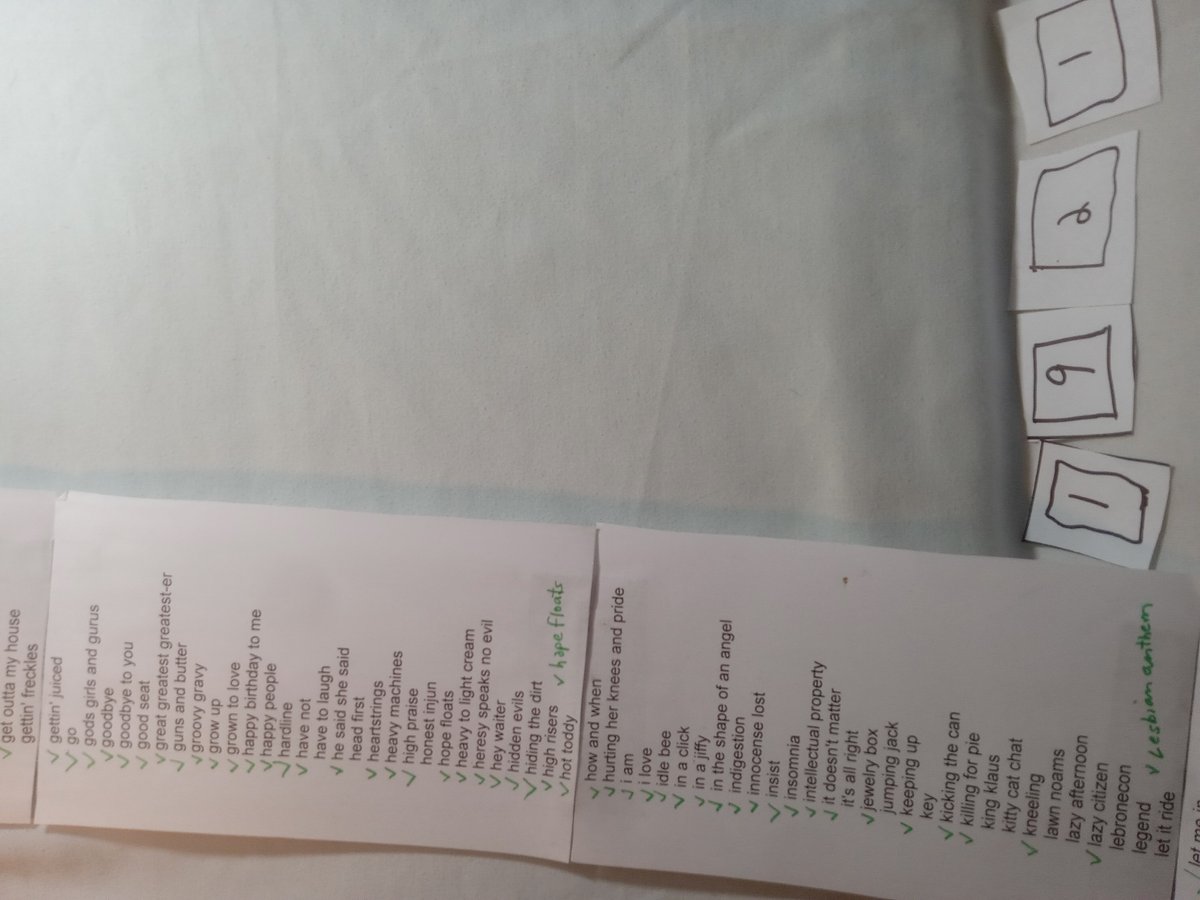
Picture 2 of 6
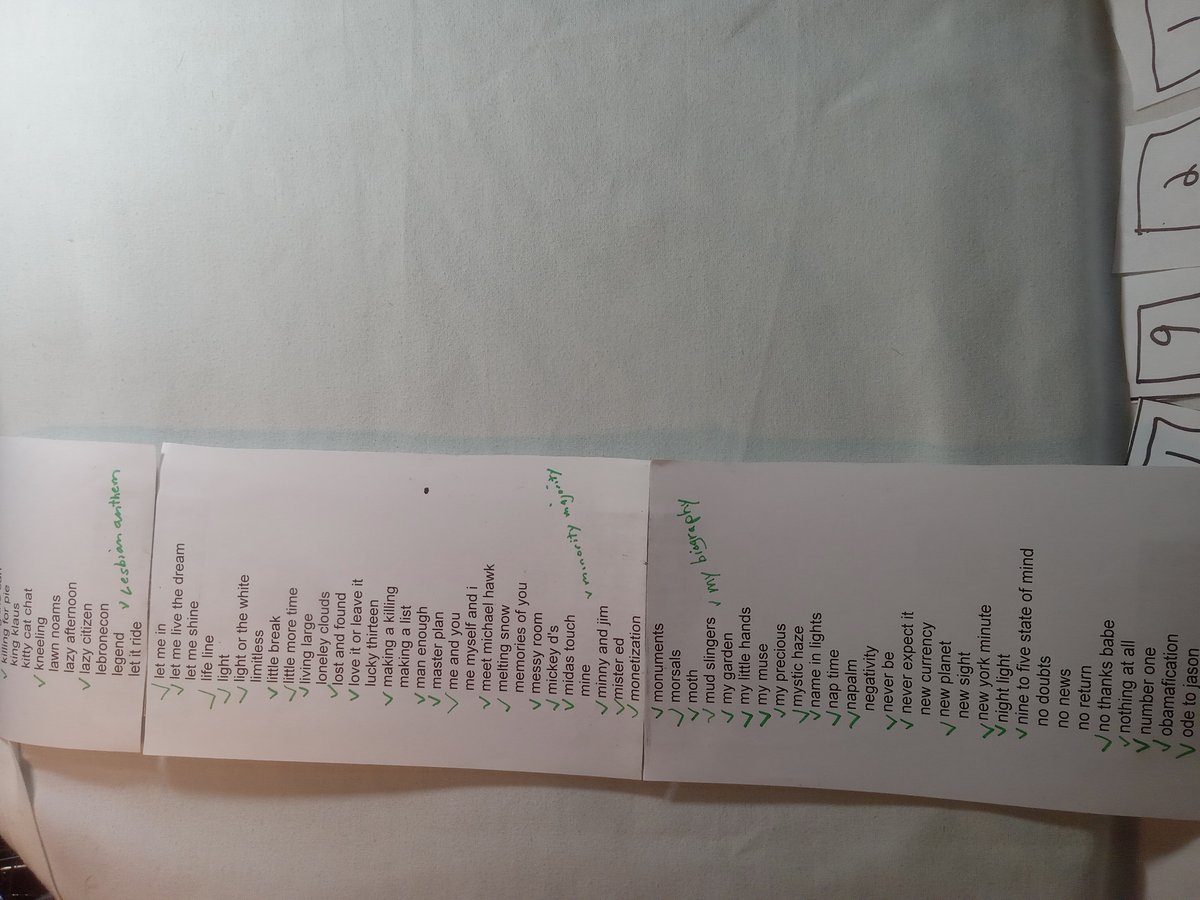
Picture 3 of 6
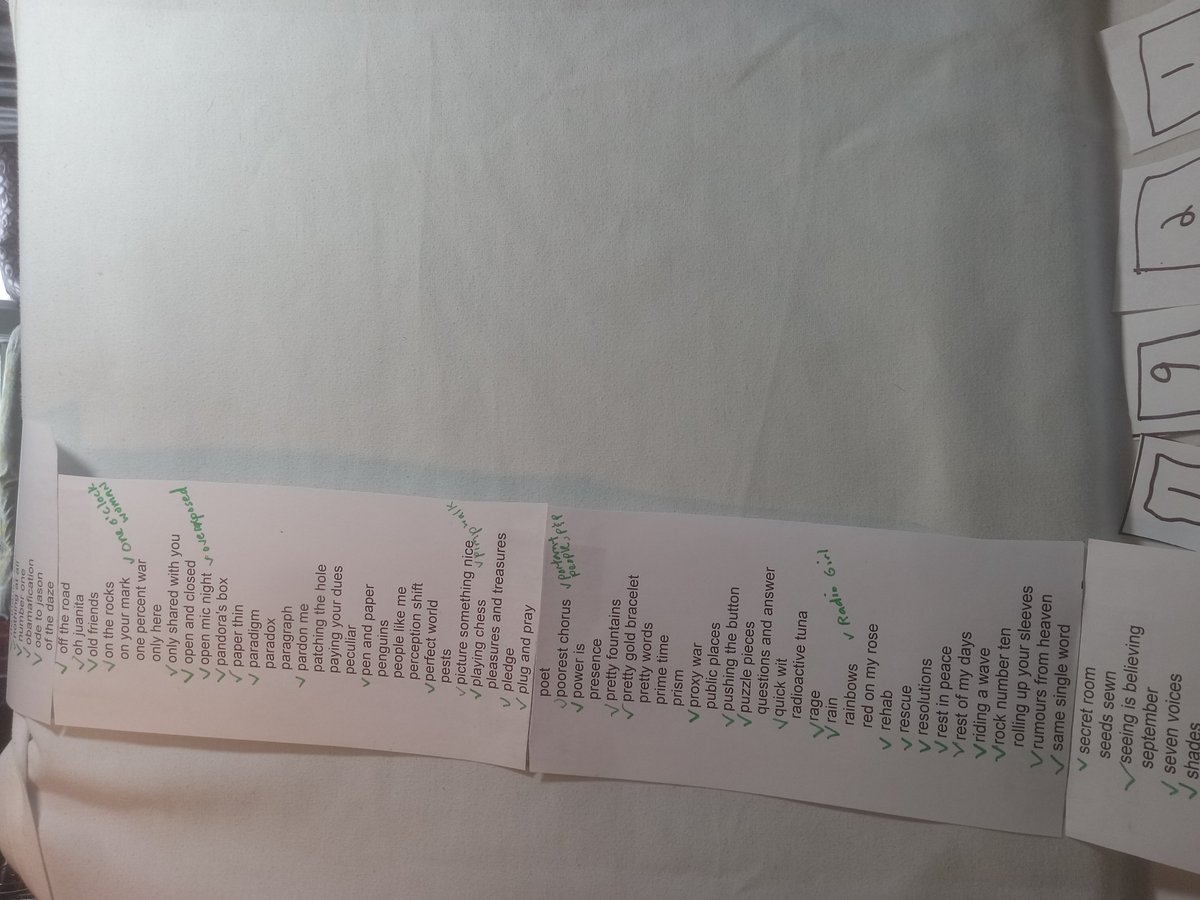
Picture 4 of 6
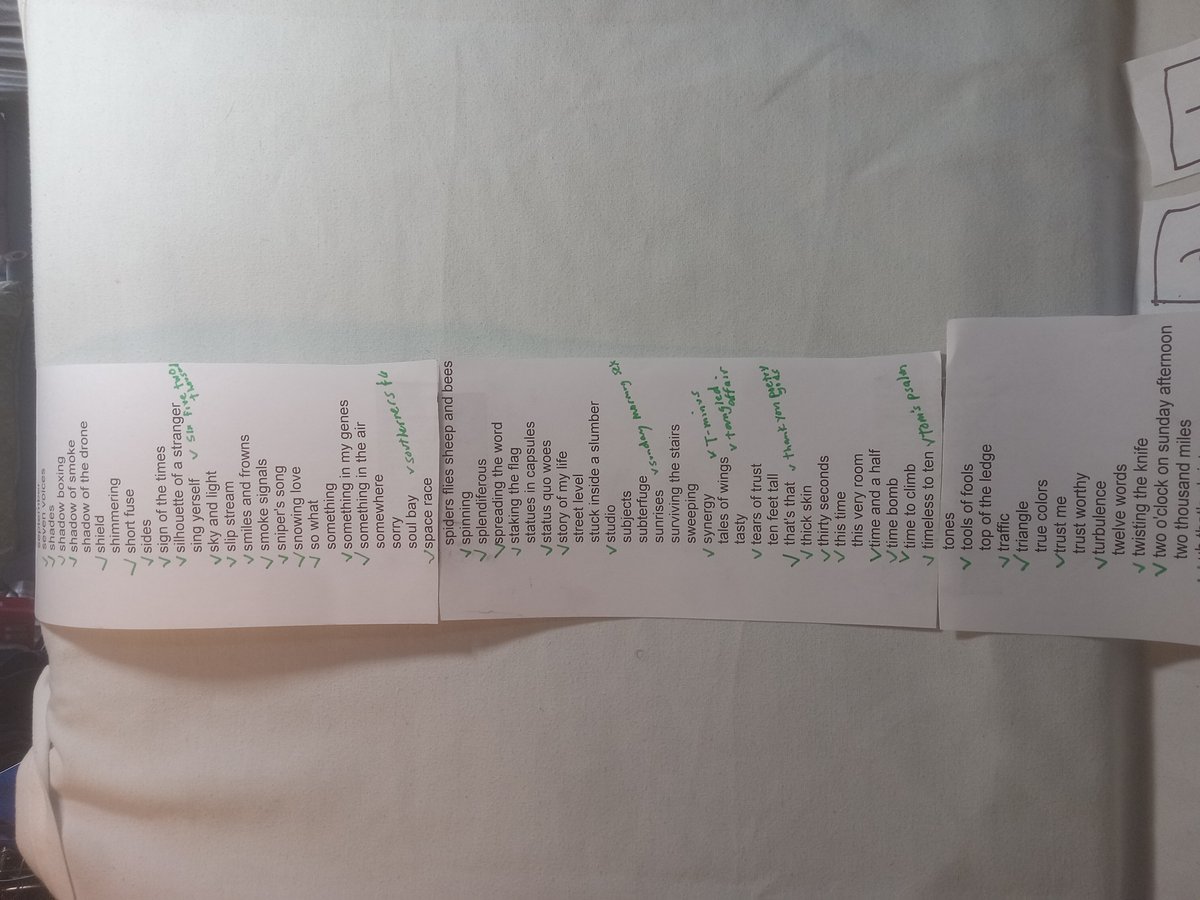
Picture 5 of 6
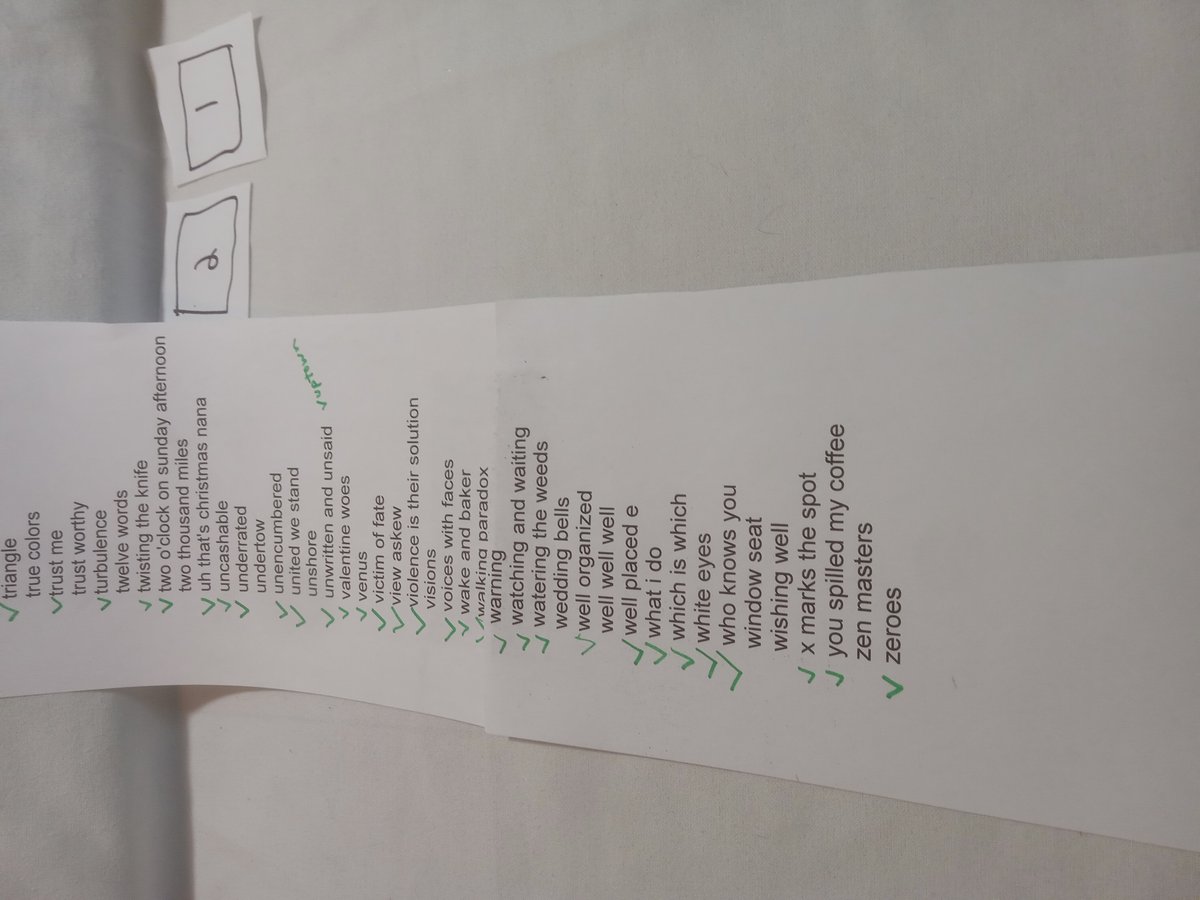
Picture 6 of 6
The words on this page
✓candy rapper superstar
✓can't dance
✓can't have that
✓cardboard box
✓cement
✓cello
✓chameleon
✓changing the game
✓chicken coup soup
✓chit chat chatter
✓chosen one ✓Cinnaboi girl
✓clap
✓clear view
✓cliffhanger
✓climbing the ladder
✓clinical depression
✓come to me
✓close friends
✓coming home
✓complicated subject
✓cop asked the witnesses
✓corey story
✓country song
✓cry me a river
✓crystal ball ✓current event
✓daddy taught me
✓day glow ✓day today
✓dance floor
✓dead warrior
✓dear life
✓decembers
✓deeper
✓delicious
✓derek's blood
✓dirt nap
✓disciple of dirt
✓do you wanna ✓He fire
✓dot space ✓does in glow
✓double speak ✓Dom vio
✓drawing a blank
✓dream away
drinking solution
✓dropping science
✓dry ice
✓east timor
✓electric waterfall
✓empty bottle
✓empty eyes
✓empty room
✓end game
✓endless chorus
✓enemy of this state
✓engraver
✓ex-poem
✓exit the sandman
✓expired
✓f the w
✓face to face
✓failing
✓fallacy of the undistributed middle
✓fancy words
✓fate is a word
✓fences
✓festival
following the blind
✓forever
✓forever next
✓forget me knot
✓forty days
✓fields of time ✓fish
✓fifty two pick up ✓five hundred f 40°
✓flair ✓floating head
✓fleeting ✓fluoride
✓free sanity
---
get outta my house
gettin' freckles
✓ gettin' juiced
✓ go
✓ gods girls and gurus
✓ goodbye
✓ goodbye to you
✓ good seat
✓ great greatest greatest-er
✓ guns and butter
✓ groovy gravy
✓ grow up
✓ grown to love
✓ happy birthday to me
✓ happy people
✓ hardline
✓ have not
have to laugh
✓ he said she said
head first
✓ heartstrings
✓ heavy machines
✓ high praise
honest injun
✓ hope floats
✓ heavy to light cream
✓ heresy speaks no evil
✓ hey waiter
✓ hiding the dirt
✓ high risers
✓ hot toddy
✓ hope floats
✓ how and when
✓ hurting her knees and pride
✓ i am
✓ i love
✓ idle bee
✓ in a click
✓ in a jiffy
✓ in the shape of an angel
✓ indigestion
✓ innocence lost
✓ insist
✓ insomnia
✓ intellectual property
it doesn't matter
✓ it's all right
✓ jewelry box
jumping jack
✓ keeping up
key
✓ kicking the can
✓ killing for pie
king klaus
kitty cat chat
✓ kneeling
lawn noams
lazy afternoon
✓ lazy citizen
lebronecon
legend
✓ lesbian anthem
let it ride
Item 1926
[Small paper, upper right]
White paper sheets containing handwritten notes paired with a personalized stationery note card.
- Why it matters
- Tom writes this
- Type
- Printed page
- Collection
- Tom writes this
- Published in
- PREVIOUSLY UNPUBLISHEDSearched against the 34 albums, every book and Poems By Tom - found in none of them
- Copies
- 2 in the catalogue · also written out as number 68matched on the words by machine - Tom confirms
Price · Tier · Tom fills these
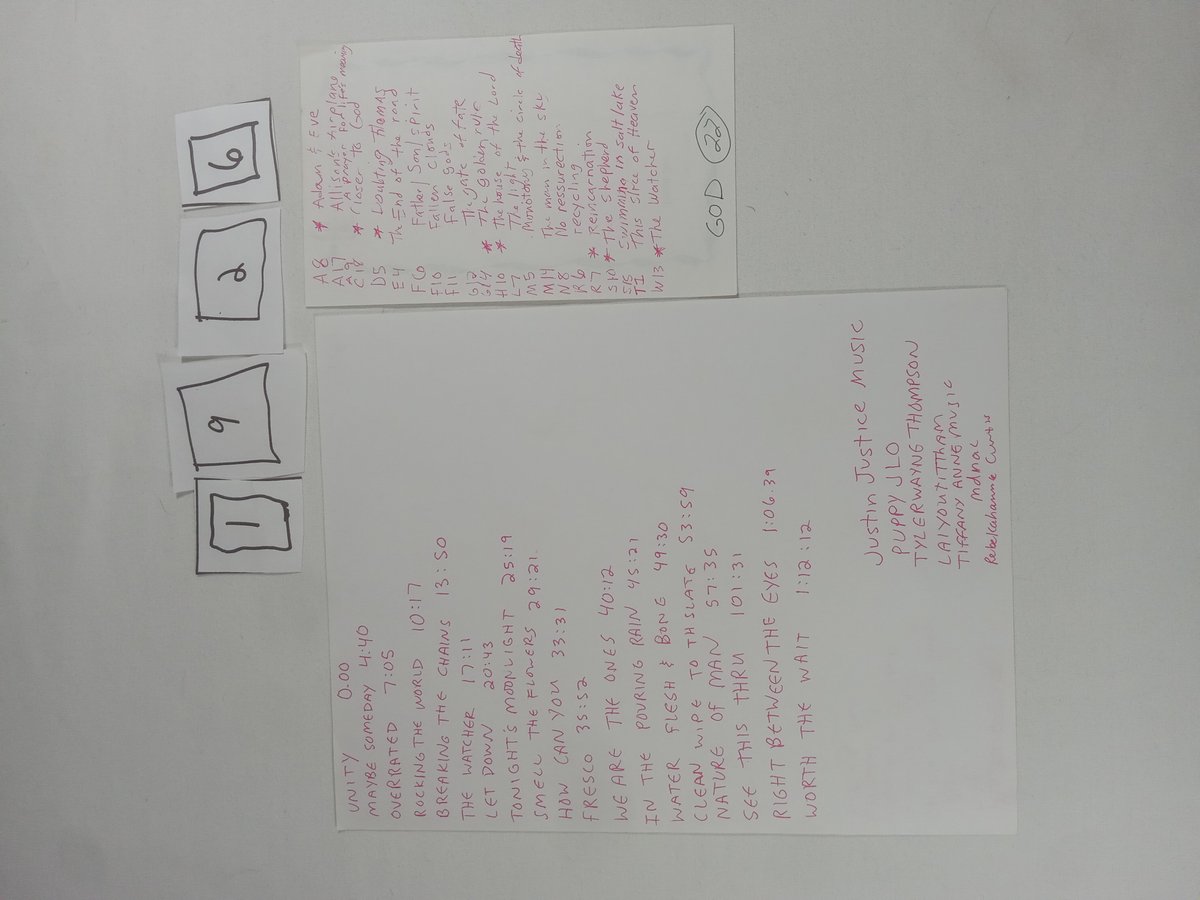
Picture 1 of 3
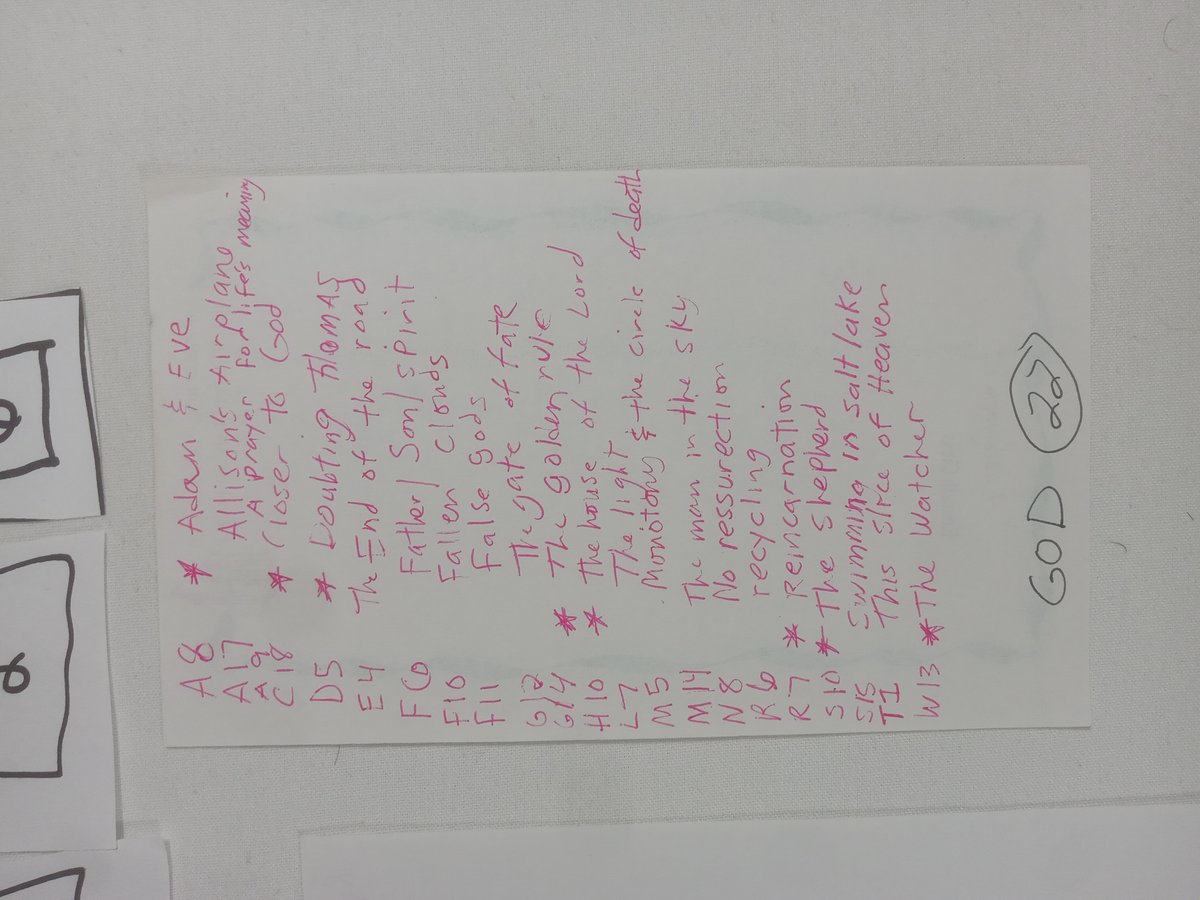
Picture 2 of 3
Picture 3 of 3
The words on this page
[Small paper, upper right]
A8 * Adam & Eve
A17 Allison's airplane
A18 * A prayer for life's meaning
C18 * Closer to God
D5 * Doubting Thomas
E4 The End of the road
F10 Father | Son | Spirit
F11 Fallen clouds
F11 False gods
G12 The gate of fate
G14 * The golden rule
H10 The house of the Lord
L7 The light
M5 Monotony & the circle of death
M14 The man in the sky
N8 No ressurection
R6 recycling
R7 * Reincarnation
S10 * The Shepherd
S15 Swimming in salt lake
T1 This slice of Heaven
W13 * The Watcher
GOD 22
[Large paper, lower half]
UNITY 0.00
MAYBE SOMEDAY 4:40
OVERRATED 7:05
ROCKING THE WORLD 10:17
BREAKING THE CHAINS 13:50
THE WATCHER 17:11
LET DOWN 20:43
TONIGHT'S MOONLIGHT 25:19
SMELL THE FLOWERS 29:21
HOW CAN YOU 33:31
FRESCO 35:52
WE ARE THE ONES 40:12
IN THE POURING RAIN 45:27
WATER FLESH & BONE 49:30
CLEAN WIPE TO THE SLATE 53:59
NATURE OF MAN 57:35
SEE THIS THRU 101:31
RIGHT BETWEEN THE EYES 1:06.39
WORTH THE WAIT 1:12:12
Justin Justice Music
PUPPY JLO
TYLER WAYNE THOMPSON
LAI YOUTIT THAM
TIFFANY ANNE MUSIC
mdnac
Rebelkahanne Curts
Item 1929
[Top Left Paper]
Four plain white sheets of paper and lined notebook paper written in black ink.
- Why it matters
- Tom writes this
- Type
- Printed page
- Collection
- Tom writes this
- Published in
- ON THE 34 ALBUMSA Day at the Office [SL3] · as the song LOOKING FOR LOVEmatched on the words: three or more seven-word runs shared with that song
Price · Tier · Tom fills these
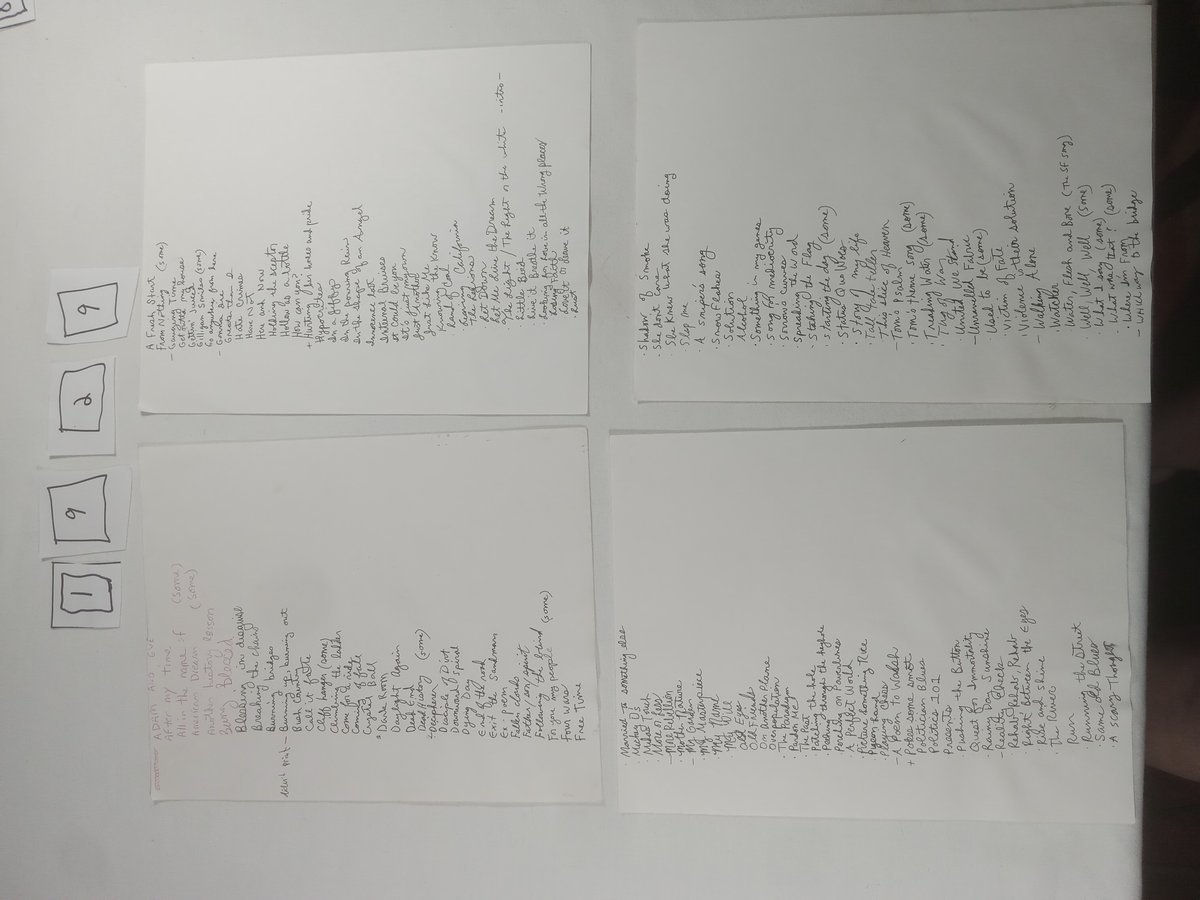
Picture 1 of 5
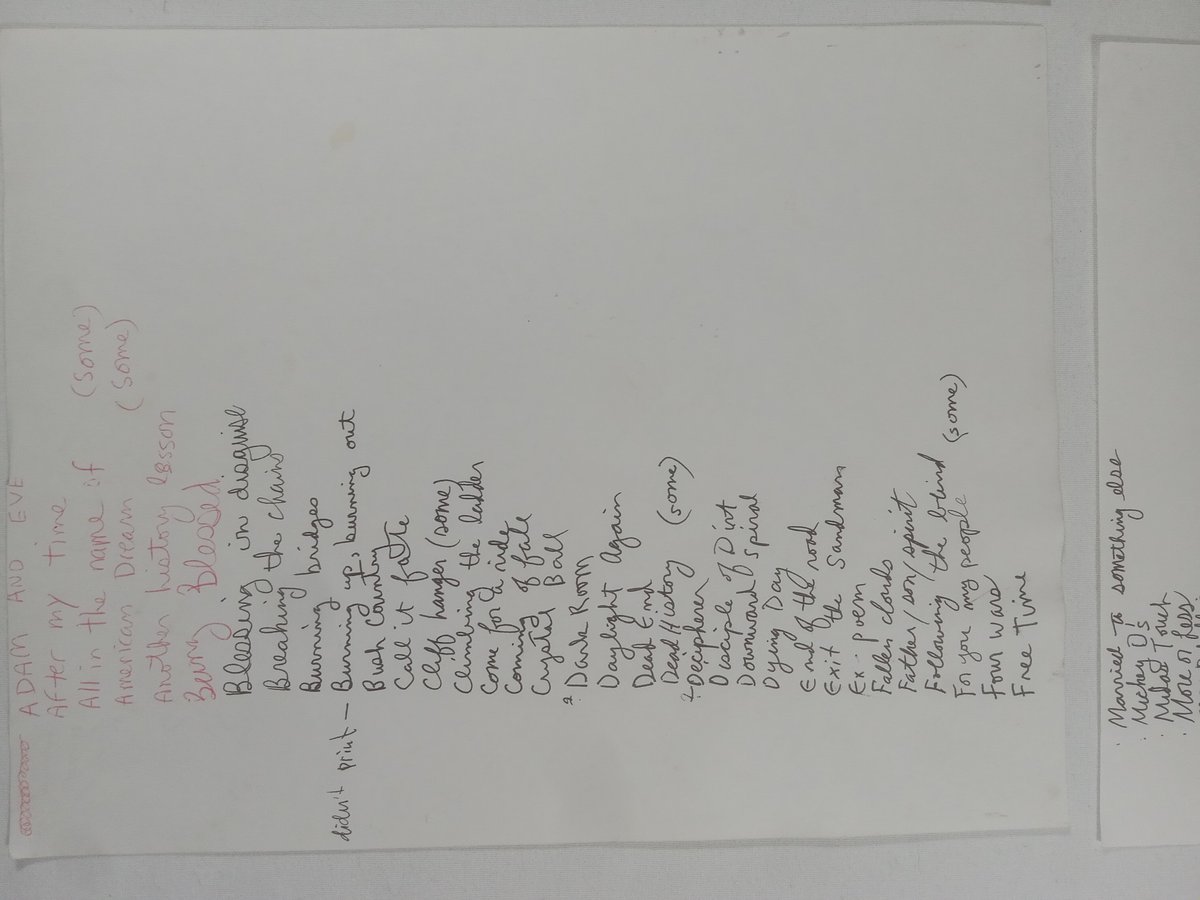
Picture 2 of 5
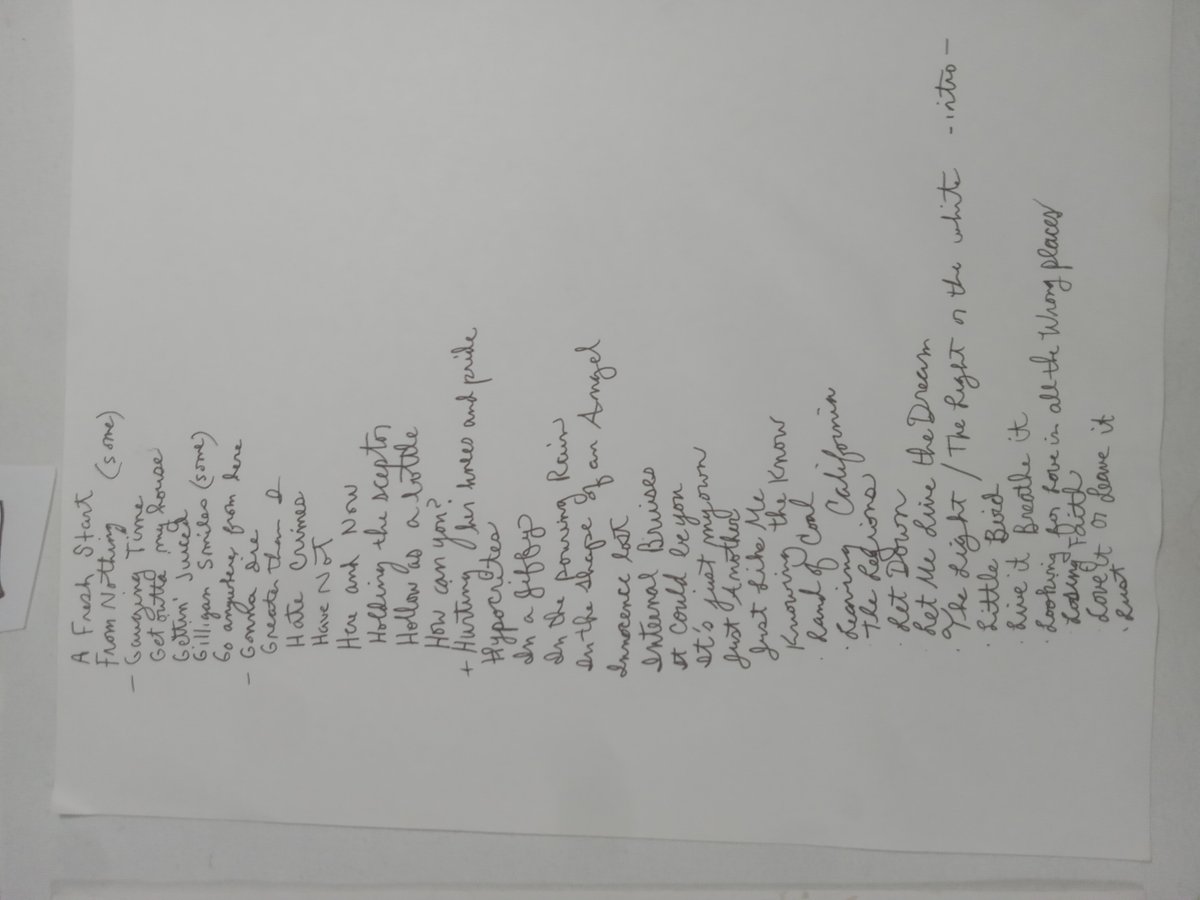
Picture 3 of 5
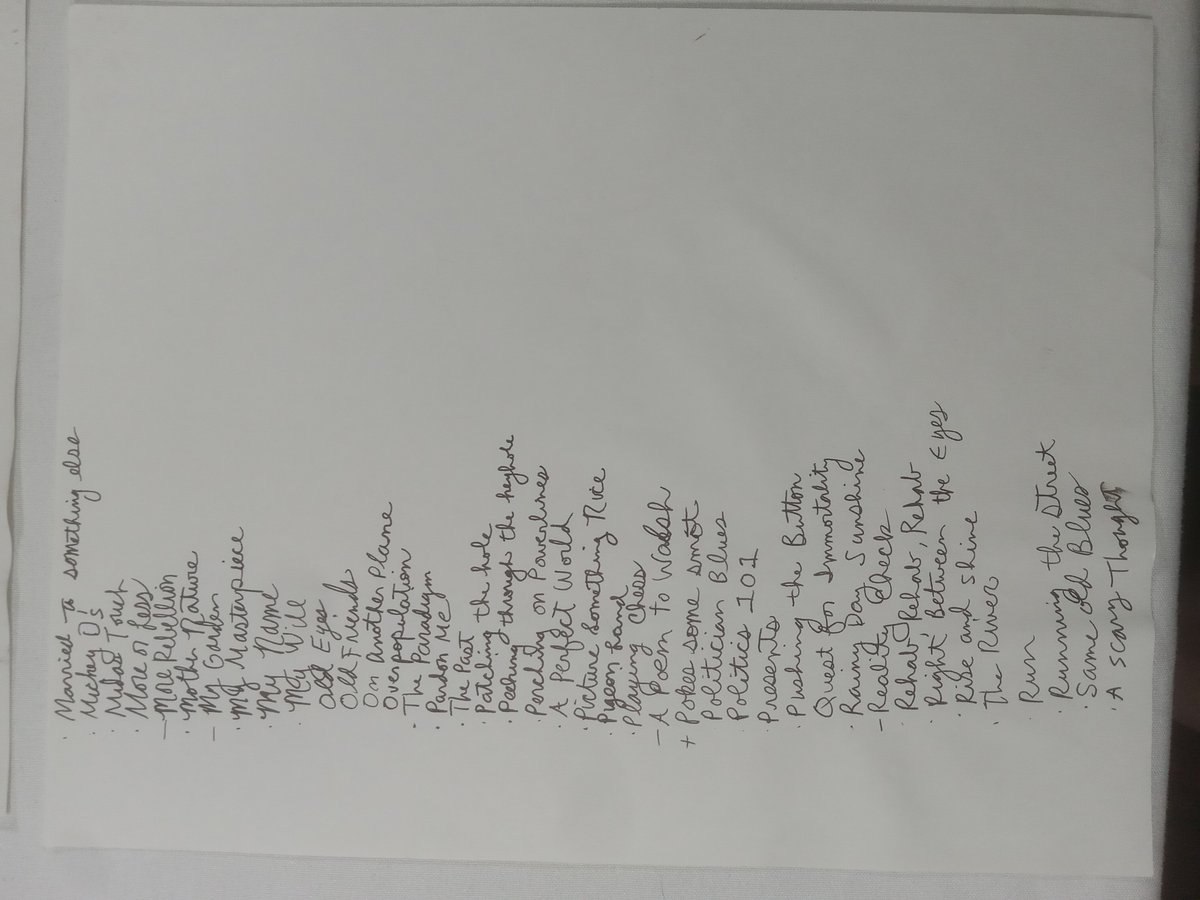
Picture 4 of 5
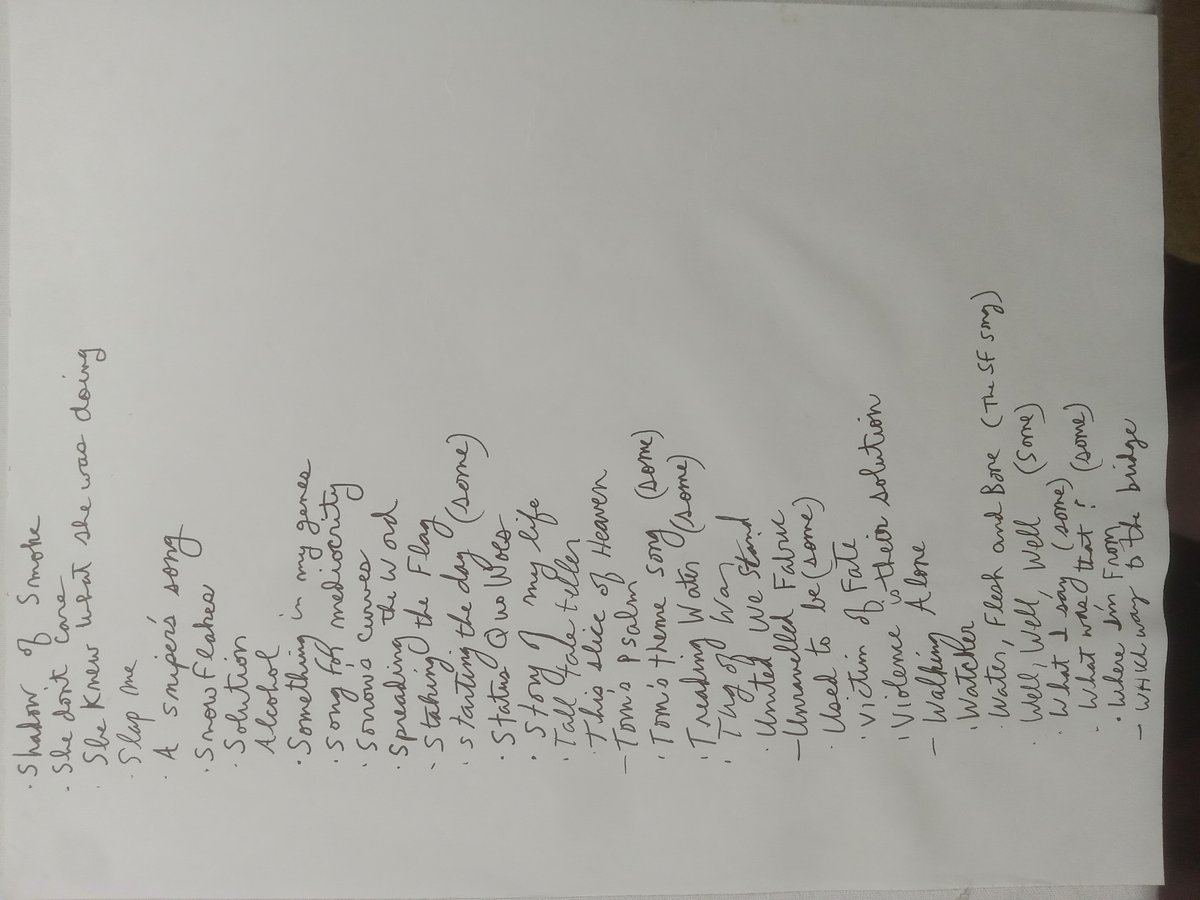
Picture 5 of 5
The words on this page
[Top Left Paper]
A Fresh Start (some)
From Nothing (some)
Gauging Time
Get outta my house
Gottin Juiced
Gilligan Smiles (some)
Glimpses from here
Good bye
Greedier than I
Hate Crimes
Have Not
Here and Now
Holding the sceptre
Hollow as a bottle
How can you?
Hurting for holes and pride
Hypocrites
In a fifty?
In the pouring Rain
In the shape of an Angel
Innocence lost
Internal Bruises
It could be you
It's just my own
Just Another
Just like Me
Knowing the Know
Land of Coal
Leaving California
Let California
End of the road
Let Down
Let Me live the Dream
The Light / The Right on the white - intro -
Little Bird
Live it Breathe it
Looking for love in all the Wrong places
Losing Faith
Love it or leave it
Riot
[Top Right Paper]
Shadow of smoke
She don't care
She Knew what she was doing
Slap Me
A sniper's song
Snow flakes
Solution
Alcohol
Something in my genes
Song for mediocrity
Sonora curves
Spreading the word
Staring the flag
Starting the day (some)
Status @ we Woke
Story of my life
Tall tale teller
This slice of Heaven
Tom's psalm
Tom's theme song (some)
Treading Water (some)
Tug of War
United We Stand
Unravelled Fabric
Used to be (some)
Victim of Fate
Violence their solution
Walking Alone
Watcher
Water, Flesh and Bone (the SF song)
Well, Well, Well (some)
What I say (some)
What what that!? (some)
Where I'm From
Which way to the bridge
[Bottom Left Paper]
ADAM AND EVE
After my time
All in the name of (some)
American Dream (some)
Another history lesson
Burn Blood
Blessing in disguise
Breaking the chains
Burning bridges
Burn it - burning up, burning out
Bush Country
Call it fate
Cliff hanger (some)
Climbing the ladder
Come for a ride
Coming of fate
Crystal Ball
Dark Room
Daylight Again
Dead end
Dead history (some)
Decipher
Disciple of Diet
Downward spiral
Dying Day
End of the road
Exit the Sandman
Ex: poem
Fallen clouds
Father son spirit
Following the blind (some)
For you my people
Four ware
Free Time
[Bottom Right Paper]
Married to something else
Mickey D's
Midus Touch
More of less
MR Rebellion
Mother Nature
My Garden
My Masterpiece
My Name
My Will
Old Eyes
Old Friends
On Another Plane
Overpopulation
The Paradigm
Pardon Me
The Past
Patching the hole
Pushing through the keyhole
Perching on Powerline
A Perfect World
Picture something nice
Pigeon hand
Playing chess
A Poem to Wadah
Pokes some smoke
Politician Blues
Politics 101
Presents the Button
Quest for Immortality
Rainy Day Sunshine
Reality Check
Rehab, Rehab, Rehab
Right between the eyes
Rise and shine
The River
Run
Running the Street
Same old Blues
A Scary Thought
---
ADAM AND EVE
After my time (some)
All in the name of (some)
American Dream
Another history lesson
Being blessed
Blessing in disguise
Breaking the chains
Burning bridges
Burning up, burning out
Bush Country
Call it fate
Cliff hanger (some)
Climbing the ladder
Come for a ride
Coming of fate
Crystal Ball
Dark Room
Daylight Again
Dead End
Dead History (some)
Decipherer
Disciple of Dirt
Downward spiral
Dying Day
End of the road
Exit the Sandman
Ex poem
Fallen clouds
Father/son/spirit
Following the blind (some)
Four wars
Free Time
Married to something else
Mickey D's
Midas Touch
More or less
---
A Fresh Start
From Nothing (some)
- Gauging Time
Get outta my house
Gettin' Juiced
Gilligan Smiles (some)
- Gonna die
Go anywhere from here
Greater than I
Hate Crimes
Have Not
Here and Now
Holding the sceptor
Hollow as a bottle
How can you?
+ Hurting his knees and pride
Hypocrites
In a jiffy
In the pouring Rain
In the shape of an Angel
Innocence lost
Internal Bruises
It Could be you
It's just my own
just Another
just like Me
Knowing the Know
Land of Coal
Leaving California
The Regions
Let Down
Let Me live the Dream
The Light / The Right on the white - intro -
Little Bird
Live it Breathe it
Looking for love in all the Wrong places
Losing Faith
Love it or leave it
Lust
---
Married to something else
Mickey D's
Midas Touch
More or less
Mother Nature
My Garden
My Masterpiece
My Name
My Will
Old Eyes
Old Friends
On Another Plane
Overpopulation
The Paradigm
Pardon Me
The Past
Patching the hole
Perching on Powerlines
A Perfect World
Picture Something Rice
Pigeon Hand
Playing Chess
A Poem to Wabash
Pokes some smot
Politician Blues
Politics 101
Presents
Pushing the Button
Quest for Immortality
Rainy Day Sunshine
Reality Check
Rehab, Rehab, Rehab
Right Between the Eyes
Rise and shine
The River
Run
Running the Street
Same Old Blues
A Scary Thought
---
• Shadow of Smoke
• She don't care
• She knew what she was doing
• Slap me
• A snipers song
• Snowflakes
• Solution
• Alcohol
• Something in my genes
• Song for mediocrity
• Sorrows Curves
• Spreading the Word
• Staring the Flag
• Starting the day (some)
• Status Quo Wos
• Story of my life
• Tall tale teller
• This slice of Heaven
• Toms psalm
• Toms theme song (some)
• Treading Water (some)
• Tug of War
• United We Stand
• Unravelled Fabric
• Used to be (some)
• Victim of Fate
• Violence is their solution
• Walking Alone
• Watcher
• Water, Flesh and Bone (The SF song)
• Well, Well, Well (some)
• What I say (some)
• What was that? (some)
• Where I'm From
• Which way to the bridge
Item 1930
blurb done = page circled
Five sheets of white paper.
- Why it matters
- Tom writes this
- Type
- Printed page
- Collection
- Tom writes this
- Published in
- IN A BOOKThe November 2024 Collection (2024)
Finished Song Lyrics (2011)
The 714-Page Book (2012)
The Laima Dedication Anthology (2011)
34 Albums, Books 1 and 2 (2026)
Brian Rainstorm Song Lyric Book (2014)
The November 2012 Anthology (2012)
Revised 31 Albums With Index (2024) - Age when written
- written by age 32 at the latestdated from the earliest book it appears in - the sheet itself may be older
Price · Tier · Tom fills these
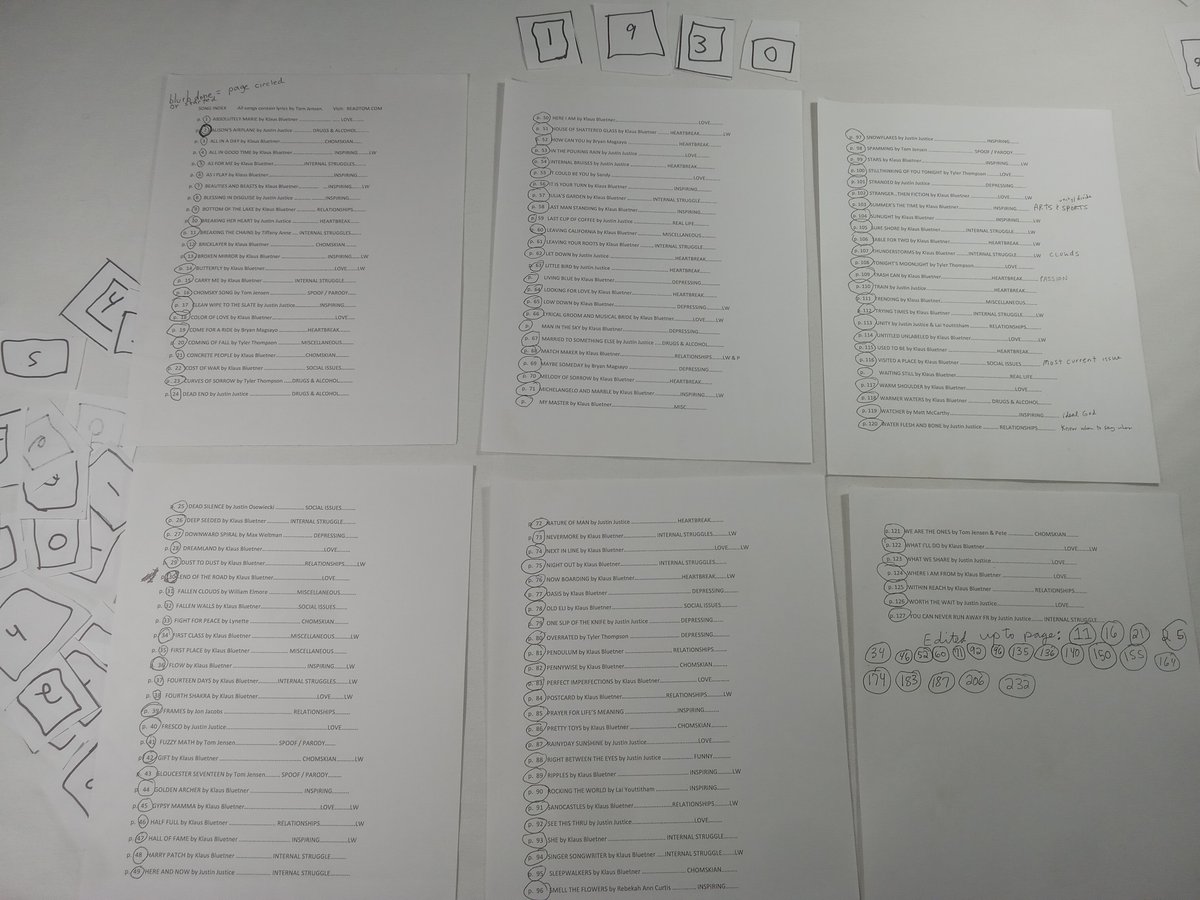
Picture 1 of 8
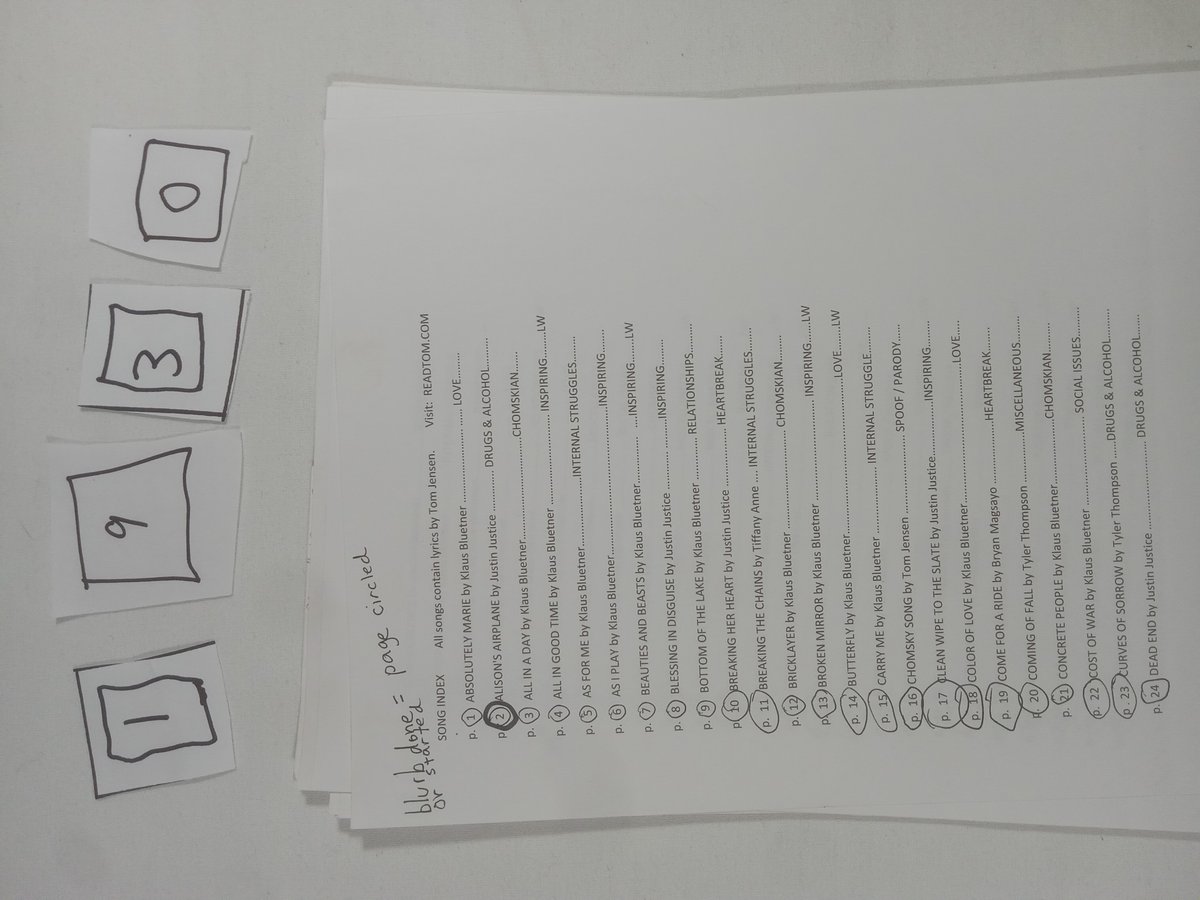
Picture 2 of 8
Picture 3 of 8
Picture 4 of 8
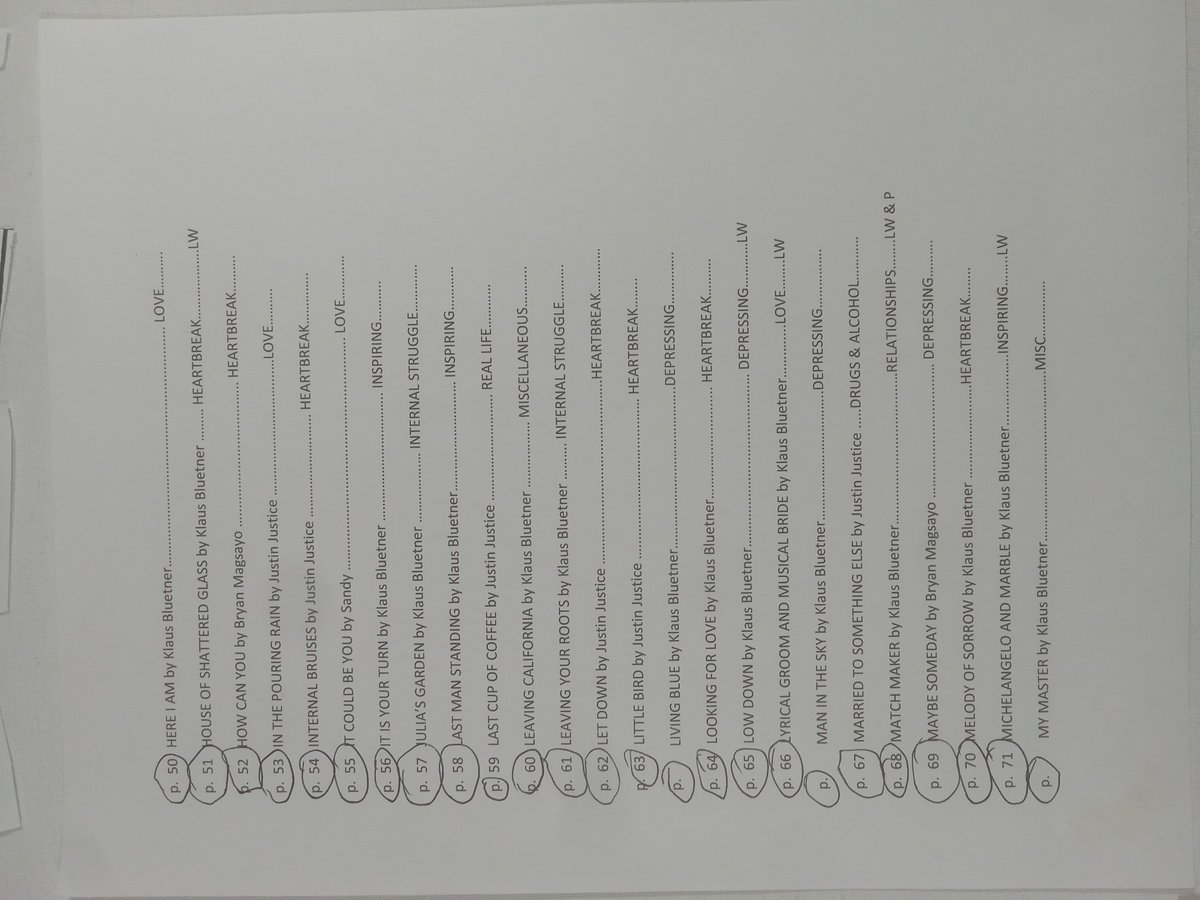
Picture 5 of 8
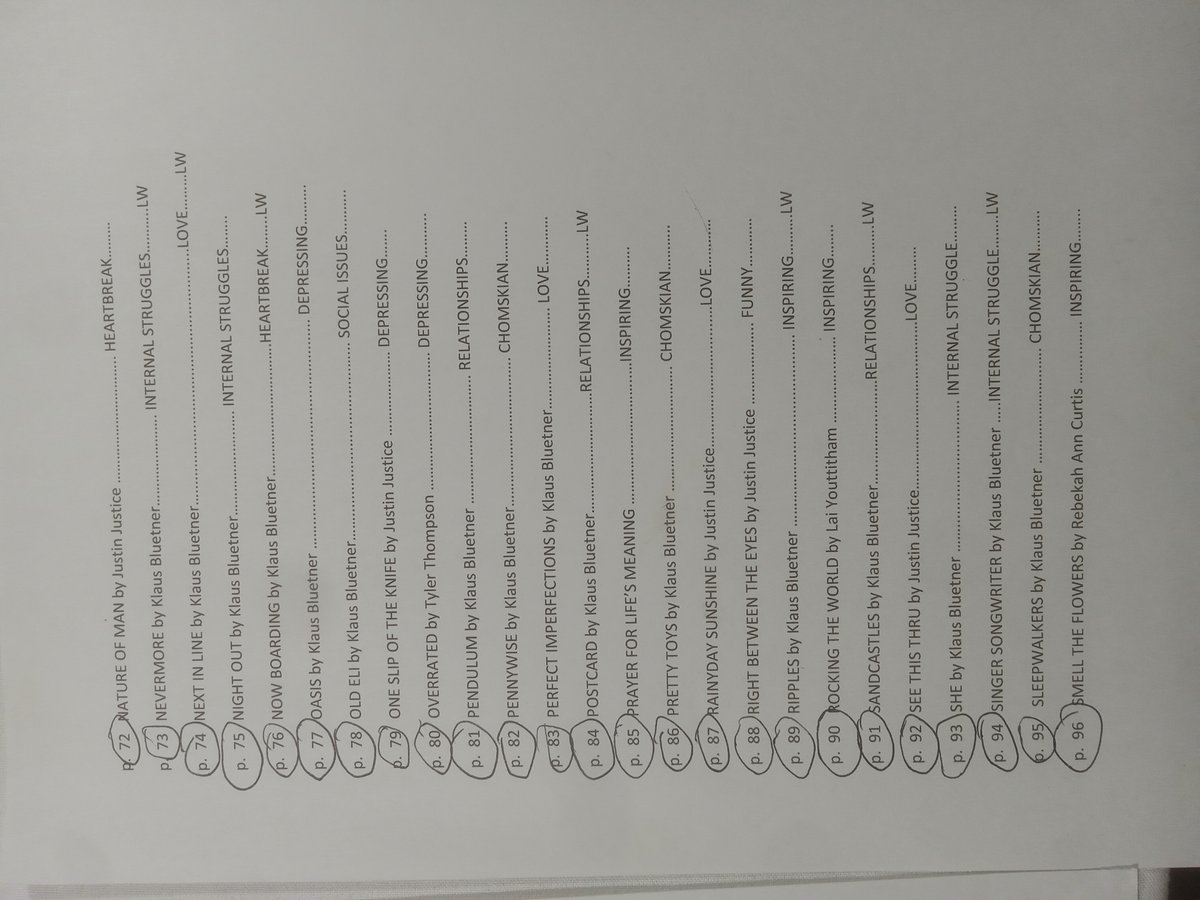
Picture 6 of 8
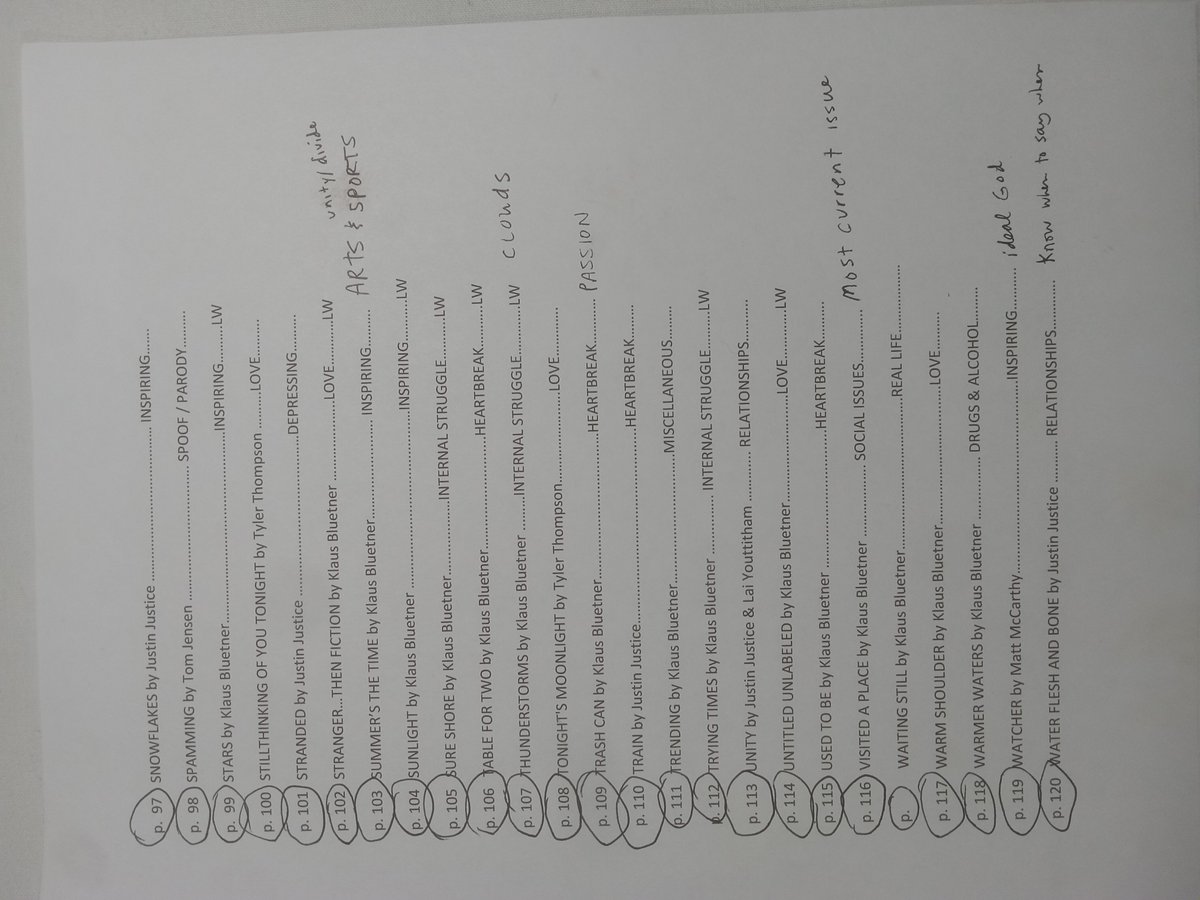
Picture 7 of 8
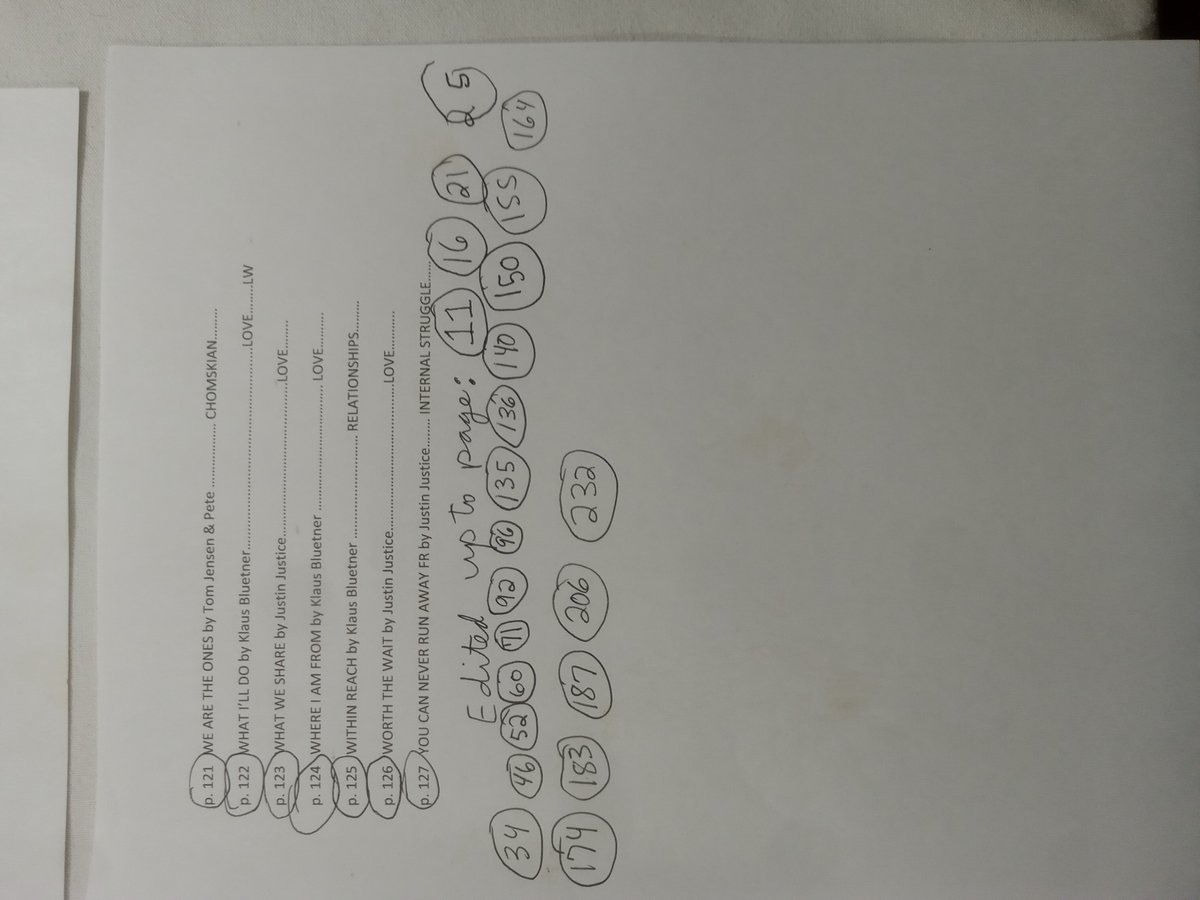
Picture 8 of 8
The words on this page
blurb done = page circled
or started
SONG INDEX All songs contain lyrics by Tom Jensen. Visit: READTOM.COM
p. 1 ABSOLUTELY MARIE by Klaus Bluetner ............................................LOVE.........
p. 2 ALISON'S AIRPLANE by Justin Justice ................................DRUGS & ALCOHOL.........
p. 3 ALL IN A DAY by Klaus Bluetner....................................................................
p. 4 ALL IN GOOD TIME by Klaus Bluetner ...........................................CHOMSKIAN.........
p. 5 AS FOR ME by Klaus Bluetner............................................................INSPIRING........LW
p. 6 AS I PLAY by Klaus Bluetner...................................................INTERNAL STRUGGLES.......
p. 7 BEAUTIES AND BEASTS by Klaus Bluetner.............................................INSPIRING.........
p. 8 BLESSING IN DISGUISE by Justin Justice .............................................INSPIRING........LW
p. 9 BOTTOM OF THE LAKE by Klaus Bluetner ............................................INSPIRING.........
p. 10 BREAKING HER HEART by Justin Justice .......................................RELATIONSHIPS.........
p. 11 BREAKING THE CHAINS by Tiffany Anne .... INTERNAL STRUGGLES...........HEARTBREAK.........
p. 12 BRICKLAYER by Klaus Bluetner ........................................................CHOMSKIAN.........
p. 13 BROKEN MIRROR by Klaus Bluetner .................................................INSPIRING........LW
p. 14 BUTTERFLY by Klaus Bluetner ...................................................................LOVE........LW
p. 15 CARRY ME by Klaus Bluetner .............................................................................
p. 16 CHOMSKY SONG by Tom Jensen ...................................................SPOOF / PARODY.........
p. 17 CLEAN WIPE TO THE SLATE by Justin Justice ......................................INSPIRING.........
p. 18 COLOR OF LOVE by Klaus Bluetner ............................................................LOVE.........
p. 19 COME FOR A RIDE by Bryan Magsayo ..............................................HEARTBREAK.........
p. 20 COMING OF FALL by Tyler Thompson ...........................................MISCELLANEOUS.........
p. 21 CONCRETE PEOPLE by Klaus Bluetner ...............................................CHOMSKIAN.........
p. 22 COST OF WAR by Klaus Bluetner .....................................................SOCIAL ISSUES.........
p. 23 CURVES OF SORROW by Tyler Thompson ..............................DRUGS & ALCOHOL.........
p. 24 DEAD END by Justin Justice ........................................................DRUGS & ALCOHOL.........
Item 1935
READTOM.COM POEMS / SONGS - typed title list, 5/21/2018
Printed list dated 5/21/2018 headed POEMS: the titles of Tom's poems and songs, run together in small type.
- Why it matters
- Tom writes this
- Type
- Printed page
- Collection
- Tom writes this
Price · Tier · Tom fills these
The only picture of this piece
The words on this page
Not typed up yet.
Item 1939
POEM LIST
Printed text on white paper pages.
- Why it matters
- Tom writes this
- Type
- Printed page
- Collection
- Tom writes this
- Published in
- ON THE 34 ALBUMSA Day at the Office [SL3] · as the song LOOKING FOR LOVEmatched on the words: three or more seven-word runs shared with that song
IN A BOOKTom Jensen Poem Anthology (2013)
Brian Rainstorm: Poetry Not Dead (2014)
The Laima Dedication Anthology (2011) - Age when written
- written by age 32 at the latestdated from the earliest book it appears in - the sheet itself may be older
Price · Tier · Tom fills these
Picture 1 of 7
Picture 2 of 7
Picture 3 of 7
Picture 4 of 7
Picture 5 of 7
Picture 6 of 7
Picture 7 of 7
The words on this page
Land of coal
Last shot
Lazy citizen
Learn from the masters
Lesbian anthem
Let me in
Let me live the dream
Lewis and clark
Liars and lawyers
Life line
Light
Light or the white
Like rolling a bone
Linear
Little break
Little more time
Little sex buddha
Living in a jimmy buffet song
Living large
Lost
Lost and found
Love it or leave it
Lovely infinity
Lucky thirteen
M
Making a killing
Man enough
Man is man
Master plan
Matches to burn
Pyramids
Q
Quest for immortality
Quick wit
R
Racist
Radio girl
Rage
Rain
Red on my rose
Rehab
Rescue
Resolutions
Rest in peace
Rest of my days
Riding a wave
Right by sight
Robin hood
Rock number ten
Rumours from heaven
Running free
Running the street
S
Same single word
Scary thought
Scrape your soul
Second class
Second date
Secret code
Secret room
See saw
Seeing is believing
Served
Seven voices
Sexual intellectual
Shades
Shadow boxing
Shadow of smoke
Shadow of the drone
She don't come easy
She knew what she was doing
Shepherd
Shield
Short fuse
Sides
Sign of the times
Silhouette of a stranger
Silly me
Silver lining
Sinbad the sailor
Six five two thousand and seven
Skating with bill lee
Sky and light
Skype me
Sleepless
Slip stream
Smackdab
Smiles and frowns
Smoke signals
Sniper's song
Snowing love
So what
Solving problems
Something
Something
Song for m
Sorry
Southerner
Space race
Spammin'
Spiders flie
Spinning
Splendifer
Staking th
Statues in
Status qu
Steady ca
Sticks and
Still walkin
Stix
Story of m
Straight f
Stranger
Street lev
Studio
Stupid
Sun bea
Sun rise
Sunday
Surviving
Synergy
T
T minus
Table fo
---
POEM LIST
A
A little closer
Act fasting
Actress
Advice
After the fact
Alcohol
All in
Always moving
Another cigarette
Another epic poem
Another history lesson
Any given day
Apocalypse now
Apples and oranges
Around the king's table
Aum... What she said...om
Avoid
Awaken
B
Bad match
Barrel roll
Bars and scars
Battle cry
Be hooven
Beast
Beats growing corn
Before noah
Behave
Being hip
Best left
Bet my mother
Betrayal
Better choices
Better than it seems
Better than me
Beware of the snoogins
Big shoes
Bird on a string
Birthright
Bite of the apple
Black dress
Blank pages
Blotches
Boardwalk
Boo hoo
Bottle me up
Brain games
Braveheart
Brownies and love
Building bridges
Bum knee
But him
Butter fingers
Buzzing
By design
C
Call it fate
Camaraderie
Camping
Can't dance
Can't have that
Candy rapper superstar
Cardboard box
Cats and dogs
Cello
Cement
Chameleon
Change
Changing the game
Chicken coup soup
Chit chat chatter
Chomsky song
Chosen one
Cinnabon girl
Clap
Clear view
Cliffhanger
Climbing the ladder
Clinical depression
Close friends
Come to me
Coming home
Complicated subject
Cop asked the witnesses
Corey story
Cousin of a kennedy
Cry me a river
Crystal ball
Current events
Electric waterfall
Empty bottle
Empty eyes
Empty room
End
addy taught me
y to day
ylight again
ad warrior
enseless
---
Barrel roll
Bars and scars
Battle cry
Be hooven
Beast
Buzing
By design
C
Call it fate
Cry me a river
Crystal ball
Current events
D
Daddy taught me
Day to day
Daylight again
Dead warrior
Defenseless
Delicious
Die bold
Dirt nap
Discartes
Disciple of dirt
Disrobed
Distractions
Do you wanna
Does the fire still glow
Dog paddling in the deep end
Dom Vio
Dot dot space
Double speek
Doubting thomas
Down
Drawing a blank
Dream away
Drink more water
Dropping science
Dry ice
Drywall
Dyslexic
E
Eanie Meanie
East timor
Either way
Electric waterfall
Empty bottle
Empty eyes
Empty room
End game
Endless chorus
Enemy of this state
Engraver
Even
Ex-poem
Exit the sandman
Expired
F
F the W
Face to face
Failing
Fallacy of the undistributed middle
False alarm
Fancy words
Fantasy and reality
Fate is a word
Feeding time
Fence
Festival
Fields of time
Fifty two pick up
Fifty ways
Filament
Fish
Fitting in
Five hundred and forty degrees
Flicker
Floating head
Fluoride
Forever
Forge
Forget me knot
Forty days
Found poem
Four wars
Free sanity
Free willy
Friend
Friends and countrymen
Fuzzy math
G
Game
Gauging time
Get outta my house
Gettin' juiced
Global warming
Gloucester seventeen
Go
Gods girls and gurus
Gold star
Good health
Good samaritan
Good seat
Goodbye
Goodbye to you
Grant's womb
Great greatest great-er
Groove back
Groovy gravy
---
Grow up
Grown to love
Guns and butter
H
H2oh
Half a pond of lily pads
Happy accident
Happy birthday to me
Happy people
Happy place
Hard line
Hard work
Hate crimes
Have not
Have to laugh
He said she said
Head first
Heartstrings
Heavenly
Heavy machines
Heavy to light cream
Helluva day
Heresy speaks no evil
Hey waiter
Hidden evils
Hiding the dirt
High noon
High praise
High risers
History to me
Homeworker
Hope floats
Horizon
Hot toddy
How and when
Hurting her knees and pride
Hypocrites
I
I am
I love
Idle bee
In a click
In a jiffy
In the shape of an angel
Incident on king street
Indigestion
Innocence lost
Insist
Insomnia
Intellectual property
Iron will
It doesn't matter
INVISIBLE PRISON
J
Jewelry box
Just your shoes
K
Keep it short
Keeping up
Kicking the can
Killing for pie
Kneeling
Knowing the know
L
Land of coal
Last shot
Lazy citizen
Learn from the masters
Lesbian anthem
Let me in
Let me live the dream
Lewis and clark
Liars and lawyers
Life line
Light
Light or the white
Like rolling a bone
Linear
Little break
Little more time
Little sex buddha
Living in a jimmy buffet song
Living large
Lost
Lost and found
Love it or leave it
Lovely infinity
Lucky thirteen
M
Making a killing
Man enough
Man is man
Master plan
Matches to burn
Me and you
Never expect it
---
High praise
High risers
History to me
Homeworker
Hope floats
Keeping up
Kicking the can
Killing for pie
Kneeling
Knowing the know
Man enough
Man is man
Master plan
Matches to burn
Me and you
Me you and hoobie doo
Meet Michael Hawk
Melting snow
Men on my shoulder
Messy room
Mickey d's
Midas touch
Minny and jim
Minority majority
Mister ed
Monetization
Money train
Monotony and the circle
Monuments
Morsals
Moth
Mountains and valleys
Mourning in the morning
Mudslingers
My best friends
My biography
My garden
My little hands
My muse
My precious
Mystic haze
N
Name in lights
Nap time
Napalm
Never be
Never expect it
New
New currency
New planet
New sight
New york minute
Night light
Nine to five state of mind
No snow
No thanks babe
Nothing at all
Nudged
Number one
O
Obamafication
Oceanside
Ode to jason
Off the road
Oh juanita
Oh you know
Old eyes
Old friends
On defense
On the rocks
One o'clock woman
Only shared with you
Open and closed
Open mic night
Order in the court
Outta the park
Overexposed
P
Pandora's box
Paper thin
Paradigm
Pardon me
Park the car
Pass a rash
Peanuts from the gallery
Pen and paper
Penguins
Perching on powerlines
Perfect
Perfect world
Pests
Picnic
Picture something nice
Pimp walk
Plastic rap
Playing chess
Pledge
Plug and pray
Poetic wax
Poorest chorus
Portant people politicians and pres
Posters of posers
Power is
Pretty fountains
Pretty gold bracelet
Prime time
Prison guard anthem
Proxy war
Pushing the button
Puzzle pieces
---
Pyramids
Q
Quest for immortality
Quick wit
R
Racist
Radio girl
Rage
Rain
Red on my rose
Rehab
Rescue
Resolutions
Rest in peace
Rest of my days
Riding a wave
Right by sight
Robin hood
Rock number ten
Rumours from heaven
Running free
Running the street
S
Same single word
Scary thought
Scrape your soul
Second class
Second date
Secret code
Secret room
See saw
Seeing is believing
Served
Seven voices
Sexual intellectual
Shades
Shadow boxing
Shadow of smoke
Shadow of the drone
She don't come easy
She knew what she was doing
Shepherd
Shield
Short fuse
Sides
Sign of the times
Silhouette of a stranger
Silly me
Silver lining
Sinbad the sailor
Six five two thousand and seven
Skating with bill lee
Sky and light
Skype me
Sleepless
Slip stream
Smackdab
Smiles and frowns
Smoke signals
Sniper's song
Snowing love
So what
Solving problems
Something in my genes
Something in the air
Song for mediocrity
Sorry
Southerners and six year olds
Space race
Spammin'
Spiders flies sheep and bees
Spinning
Splendiferous
Spreading the word
Staking the flag
Statues in capsules
Status quo woes
Steady calm
Sticks and stones
Still walking the earth
Stix
Story of my life
Straight for the border
Stranger in the manger
Street level
Studio
Stupid
Sun beams
Sun rises
Sunday morning sex
Surviving the stairs
Synergy
T
T minus
Table for five
Tales of wings
Two faced
Warning
---
Second date
Secret code
Secret room
Sniper's song
Snowing love
So what
Solving problems
T
T minus
Table for five
Tales of wings
Tangled affair
Tasty
Tears of trust
Thank you poetry gods
Thanks dad
That's that
Thick skin
Thirty seconds
This slice of heaven
This time
Thousand miles above
Time
Time and a half
Time bomb
Time to climb
Timeless to ten
To put it bluntly
Toilet paper song
Tom's psalm
Tools of fools
Totem pole
Traffic
Triangle
Trivial pursuit
Trump
Trust me
Trust your whiskers
Turbulence
Twelve days
Twenty seven
Twisting the knife
Two faced
Two o'clock on sunday afterr
Two pair
Two seasons
Two thousand miles
U
Uh that's christmas nana
Uncashable
Undefeated
Undefined
Undercaste
Underrated
Undertow
Unencumbered
United we stand
Unwinnable
Unwritten and unsaid
Uptown
V
Valentine woes
Venus
Victim of fate
View askew
Violence is their solution
Voices with faces
W
Wake and baker
Walking on words
Walking paradox
Walking through walls
Warning
Watch this
Watching and waiting
Water birds
Watering the weeds
We may
Wedding bells
Well glory be
Well glory be
Well organized
Well placed e
What i do
Which is which
White eyes
Who knows you
Why women go in pairs
Will do
Winter themed happiness
Wish I wet my bed
Worth a shot
X
X marks the spot
Y
Yesterday's songs
You spilled my coffee
Z
Zeroes
---
**Top Left Note:**
Keep on Diggin'
Album 1
---
Keep on Diggin'
Album 1
---
DISCIPLES OF DIRT
Album 2 [scribbled out word]
Bones
and
Stones
(17) Climbing the Ladder
---
Disciples of Dirt
Album 3 Higher Ground (double album)
(Sun)
IN The Pouring rain
Rainy Day Sunshine
The watcher
The World
Where I'm from
Dream Land
Smell the Flowers II
Hurting her Knees and pride
The end of the road
Better than Me
This slice of Heaven
Rainbows on Waterfalls
(Rain)
Let Down
Internal Bruises
Little Bird
Get outta my house
How can you?
An Ex-poem
Used to be
Looking for Love in all the wrong places
Water Flesh and Bone
Blessing in Disguise
Nothing at All
Unwritten and Unsaid
Another Song
12
Album Four - Higher Ground
---
Album Four - Higher Ground
Rain Falling Down
(pick 10)
✓ (2) Let Down
✓ (5) Internal Bruises
✓ (7) Little Bird
✓ (20) Get outta my house
✓ (23) How can you?
✓ (24) An ex-poem
✓ (27) Used to be
✓ (33) Looking for love in all the wrong places
✓ (36) Water, Flesh and Bone
(47) Blessing in Disguise
(66) Unwritten and Unsaid
(68) Another Song
---
(Pick 10)
v (9) In the Pouring Rain
v (15) Rainy Day Sunshine
v (16) The Watcher
v (34) The world
v (37) Where I'm from
v (46) Dream Land
v (52) Smell the Flowers II
v (53) Hurting her knees and pride
v (57) The end of the road
v (64) Better than Me
No (67) This slice of Heaven
No (71) Rainbows or Waterfalls
Last shot
Lazy citizen
Learn from the masters
Lesbian anthem
Let me in
Let me live the dream
Lewis and clark
Liars and lawyers
Life line
Light
Light or the white
Like rolling a bone
Linear
Little break
Little more time
Little sex buddha
Living in a jimmy buffet song
Living large
Lost
Lost and found
Love it or leave it
Lovely infinity
Lucky thirteen
M
Making a killing
Man enough
Man is man
Master plan
Matches to burn
Pyramids
Q
Quest for immortality
Quick wit
R
Racist
Radio girl
Rage
Rain
Red on my rose
Rehab
Rescue
Resolutions
Rest in peace
Rest of my days
Riding a wave
Right by sight
Robin hood
Rock number ten
Rumours from heaven
Running free
Running the street
S
Same single word
Scary thought
Scrape your soul
Second class
Second date
Secret code
Secret room
See saw
Seeing is believing
Served
Seven voices
Sexual intellectual
Shades
Shadow boxing
Shadow of smoke
Shadow of the drone
She don't come easy
She knew what she was doing
Shepherd
Shield
Short fuse
Sides
Sign of the times
Silhouette of a stranger
Silly me
Silver lining
Sinbad the sailor
Six five two thousand and seven
Skating with bill lee
Sky and light
Skype me
Sleepless
Slip stream
Smackdab
Smiles and frowns
Smoke signals
Sniper's song
Snowing love
So what
Solving problems
Something
Something
Song for m
Sorry
Southerner
Space race
Spammin'
Spiders flie
Spinning
Splendifer
Staking th
Statues in
Status qu
Steady ca
Sticks and
Still walkin
Stix
Story of m
Straight f
Stranger
Street lev
Studio
Stupid
Sun bea
Sun rise
Sunday
Surviving
Synergy
T
T minus
Table fo
---
POEM LIST
A
A little closer
Act fasting
Actress
Advice
After the fact
Alcohol
All in
Always moving
Another cigarette
Another epic poem
Another history lesson
Any given day
Apocalypse now
Apples and oranges
Around the king's table
Aum... What she said...om
Avoid
Awaken
B
Bad match
Barrel roll
Bars and scars
Battle cry
Be hooven
Beast
Beats growing corn
Before noah
Behave
Being hip
Best left
Bet my mother
Betrayal
Better choices
Better than it seems
Better than me
Beware of the snoogins
Big shoes
Bird on a string
Birthright
Bite of the apple
Black dress
Blank pages
Blotches
Boardwalk
Boo hoo
Bottle me up
Brain games
Braveheart
Brownies and love
Building bridges
Bum knee
But him
Butter fingers
Buzzing
By design
C
Call it fate
Camaraderie
Camping
Can't dance
Can't have that
Candy rapper superstar
Cardboard box
Cats and dogs
Cello
Cement
Chameleon
Change
Changing the game
Chicken coup soup
Chit chat chatter
Chomsky song
Chosen one
Cinnabon girl
Clap
Clear view
Cliffhanger
Climbing the ladder
Clinical depression
Close friends
Come to me
Coming home
Complicated subject
Cop asked the witnesses
Corey story
Cousin of a kennedy
Cry me a river
Crystal ball
Current events
Electric waterfall
Empty bottle
Empty eyes
Empty room
End
addy taught me
y to day
ylight again
ad warrior
enseless
---
Barrel roll
Bars and scars
Battle cry
Be hooven
Beast
Buzing
By design
C
Call it fate
Cry me a river
Crystal ball
Current events
D
Daddy taught me
Day to day
Daylight again
Dead warrior
Defenseless
Delicious
Die bold
Dirt nap
Discartes
Disciple of dirt
Disrobed
Distractions
Do you wanna
Does the fire still glow
Dog paddling in the deep end
Dom Vio
Dot dot space
Double speek
Doubting thomas
Down
Drawing a blank
Dream away
Drink more water
Dropping science
Dry ice
Drywall
Dyslexic
E
Eanie Meanie
East timor
Either way
Electric waterfall
Empty bottle
Empty eyes
Empty room
End game
Endless chorus
Enemy of this state
Engraver
Even
Ex-poem
Exit the sandman
Expired
F
F the W
Face to face
Failing
Fallacy of the undistributed middle
False alarm
Fancy words
Fantasy and reality
Fate is a word
Feeding time
Fence
Festival
Fields of time
Fifty two pick up
Fifty ways
Filament
Fish
Fitting in
Five hundred and forty degrees
Flicker
Floating head
Fluoride
Forever
Forge
Forget me knot
Forty days
Found poem
Four wars
Free sanity
Free willy
Friend
Friends and countrymen
Fuzzy math
G
Game
Gauging time
Get outta my house
Gettin' juiced
Global warming
Gloucester seventeen
Go
Gods girls and gurus
Gold star
Good health
Good samaritan
Good seat
Goodbye
Goodbye to you
Grant's womb
Great greatest great-er
Groove back
Groovy gravy
---
Grow up
Grown to love
Guns and butter
H
H2oh
Half a pond of lily pads
Happy accident
Happy birthday to me
Happy people
Happy place
Hard line
Hard work
Hate crimes
Have not
Have to laugh
He said she said
Head first
Heartstrings
Heavenly
Heavy machines
Heavy to light cream
Helluva day
Heresy speaks no evil
Hey waiter
Hidden evils
Hiding the dirt
High noon
High praise
High risers
History to me
Homeworker
Hope floats
Horizon
Hot toddy
How and when
Hurting her knees and pride
Hypocrites
I
I am
I love
Idle bee
In a click
In a jiffy
In the shape of an angel
Incident on king street
Indigestion
Innocence lost
Insist
Insomnia
Intellectual property
Iron will
It doesn't matter
INVISIBLE PRISON
J
Jewelry box
Just your shoes
K
Keep it short
Keeping up
Kicking the can
Killing for pie
Kneeling
Knowing the know
L
Land of coal
Last shot
Lazy citizen
Learn from the masters
Lesbian anthem
Let me in
Let me live the dream
Lewis and clark
Liars and lawyers
Life line
Light
Light or the white
Like rolling a bone
Linear
Little break
Little more time
Little sex buddha
Living in a jimmy buffet song
Living large
Lost
Lost and found
Love it or leave it
Lovely infinity
Lucky thirteen
M
Making a killing
Man enough
Man is man
Master plan
Matches to burn
Me and you
Never expect it
---
High praise
High risers
History to me
Homeworker
Hope floats
Keeping up
Kicking the can
Killing for pie
Kneeling
Knowing the know
Man enough
Man is man
Master plan
Matches to burn
Me and you
Me you and hoobie doo
Meet Michael Hawk
Melting snow
Men on my shoulder
Messy room
Mickey d's
Midas touch
Minny and jim
Minority majority
Mister ed
Monetization
Money train
Monotony and the circle
Monuments
Morsals
Moth
Mountains and valleys
Mourning in the morning
Mudslingers
My best friends
My biography
My garden
My little hands
My muse
My precious
Mystic haze
N
Name in lights
Nap time
Napalm
Never be
Never expect it
New
New currency
New planet
New sight
New york minute
Night light
Nine to five state of mind
No snow
No thanks babe
Nothing at all
Nudged
Number one
O
Obamafication
Oceanside
Ode to jason
Off the road
Oh juanita
Oh you know
Old eyes
Old friends
On defense
On the rocks
One o'clock woman
Only shared with you
Open and closed
Open mic night
Order in the court
Outta the park
Overexposed
P
Pandora's box
Paper thin
Paradigm
Pardon me
Park the car
Pass a rash
Peanuts from the gallery
Pen and paper
Penguins
Perching on powerlines
Perfect
Perfect world
Pests
Picnic
Picture something nice
Pimp walk
Plastic rap
Playing chess
Pledge
Plug and pray
Poetic wax
Poorest chorus
Portant people politicians and pres
Posters of posers
Power is
Pretty fountains
Pretty gold bracelet
Prime time
Prison guard anthem
Proxy war
Pushing the button
Puzzle pieces
---
Pyramids
Q
Quest for immortality
Quick wit
R
Racist
Radio girl
Rage
Rain
Red on my rose
Rehab
Rescue
Resolutions
Rest in peace
Rest of my days
Riding a wave
Right by sight
Robin hood
Rock number ten
Rumours from heaven
Running free
Running the street
S
Same single word
Scary thought
Scrape your soul
Second class
Second date
Secret code
Secret room
See saw
Seeing is believing
Served
Seven voices
Sexual intellectual
Shades
Shadow boxing
Shadow of smoke
Shadow of the drone
She don't come easy
She knew what she was doing
Shepherd
Shield
Short fuse
Sides
Sign of the times
Silhouette of a stranger
Silly me
Silver lining
Sinbad the sailor
Six five two thousand and seven
Skating with bill lee
Sky and light
Skype me
Sleepless
Slip stream
Smackdab
Smiles and frowns
Smoke signals
Sniper's song
Snowing love
So what
Solving problems
Something in my genes
Something in the air
Song for mediocrity
Sorry
Southerners and six year olds
Space race
Spammin'
Spiders flies sheep and bees
Spinning
Splendiferous
Spreading the word
Staking the flag
Statues in capsules
Status quo woes
Steady calm
Sticks and stones
Still walking the earth
Stix
Story of my life
Straight for the border
Stranger in the manger
Street level
Studio
Stupid
Sun beams
Sun rises
Sunday morning sex
Surviving the stairs
Synergy
T
T minus
Table for five
Tales of wings
Two faced
Warning
---
Second date
Secret code
Secret room
Sniper's song
Snowing love
So what
Solving problems
T
T minus
Table for five
Tales of wings
Tangled affair
Tasty
Tears of trust
Thank you poetry gods
Thanks dad
That's that
Thick skin
Thirty seconds
This slice of heaven
This time
Thousand miles above
Time
Time and a half
Time bomb
Time to climb
Timeless to ten
To put it bluntly
Toilet paper song
Tom's psalm
Tools of fools
Totem pole
Traffic
Triangle
Trivial pursuit
Trump
Trust me
Trust your whiskers
Turbulence
Twelve days
Twenty seven
Twisting the knife
Two faced
Two o'clock on sunday afterr
Two pair
Two seasons
Two thousand miles
U
Uh that's christmas nana
Uncashable
Undefeated
Undefined
Undercaste
Underrated
Undertow
Unencumbered
United we stand
Unwinnable
Unwritten and unsaid
Uptown
V
Valentine woes
Venus
Victim of fate
View askew
Violence is their solution
Voices with faces
W
Wake and baker
Walking on words
Walking paradox
Walking through walls
Warning
Watch this
Watching and waiting
Water birds
Watering the weeds
We may
Wedding bells
Well glory be
Well glory be
Well organized
Well placed e
What i do
Which is which
White eyes
Who knows you
Why women go in pairs
Will do
Winter themed happiness
Wish I wet my bed
Worth a shot
X
X marks the spot
Y
Yesterday's songs
You spilled my coffee
Z
Zeroes
---
**Top Left Note:**
Keep on Diggin'
Album 1
---
Keep on Diggin'
Album 1
---
DISCIPLES OF DIRT
Album 2 [scribbled out word]
Bones
and
Stones
(17) Climbing the Ladder
---
Disciples of Dirt
Album 3 Higher Ground (double album)
(Sun)
IN The Pouring rain
Rainy Day Sunshine
The watcher
The World
Where I'm from
Dream Land
Smell the Flowers II
Hurting her Knees and pride
The end of the road
Better than Me
This slice of Heaven
Rainbows on Waterfalls
(Rain)
Let Down
Internal Bruises
Little Bird
Get outta my house
How can you?
An Ex-poem
Used to be
Looking for Love in all the wrong places
Water Flesh and Bone
Blessing in Disguise
Nothing at All
Unwritten and Unsaid
Another Song
12
Album Four - Higher Ground
---
Album Four - Higher Ground
Rain Falling Down
(pick 10)
✓ (2) Let Down
✓ (5) Internal Bruises
✓ (7) Little Bird
✓ (20) Get outta my house
✓ (23) How can you?
✓ (24) An ex-poem
✓ (27) Used to be
✓ (33) Looking for love in all the wrong places
✓ (36) Water, Flesh and Bone
(47) Blessing in Disguise
(66) Unwritten and Unsaid
(68) Another Song
---
(Pick 10)
v (9) In the Pouring Rain
v (15) Rainy Day Sunshine
v (16) The Watcher
v (34) The world
v (37) Where I'm from
v (46) Dream Land
v (52) Smell the Flowers II
v (53) Hurting her knees and pride
v (57) The end of the road
v (64) Better than Me
No (67) This slice of Heaven
No (71) Rainbows or Waterfalls
Item 1943
DISCIPLES OF DIRT
Printed white sheets of paper with handwritten additions.
- Why it matters
- Tom writes this
- Type
- Printed page
- Collection
- Tom writes this
- Published in
- PREVIOUSLY UNPUBLISHEDSearched against the 34 albums, every book and Poems By Tom - found in none of them
- Copies
- 2 in the catalogue · also written out as number 1944matched on the words by machine - Tom confirms
Price · Tier · Tom fills these
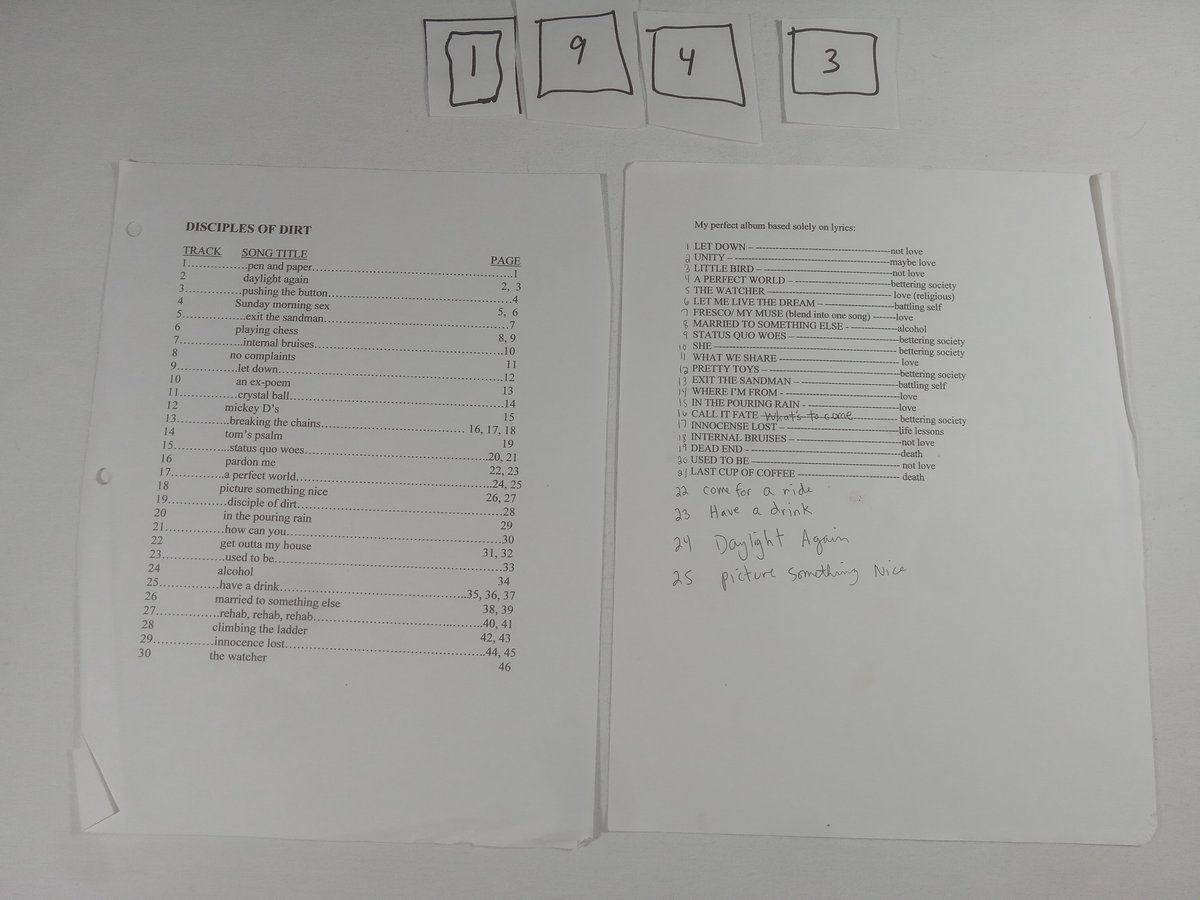
Picture 1 of 3
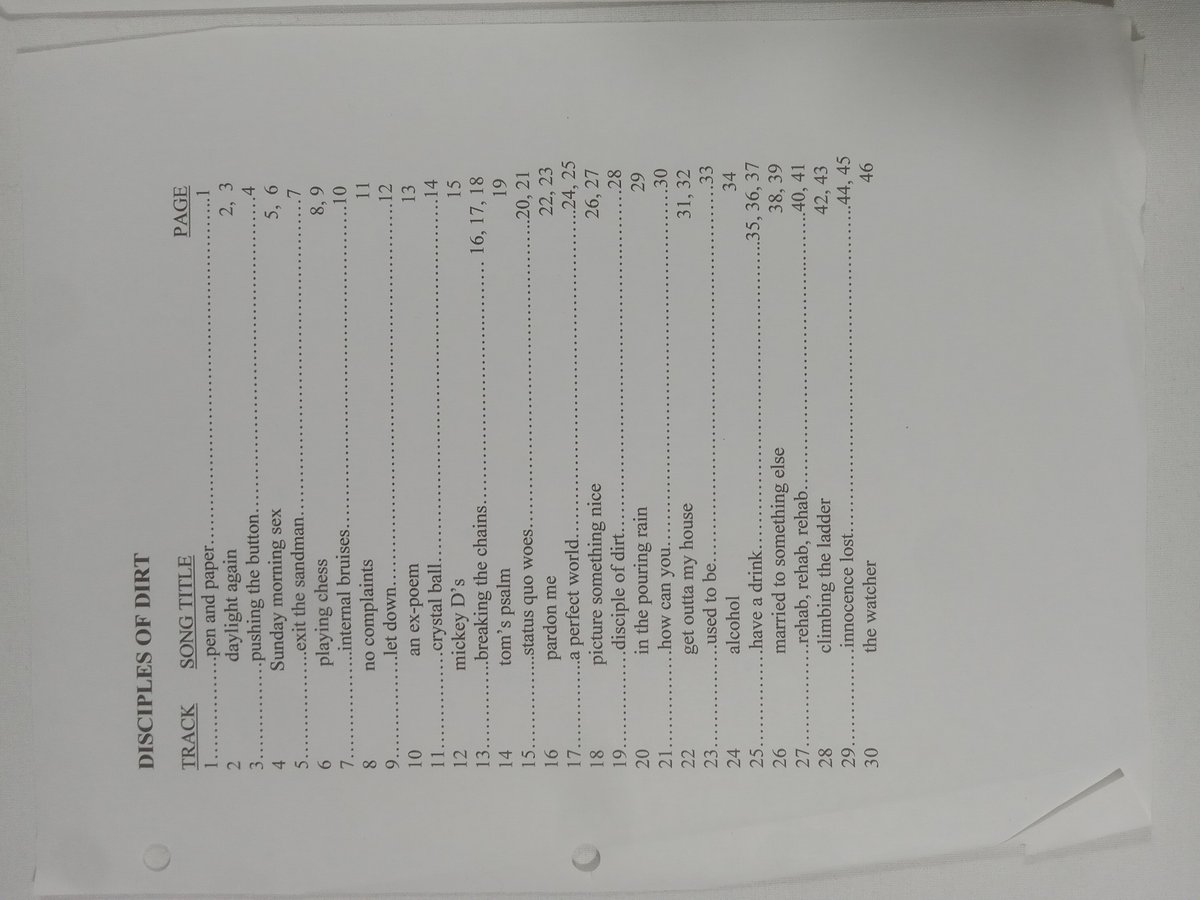
Picture 2 of 3
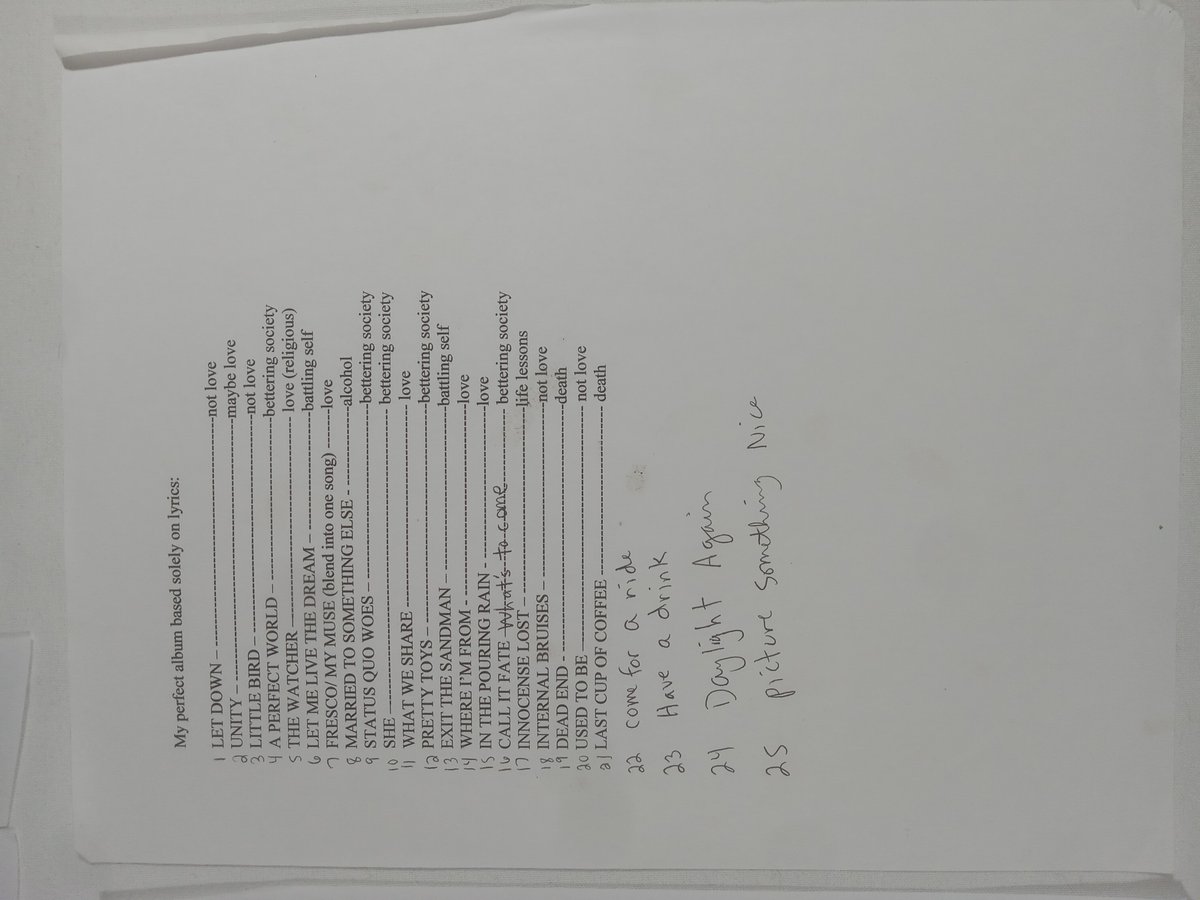
Picture 3 of 3
The words on this page
DISCIPLES OF DIRT
TRACK | SONG TITLE | PAGE
1 | ......................pen and paper. | .......................1
2 | ......................daylight again | ....................2, 3
3 | ......................pushing the button.. | .....................4
4 | ......................Sunday morning sex | ....................5, 6
5 | ......................exit the sandman.. | .....................7
6 | ......................playing chess | ....................8, 9
7 | ......................internal bruises.. | ....................10
8 | ......................no complaints | ....................11
9 | ......................let down.. | ....................12
10 | ......................an ex-poem | ....................13
11 | ......................crystal ball.. | ....................14
12 | ......................mickey D's | ....................15
13 | ......................breaking the chains.. | ................16, 17, 18
14 | ......................tom's psalm | ....................19
15 | ......................status quo woes.. | ................20, 21
16 | ......................pardon me | ................22, 23
17 | ......................a perfect world.. | ................24, 25
18 | ......................picture something nice | ................26, 27
19 | ......................disciple of dirt.. | ................28
20 | ......................in the pouring rain | ................29
21 | ......................how can you.. | ....................30
22 | ......................get outta my house | ................31, 32
23 | ......................used to be.. | ....................33
24 | ......................alcohol | ....................34
25 | ......................have a drink.. | ................35, 36, 37
26 | ......................married to something else | ................38, 39
27 | ......................rehab, rehab, rehab.. | ................40, 41
28 | ......................climbing the ladder | ................42, 43
29 | ......................innocence lost.. | ................44, 45
30 | ......................the watcher | ....................46
My perfect album based solely on lyrics:
1 LET DOWN ------------------------------------not love
2 UNITY -----------------------------------------maybe love
3 LITTLE BIRD ----------------------------------not love
4 A PERFECT WORLD --------------------------bettering society
5 THE WATCHER -------------------------------love (religious)
6 LET ME LIVE THE DREAM -------------------battling self
7 FRESCO/ MY MUSE (blend into one song) -----love
8 MARRIED TO SOMETHING ELSE -----------alcohol
9 STATUS QUO WOES --------------------------bettering society
10 SHE -------------------------------------------bettering society
11 WHAT WE SHARE ----------------------------love
12 PRETTY TOYS --------------------------------bettering society
13 EXIT THE SANDMAN -------------------------battling self
14 WHERE I'M FROM - --------------------------love
15 IN THE POURING RAIN - ---------------------love
16 CALL IT FATE -What's to come------------------bettering society
17 INNOCENSE LOST -----------------------------life lessons
18 INTERNAL BRUISES --------------------------not love
19 DEAD END -------------------------------------not love
20 USED TO BE ------------------------------------death
21 LAST CUP OF COFFEE ------------------------death
22 come for a ride
23 Have a drink
24 Daylight Again
25 picture Something Nice
---
DISCIPLES OF DIRT
TRACK SONG TITLE PAGE
1 .................pen and paper..................................................1
2 .................daylight again ................................................2, 3
3 .................pushing the button...........................................4
4 .................Sunday morning sex ........................................5, 6
5 .................exit the sandman.............................................7
6 .................playing chess .................................................8, 9
7 .................internal bruises...............................................10
8 .................no complaints .................................................11
9 .................let down..........................................................12
10 ...............an ex-poem .....................................................13
11 ...............crystal ball......................................................14
12 ...............mickey D's ......................................................15
13 ...............breaking the chains.........................................16, 17, 18
14 ...............tom's psalm ....................................................19
15 ...............status quo woes...............................................20, 21
16 ...............pardon me ......................................................22, 23
17 ...............a perfect world................................................24, 25
18 ...............disciple of dirt................................................26, 27
19 ...............in the pouring rain .........................................28
20 ...............how can you....................................................29
21 ...............get outta my house .........................................30
22 ...............used to be........................................................31, 32
23 ...............alcohol ............................................................33
24 ...............have a drink....................................................34
25 ...............married to something else ...............................35, 36, 37
26 ...............rehab, rehab, rehab.........................................38, 39
27 ...............climbing the ladder .........................................40, 41
28 ...............innocence lost.................................................42, 43
29 ...............the watcher .....................................................44, 45
30 .......................................................................................46
---
My perfect album based solely on lyrics:
1 LET DOWN --------------------------not love
2 UNITY --------------------------maybe love
3 LITTLE BIRD --------------------------not love
4 A PERFECT WORLD --------------------------bettering society
5 THE WATCHER --------------------------love (religious)
6 LET ME LIVE THE DREAM --------------------------battling self
7 FRESCO/ MY MUSE (blend into one song) -----love
8 MARRIED TO SOMETHING ELSE ------------------alcohol
9 STATUS QUO WOES --------------------------bettering society
10 SHE --------------------------bettering society
11 WHAT WE SHARE --------------------------love
12 PRETTY TOYS --------------------------bettering society
13 EXIT THE SANDMAN --------------------------battling self
14 WHERE I'M FROM --------------------------love
15 IN THE POURING RAIN --------------------------love
16 CALL IT FATE What's-to-come---------- bettering society
17 INNOCENSE LOST --------------------------life lessons
18 INTERNAL BRUISES --------------------------not love
19 DEAD END --------------------------death
20 USED TO BE --------------------------not love
21 LAST CUP OF COFFEE --------------------------death
22 come for a ride
23 Have a drink
24 Daylight Again
25 picture something Nice
Item 1944
DISCIPLES OF DIRT
Printed white paper sheets and cards with a small attached piece of torn lined notebook paper.
- Why it matters
- Tom writes this
- Type
- Printed page
- Collection
- Tom writes this
- Published in
- PREVIOUSLY UNPUBLISHEDSearched against the 34 albums, every book and Poems By Tom - found in none of them
- Copies
- 2 in the catalogue · also written out as number 1943matched on the words by machine - Tom confirms
Price · Tier · Tom fills these
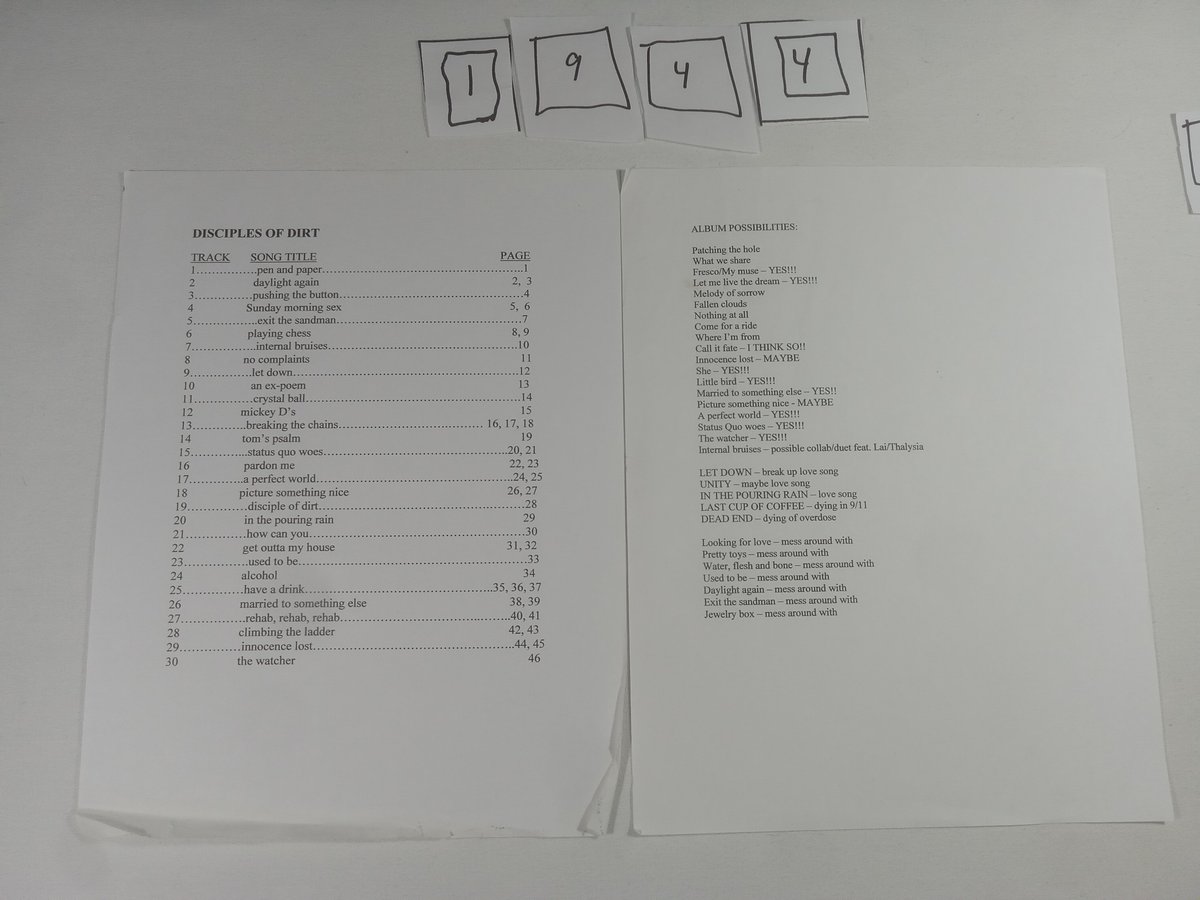
Picture 1 of 10
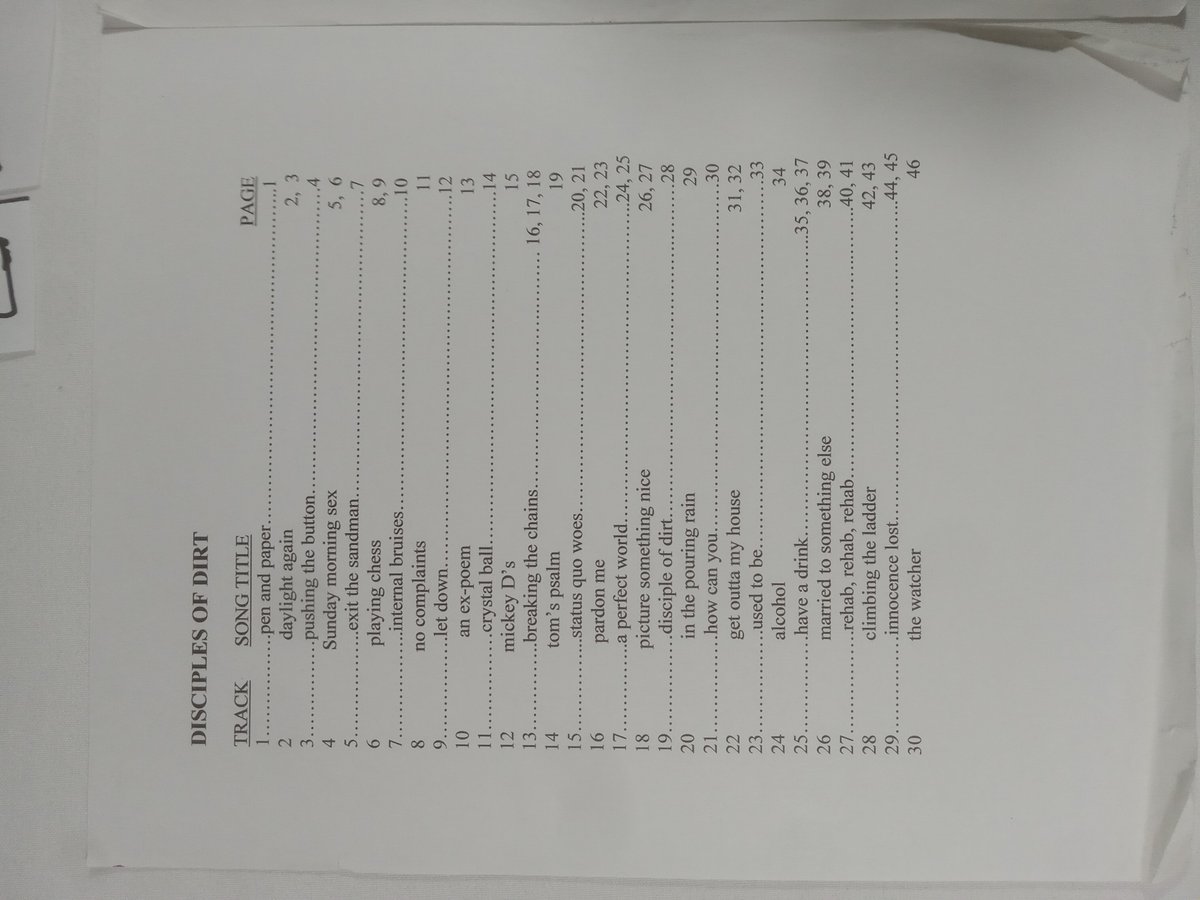
Picture 2 of 10
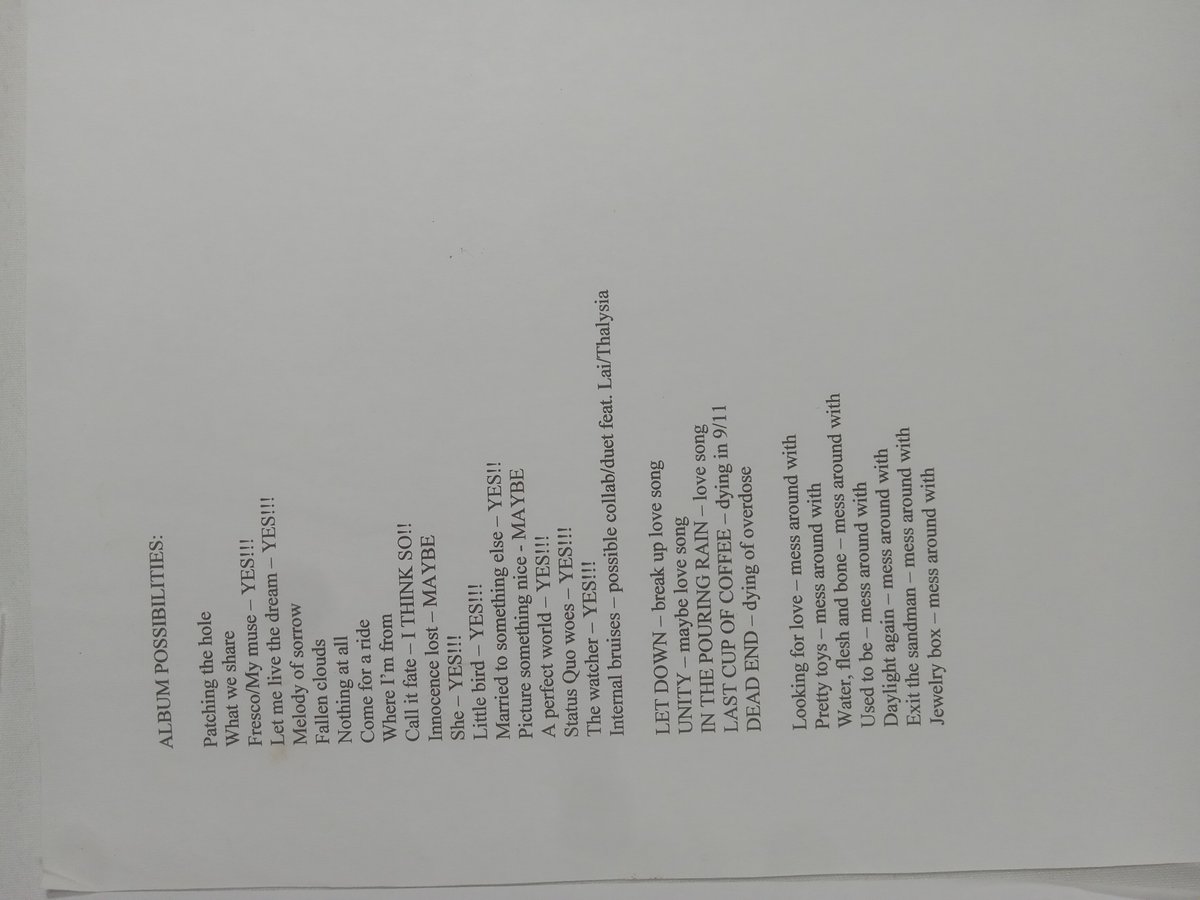
Picture 3 of 10
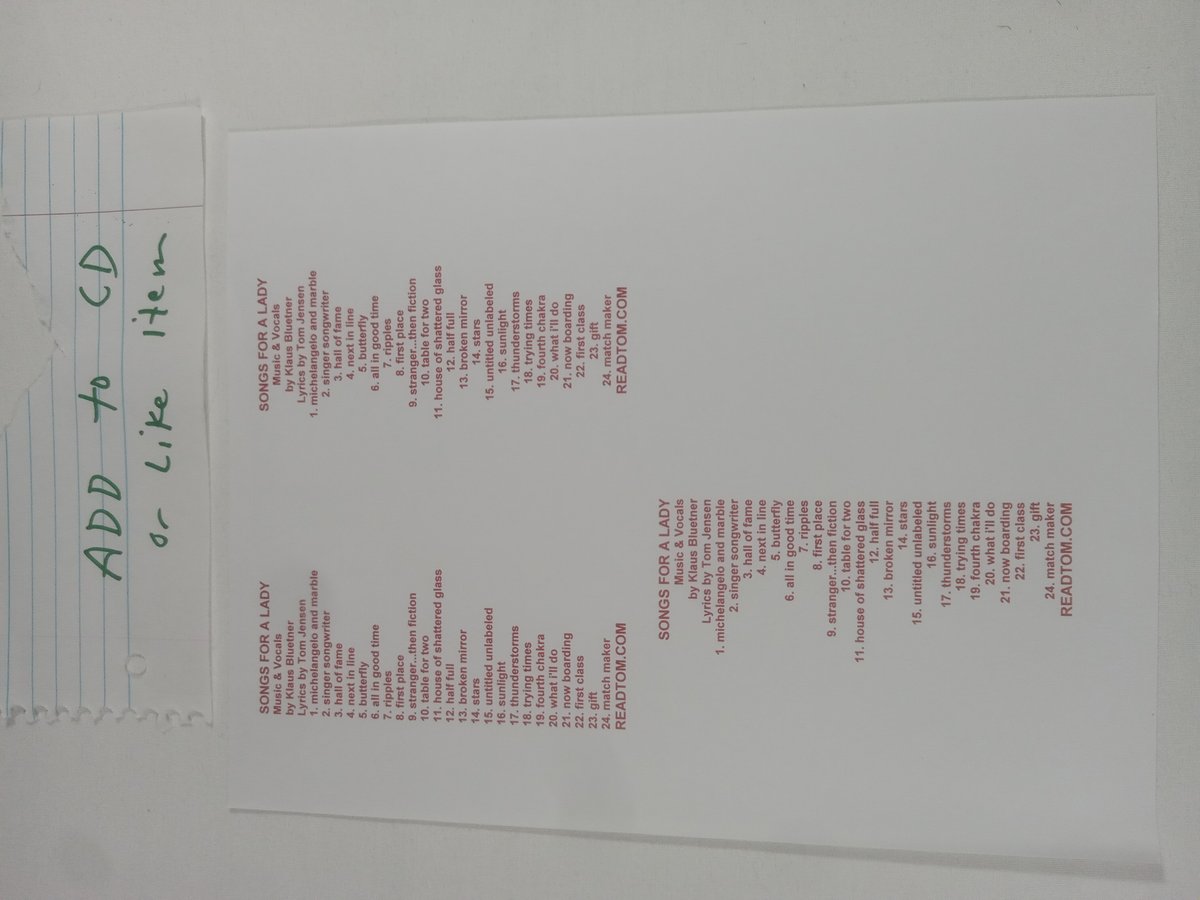
Picture 4 of 10
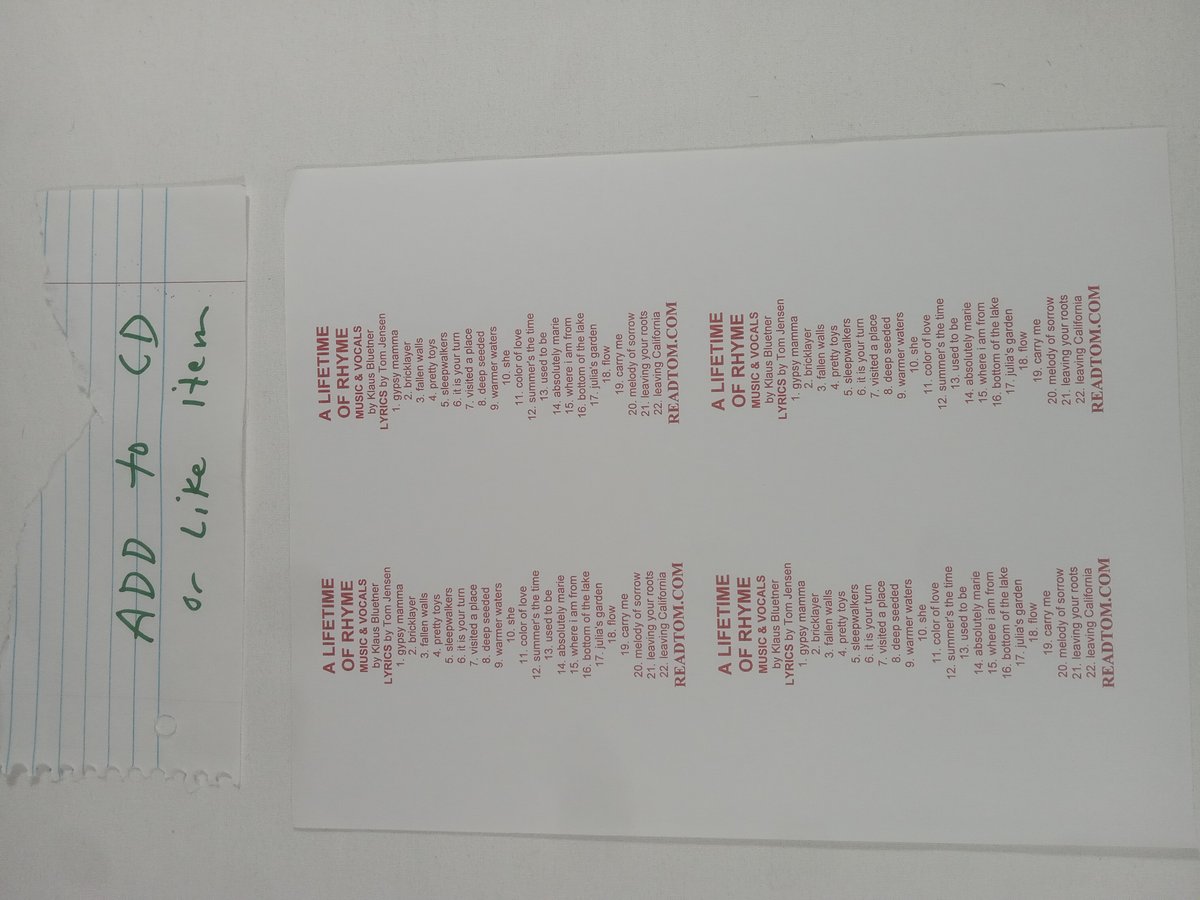
Picture 5 of 10
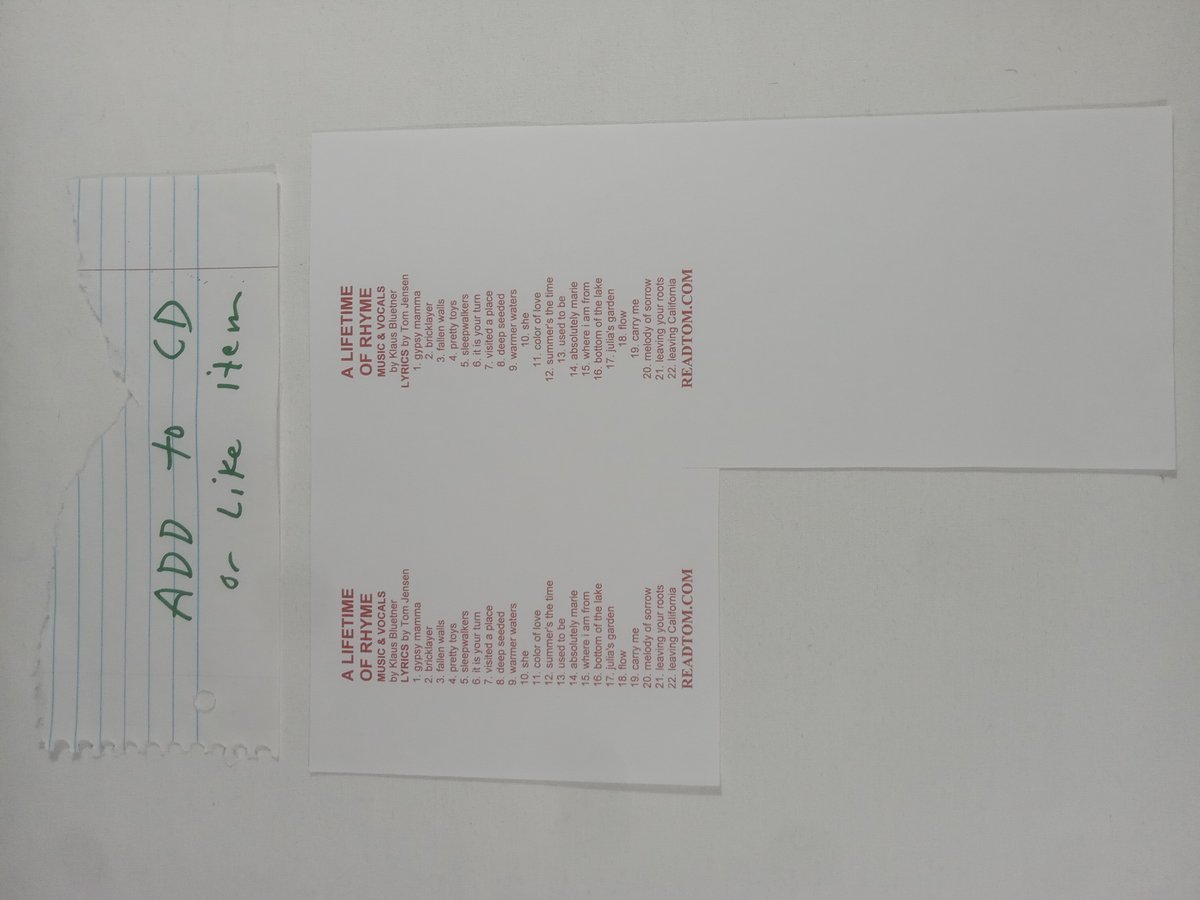
Picture 6 of 10
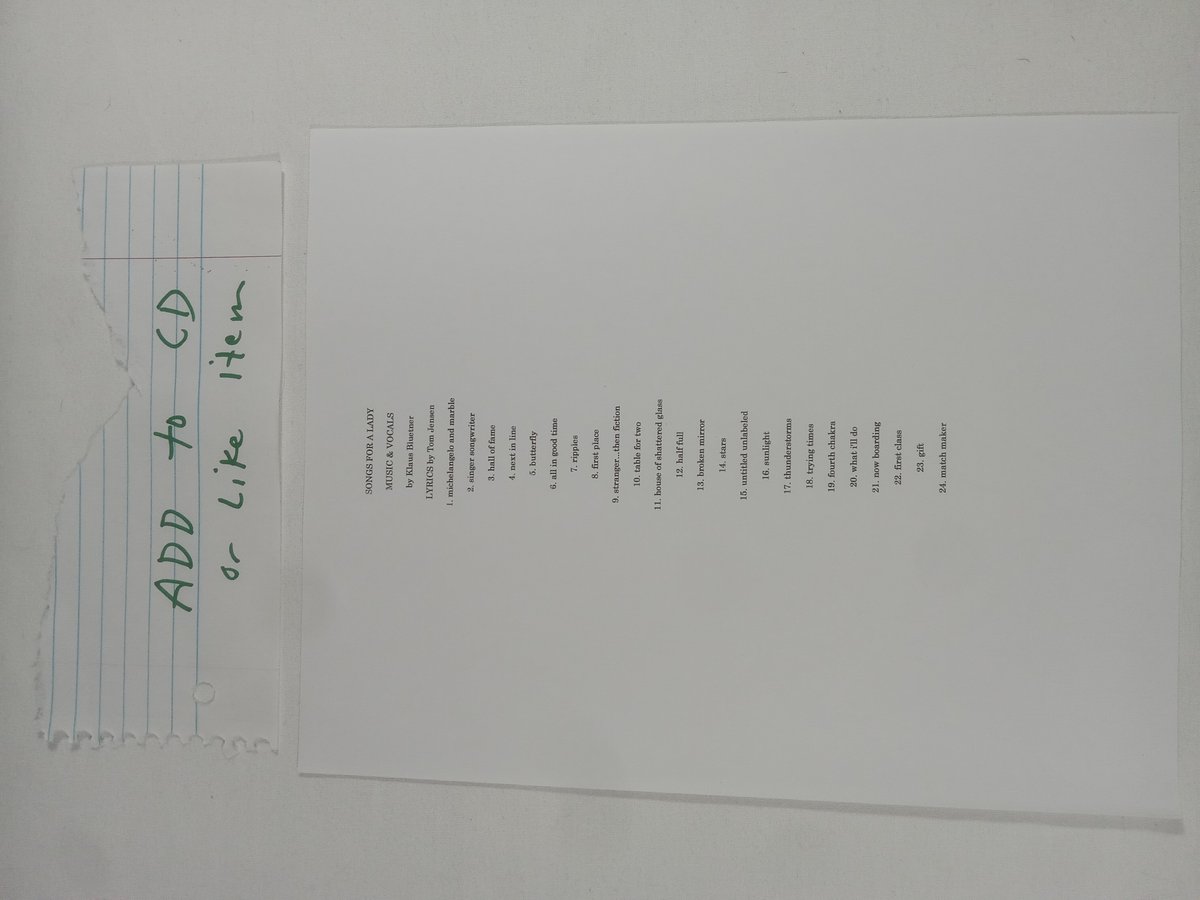
Picture 7 of 10
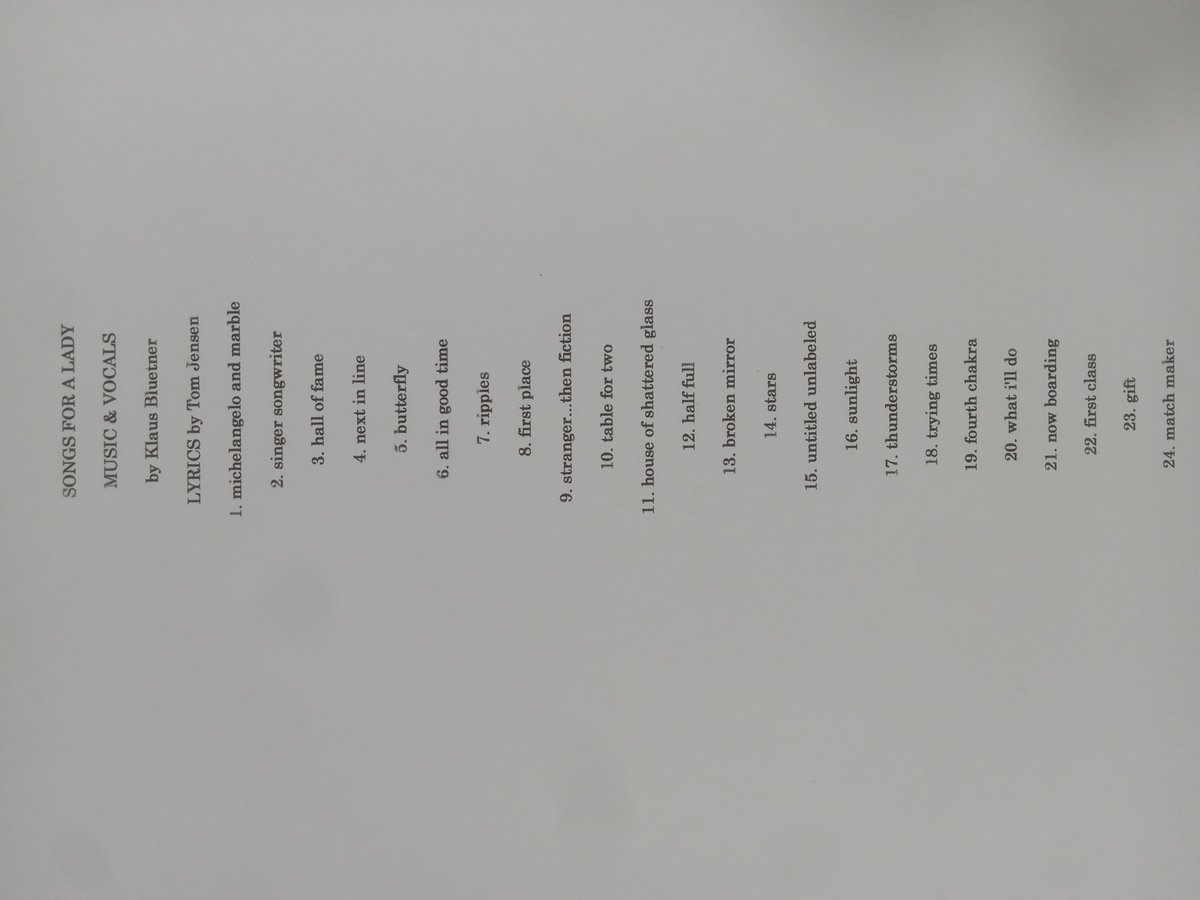
Picture 8 of 10
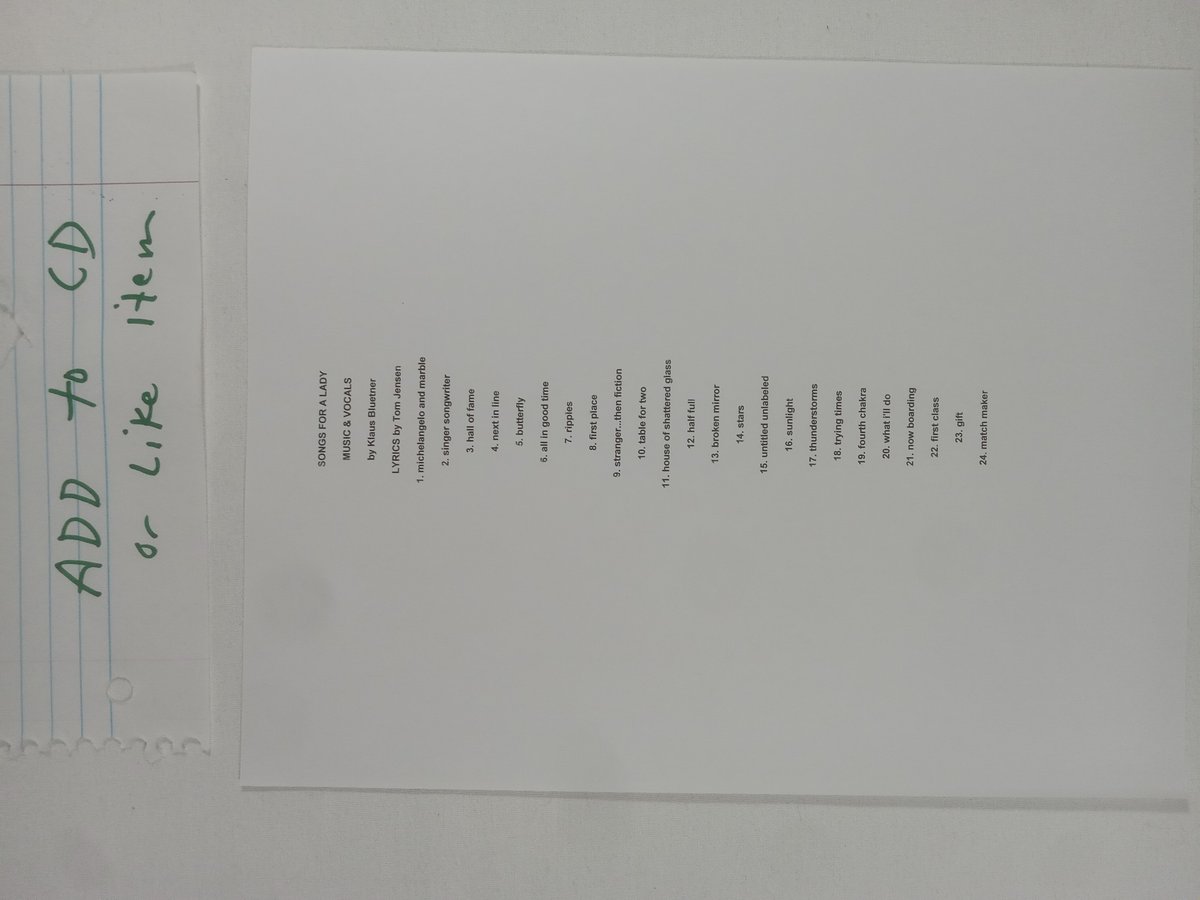
Picture 9 of 10
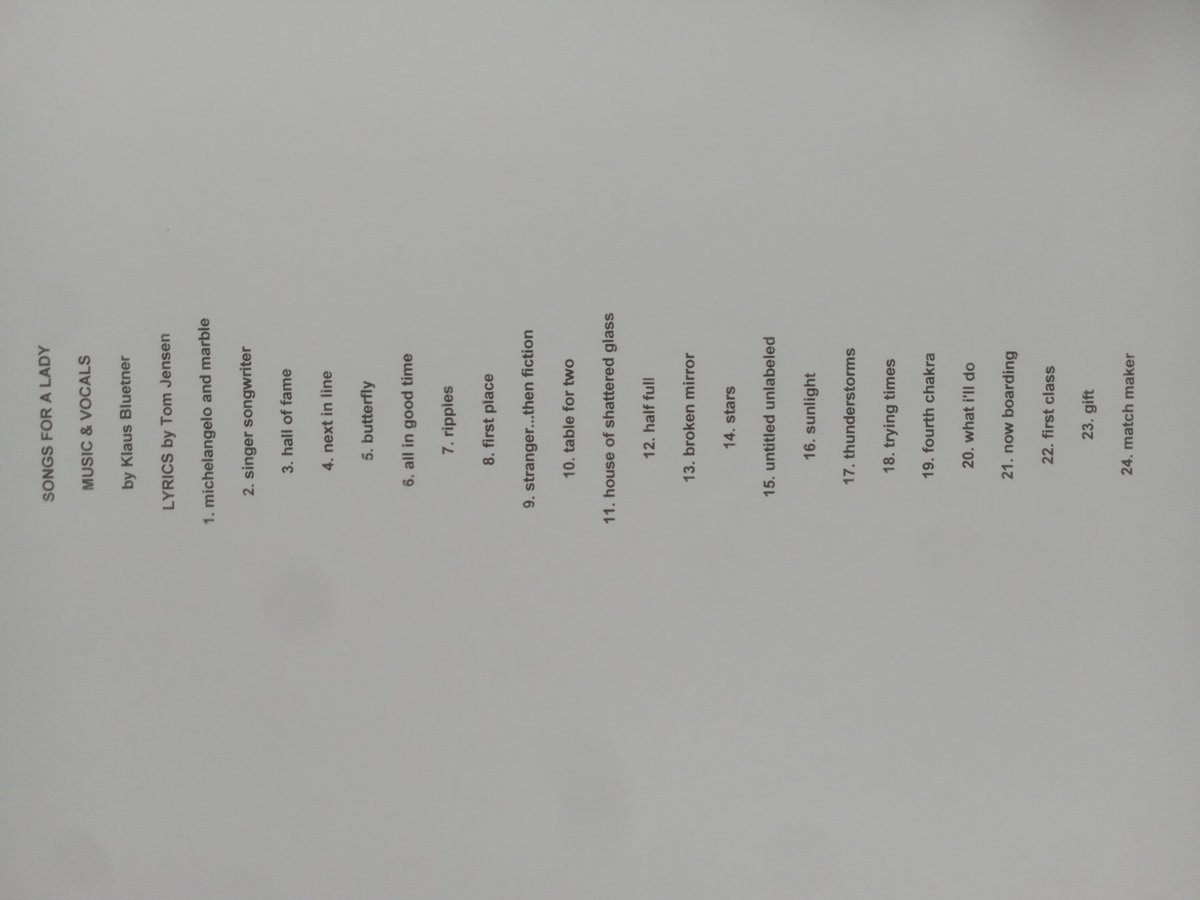
Picture 10 of 10
The words on this page
[1] [9] [4] [4]
DISCIPLES OF DIRT
TRACK SONG TITLE PAGE
1................pen and paper........................................1
2................daylight again......................................2, 3
3................pushing the button...................................4
4................Sunday morning sex.................................5, 6
5................exit the sandman......................................7
6................playing chess........................................8, 9
7................internal bruises....................................10
8................no complaints........................................11
9................let down............................................12
10...............an ex-poem...........................................13
11...............crystal ball........................................14
12...............mickey D's...........................................15
13...............breaking the chains...............................16, 17, 18
14...............tom's psalm..........................................19
15...............status quo woes...................................20, 21
16...............pardon me........................................22, 23
17...............a perfect world....................................24, 25
18...............picture something nice.............................26, 27
19...............disciple of dirt.....................................28
20...............in the pouring rain..................................29
21...............how can you..........................................30
22...............get outta my house.................................31, 32
23...............used to be...........................................33
24...............alcohol..............................................34
25...............have a drink...................................35, 36, 37
26...............married to something else..........................38, 39
27...............rehab, rehab, rehab..............................40, 41
28...............climbing the ladder................................42, 43
29...............innocence lost.....................................44, 45
30...............the watcher..........................................46
ALBUM POSSIBILITIES:
Patching the hole
What we share
Fresco/My muse - YES!!!
Let me live the dream - YES!!!
Melody of sorrow
Fallen clouds
Nothing at all
Come for a ride
Where I'm from
Call it fate - I THINK SO!!
Innocence lost - MAYBE
She - YES!!!
Little bird - YES!!!
Married to something else - YES!!
Picture something nice - MAYBE
A perfect world - YES!!!
Status Quo woes - YES!!!
The watcher - YES!!!
Internal bruises - possible collab/duet feat. Lai/Thalysia
LET DOWN - break up love song
UNITY - maybe love song
IN THE POURING RAIN - love song
LAST CUP OF COFFEE - dying in 9/11
DEAD END - dying of overdose
Looking for love - mess around with
Pretty toys - mess around with
Water, flesh and bone - mess around with
Used to be - mess around with
Daylight again - mess around with
Exit the sandman - mess around with
Jewelry box - mess around with
---
DISCIPLES OF DIRT
TRACK SONG TITLE PAGE
1 ....................pen and paper................................................. 1
2 ....................daylight again ............................................... 2, 3
3 ....................pushing the button........................................... 4
4 ....................Sunday morning sex ........................................ 5, 6
5 ....................exit the sandman............................................... 7
6 ....................playing chess ................................................ 8, 9
7 ....................internal bruises..................................................10
8 ....................no complaints .................................................. 11
9 ....................let down............................................................12
10 .................an ex-poem .......................................................13
11 .................crystal ball.........................................................14
12 .................mickey D's ........................................................ 15
13 .................breaking the chains...................................... 16, 17, 18
14 .................tom's psalm ........................................................ 19
15 .................status quo woes............................................... 20, 21
16 .................pardon me ....................................................... 22, 23
17 .................a perfect world................................................. 24, 25
18 .................picture something nice ...................................... 26, 27
19 .................disciple of dirt.................................................... 28
20 .................in the pouring rain .............................................. 29
21 .................how can you........................................................ 30
22 .................get outta my house ......................................... 31, 32
23 .................used to be.......................................................... 33
24 .................alcohol ............................................................... 34
25 .................have a drink................................................. 35, 36, 37
26 .................married to something else ................................ 38, 39
27 .................rehab, rehab, rehab............................................ 40, 41
28 .................climbing the ladder .......................................... 42, 43
29 .................innocence lost................................................. 44, 45
30 .................the watcher .......................................................... 46
---
ALBUM POSSIBILITIES:
Patching the hole
What we share
Fresco/My muse - YES!!!
Let me live the dream - YES!!!
Melody of sorrow
Fallen clouds
Nothing at all
Come for a ride
Where I'm from
Call it fate - I THINK SO!!
Innocence lost - MAYBE
She - YES!!!
Little bird - YES!!!
Married to something else - YES!!
Picture something nice - MAYBE
A perfect world - YES!!!
Status Quo woes - YES!!!
The watcher - YES!!!
Internal bruises - possible collab/duet feat. Lai/Thalysia
LET DOWN - break up love song
UNITY - maybe love song
IN THE POURING RAIN - love song
LAST CUP OF COFFEE - dying in 9/11
DEAD END - dying of overdose
Looking for love - mess around with
Pretty toys - mess around with
Water, flesh and bone - mess around with
Used to be - mess around with
Daylight again - mess around with
Exit the sandman - mess around with
Jewelry box - mess around with
---
ADD to CD
or Like item
SONGS FOR A LADY
Music & Vocals
by Klaus Bluetner
Lyrics by Tom Jensen
1. michelangelo and marble
2. singer songwriter
3. hall of fame
4. next in line
5. butterfly
6. all in good time
7. ripples
8. first place
9. stranger...then fiction
10. table for two
11. house of shattered glass
12. half full
13. broken mirror
14. stars
15. untitled unlabeled
16. sunlight
17. thunderstorms
18. trying times
19. fourth chakra
20. what i'll do
21. now boarding
22. first class
23. gift
24. match maker
READTOM.COM
---
[Handwritten text on lined paper:]
ADD to CD
or Like item
[Text in printed columns:]
A LIFETIME
OF RHYME
MUSIC & VOCALS
by Klaus Bluetner
LYRICS by Tom Jensen
1. gypsy mamma
2. bricklayer
3. fallen walls
4. pretty toys
5. sleepwalkers
6. it is your turn
7. visited a place
8. deep seeded
9. warmer waters
10. she
11. color of love
12. summer's the time
13. used to be
14. absolutely marie
15. where i am from
16. bottom of the lake
17. julia's garden
18. flow
19. carry me
20. melody of sorrow
21. leaving your roots
22. leaving California
READTOM.COM
---
ADD to CD
or Like item.
A LIFETIME
OF RHYME
MUSIC & VOCALS
by Klaus Bluetner
LYRICS by Tom Jensen
1. gypsy mamma
2. bricklayer
3. fallen walls
4. pretty toys
5. sleepwalkers
6. it is your turn
7. visited a place
8. deep seeded
9. warmer waters
10. she
11. color of love
12. summer's the time
13. used to be
14. absolutely marie
15. where i am from
16. bottom of the lake
17. julia's garden
18. flow
19. carry me
20. melody of sorrow
21. leaving your roots
22. leaving California
READTOM.COM
---
[Handwritten on the torn lined paper]:
ADD to CD
or Like item.
[Printed text on the main page]:
SONGS FOR A LADY
MUSIC & VOCALS
by Klaus Bluetner
LYRICS by Tom Jensen
1. michelangelo and marble
2. singer songwriter
3. hall of fame
4. next in line
5. butterfly
6. all in good time
7. ripples
8. first place
9. stranger...then fiction
10. table for two
11. house of shattered glass
12. half full
13. broken mirror
14. stars
15. untitled unlabeled
16. sunlight
17. thunderstorms
18. trying times
19. fourth chakra
20. what i'll do
21. now boarding
22. first class
23. gift
24. match maker
---
ADD to CD
or Like item
SONGS FOR A LADY
MUSIC & VOCALS
by Klaus Bluetner
LYRICS by Tom Jensen
1. michelangelo and marble
2. singer songwriter
3. hall of fame
4. next in line
5. butterfly
6. all in good time
7. ripples
8. first place
9. stranger...then fiction
10. table for two
11. house of shattered glass
12. half full
13. broken mirror
14. stars
15. untitled unlabeled
16. sunlight
17. thunderstorms
18. trying times
19. fourth chakra
20. what i'll do
21. now boarding
22. first class
23. gift
24. match maker
---
SONGS FOR A LADY
MUSIC & VOCALS
by Klaus Bluetner
LYRICS by Tom Jensen
1. michelangelo and marble
2. singer songwriter
3. hall of fame
4. next in line
5. butterfly
6. all in good time
7. ripples
8. first place
9. stranger...then fiction
10. table for two
11. house of shattered glass
12. half full
13. broken mirror
14. stars
15. untitled unlabeled
16. sunlight
17. thunderstorms
18. trying times
19. fourth chakra
20. what i'll do
21. now boarding
22. first class
23. gift
24. match maker
DISCIPLES OF DIRT
TRACK SONG TITLE PAGE
1................pen and paper........................................1
2................daylight again......................................2, 3
3................pushing the button...................................4
4................Sunday morning sex.................................5, 6
5................exit the sandman......................................7
6................playing chess........................................8, 9
7................internal bruises....................................10
8................no complaints........................................11
9................let down............................................12
10...............an ex-poem...........................................13
11...............crystal ball........................................14
12...............mickey D's...........................................15
13...............breaking the chains...............................16, 17, 18
14...............tom's psalm..........................................19
15...............status quo woes...................................20, 21
16...............pardon me........................................22, 23
17...............a perfect world....................................24, 25
18...............picture something nice.............................26, 27
19...............disciple of dirt.....................................28
20...............in the pouring rain..................................29
21...............how can you..........................................30
22...............get outta my house.................................31, 32
23...............used to be...........................................33
24...............alcohol..............................................34
25...............have a drink...................................35, 36, 37
26...............married to something else..........................38, 39
27...............rehab, rehab, rehab..............................40, 41
28...............climbing the ladder................................42, 43
29...............innocence lost.....................................44, 45
30...............the watcher..........................................46
ALBUM POSSIBILITIES:
Patching the hole
What we share
Fresco/My muse - YES!!!
Let me live the dream - YES!!!
Melody of sorrow
Fallen clouds
Nothing at all
Come for a ride
Where I'm from
Call it fate - I THINK SO!!
Innocence lost - MAYBE
She - YES!!!
Little bird - YES!!!
Married to something else - YES!!
Picture something nice - MAYBE
A perfect world - YES!!!
Status Quo woes - YES!!!
The watcher - YES!!!
Internal bruises - possible collab/duet feat. Lai/Thalysia
LET DOWN - break up love song
UNITY - maybe love song
IN THE POURING RAIN - love song
LAST CUP OF COFFEE - dying in 9/11
DEAD END - dying of overdose
Looking for love - mess around with
Pretty toys - mess around with
Water, flesh and bone - mess around with
Used to be - mess around with
Daylight again - mess around with
Exit the sandman - mess around with
Jewelry box - mess around with
---
DISCIPLES OF DIRT
TRACK SONG TITLE PAGE
1 ....................pen and paper................................................. 1
2 ....................daylight again ............................................... 2, 3
3 ....................pushing the button........................................... 4
4 ....................Sunday morning sex ........................................ 5, 6
5 ....................exit the sandman............................................... 7
6 ....................playing chess ................................................ 8, 9
7 ....................internal bruises..................................................10
8 ....................no complaints .................................................. 11
9 ....................let down............................................................12
10 .................an ex-poem .......................................................13
11 .................crystal ball.........................................................14
12 .................mickey D's ........................................................ 15
13 .................breaking the chains...................................... 16, 17, 18
14 .................tom's psalm ........................................................ 19
15 .................status quo woes............................................... 20, 21
16 .................pardon me ....................................................... 22, 23
17 .................a perfect world................................................. 24, 25
18 .................picture something nice ...................................... 26, 27
19 .................disciple of dirt.................................................... 28
20 .................in the pouring rain .............................................. 29
21 .................how can you........................................................ 30
22 .................get outta my house ......................................... 31, 32
23 .................used to be.......................................................... 33
24 .................alcohol ............................................................... 34
25 .................have a drink................................................. 35, 36, 37
26 .................married to something else ................................ 38, 39
27 .................rehab, rehab, rehab............................................ 40, 41
28 .................climbing the ladder .......................................... 42, 43
29 .................innocence lost................................................. 44, 45
30 .................the watcher .......................................................... 46
---
ALBUM POSSIBILITIES:
Patching the hole
What we share
Fresco/My muse - YES!!!
Let me live the dream - YES!!!
Melody of sorrow
Fallen clouds
Nothing at all
Come for a ride
Where I'm from
Call it fate - I THINK SO!!
Innocence lost - MAYBE
She - YES!!!
Little bird - YES!!!
Married to something else - YES!!
Picture something nice - MAYBE
A perfect world - YES!!!
Status Quo woes - YES!!!
The watcher - YES!!!
Internal bruises - possible collab/duet feat. Lai/Thalysia
LET DOWN - break up love song
UNITY - maybe love song
IN THE POURING RAIN - love song
LAST CUP OF COFFEE - dying in 9/11
DEAD END - dying of overdose
Looking for love - mess around with
Pretty toys - mess around with
Water, flesh and bone - mess around with
Used to be - mess around with
Daylight again - mess around with
Exit the sandman - mess around with
Jewelry box - mess around with
---
ADD to CD
or Like item
SONGS FOR A LADY
Music & Vocals
by Klaus Bluetner
Lyrics by Tom Jensen
1. michelangelo and marble
2. singer songwriter
3. hall of fame
4. next in line
5. butterfly
6. all in good time
7. ripples
8. first place
9. stranger...then fiction
10. table for two
11. house of shattered glass
12. half full
13. broken mirror
14. stars
15. untitled unlabeled
16. sunlight
17. thunderstorms
18. trying times
19. fourth chakra
20. what i'll do
21. now boarding
22. first class
23. gift
24. match maker
READTOM.COM
SONGS FOR A LADY
Music & Vocals
by Klaus Bluetner
Lyrics by Tom Jensen
1. michelangelo and marble
2. singer songwriter
3. hall of fame
4. next in line
5. butterfly
6. all in good time
7. ripples
8. first place
9. stranger...then fiction
10. table for two
11. house of shattered glass
12. half full
13. broken mirror
14. stars
15. untitled unlabeled
16. sunlight
17. thunderstorms
18. trying times
19. fourth chakra
20. what i'll do
21. now boarding
22. first class
23. gift
24. match maker
READTOM.COM
SONGS FOR A LADY
Music & Vocals
by Klaus Bluetner
Lyrics by Tom Jensen
1. michelangelo and marble
2. singer songwriter
3. hall of fame
4. next in line
5. butterfly
6. all in good time
7. ripples
8. first place
9. stranger...then fiction
10. table for two
11. house of shattered glass
12. half full
13. broken mirror
14. stars
15. untitled unlabeled
16. sunlight
17. thunderstorms
18. trying times
19. fourth chakra
20. what i'll do
21. now boarding
22. first class
23. gift
24. match maker
READTOM.COM
---
[Handwritten text on lined paper:]
ADD to CD
or Like item
[Text in printed columns:]
A LIFETIME
OF RHYME
MUSIC & VOCALS
by Klaus Bluetner
LYRICS by Tom Jensen
1. gypsy mamma
2. bricklayer
3. fallen walls
4. pretty toys
5. sleepwalkers
6. it is your turn
7. visited a place
8. deep seeded
9. warmer waters
10. she
11. color of love
12. summer's the time
13. used to be
14. absolutely marie
15. where i am from
16. bottom of the lake
17. julia's garden
18. flow
19. carry me
20. melody of sorrow
21. leaving your roots
22. leaving California
READTOM.COM
A LIFETIME
OF RHYME
MUSIC & VOCALS
by Klaus Bluetner
LYRICS by Tom Jensen
1. gypsy mamma
2. bricklayer
3. fallen walls
4. pretty toys
5. sleepwalkers
6. it is your turn
7. visited a place
8. deep seeded
9. warmer waters
10. she
11. color of love
12. summer's the time
13. used to be
14. absolutely marie
15. where i am from
16. bottom of the lake
17. julia's garden
18. flow
19. carry me
20. melody of sorrow
21. leaving your roots
22. leaving California
READTOM.COM
A LIFETIME
OF RHYME
MUSIC & VOCALS
by Klaus Bluetner
LYRICS by Tom Jensen
1. gypsy mamma
2. bricklayer
3. fallen walls
4. pretty toys
5. sleepwalkers
6. it is your turn
7. visited a place
8. deep seeded
9. warmer waters
10. she
11. color of love
12. summer's the time
13. used to be
14. absolutely marie
15. where i am from
16. bottom of the lake
17. julia's garden
18. flow
19. carry me
20. melody of sorrow
21. leaving your roots
22. leaving California
READTOM.COM
A LIFETIME
OF RHYME
MUSIC & VOCALS
by Klaus Bluetner
LYRICS by Tom Jensen
1. gypsy mamma
2. bricklayer
3. fallen walls
4. pretty toys
5. sleepwalkers
6. it is your turn
7. visited a place
8. deep seeded
9. warmer waters
10. she
11. color of love
12. summer's the time
13. used to be
14. absolutely marie
15. where i am from
16. bottom of the lake
17. julia's garden
18. flow
19. carry me
20. melody of sorrow
21. leaving your roots
22. leaving California
READTOM.COM
---
ADD to CD
or Like item.
A LIFETIME
OF RHYME
MUSIC & VOCALS
by Klaus Bluetner
LYRICS by Tom Jensen
1. gypsy mamma
2. bricklayer
3. fallen walls
4. pretty toys
5. sleepwalkers
6. it is your turn
7. visited a place
8. deep seeded
9. warmer waters
10. she
11. color of love
12. summer's the time
13. used to be
14. absolutely marie
15. where i am from
16. bottom of the lake
17. julia's garden
18. flow
19. carry me
20. melody of sorrow
21. leaving your roots
22. leaving California
READTOM.COM
A LIFETIME
OF RHYME
MUSIC & VOCALS
by Klaus Bluetner
LYRICS by Tom Jensen
1. gypsy mamma
2. bricklayer
3. fallen walls
4. pretty toys
5. sleepwalkers
6. it is your turn
7. visited a place
8. deep seeded
9. warmer waters
10. she
11. color of love
12. summer's the time
13. used to be
14. absolutely marie
15. where i am from
16. bottom of the lake
17. julia's garden
18. flow
19. carry me
20. melody of sorrow
21. leaving your roots
22. leaving California
READTOM.COM
---
[Handwritten on the torn lined paper]:
ADD to CD
or Like item.
[Printed text on the main page]:
SONGS FOR A LADY
MUSIC & VOCALS
by Klaus Bluetner
LYRICS by Tom Jensen
1. michelangelo and marble
2. singer songwriter
3. hall of fame
4. next in line
5. butterfly
6. all in good time
7. ripples
8. first place
9. stranger...then fiction
10. table for two
11. house of shattered glass
12. half full
13. broken mirror
14. stars
15. untitled unlabeled
16. sunlight
17. thunderstorms
18. trying times
19. fourth chakra
20. what i'll do
21. now boarding
22. first class
23. gift
24. match maker
---
SONGS FOR A LADY
MUSIC & VOCALS
by Klaus Bluetner
LYRICS by Tom Jensen
1. michelangelo and marble
2. singer songwriter
3. hall of fame
4. next in line
5. butterfly
6. all in good time
7. ripples
8. first place
9. stranger...then fiction
10. table for two
11. house of shattered glass
12. half full
13. broken mirror
14. stars
15. untitled unlabeled
16. sunlight
17. thunderstorms
18. trying times
19. fourth chakra
20. what i'll do
21. now boarding
22. first class
23. gift
24. match maker
---
ADD to CD
or Like item
SONGS FOR A LADY
MUSIC & VOCALS
by Klaus Bluetner
LYRICS by Tom Jensen
1. michelangelo and marble
2. singer songwriter
3. hall of fame
4. next in line
5. butterfly
6. all in good time
7. ripples
8. first place
9. stranger...then fiction
10. table for two
11. house of shattered glass
12. half full
13. broken mirror
14. stars
15. untitled unlabeled
16. sunlight
17. thunderstorms
18. trying times
19. fourth chakra
20. what i'll do
21. now boarding
22. first class
23. gift
24. match maker
---
SONGS FOR A LADY
MUSIC & VOCALS
by Klaus Bluetner
LYRICS by Tom Jensen
1. michelangelo and marble
2. singer songwriter
3. hall of fame
4. next in line
5. butterfly
6. all in good time
7. ripples
8. first place
9. stranger...then fiction
10. table for two
11. house of shattered glass
12. half full
13. broken mirror
14. stars
15. untitled unlabeled
16. sunlight
17. thunderstorms
18. trying times
19. fourth chakra
20. what i'll do
21. now boarding
22. first class
23. gift
24. match maker
Item 1945
Assorted musicians CD
White sheets of paper with printed text and handwritten notations, alongside lined notebook paper.
- Why it matters
- Tom writes this
- Type
- Printed page
- Collection
- Tom writes this
- Published in
- PREVIOUSLY UNPUBLISHEDSearched against the 34 albums, every book and Poems By Tom - found in none of them
- Copies
- 2 in the catalogue · also written out as number 10matched on the words by machine - Tom confirms
Price · Tier · Tom fills these
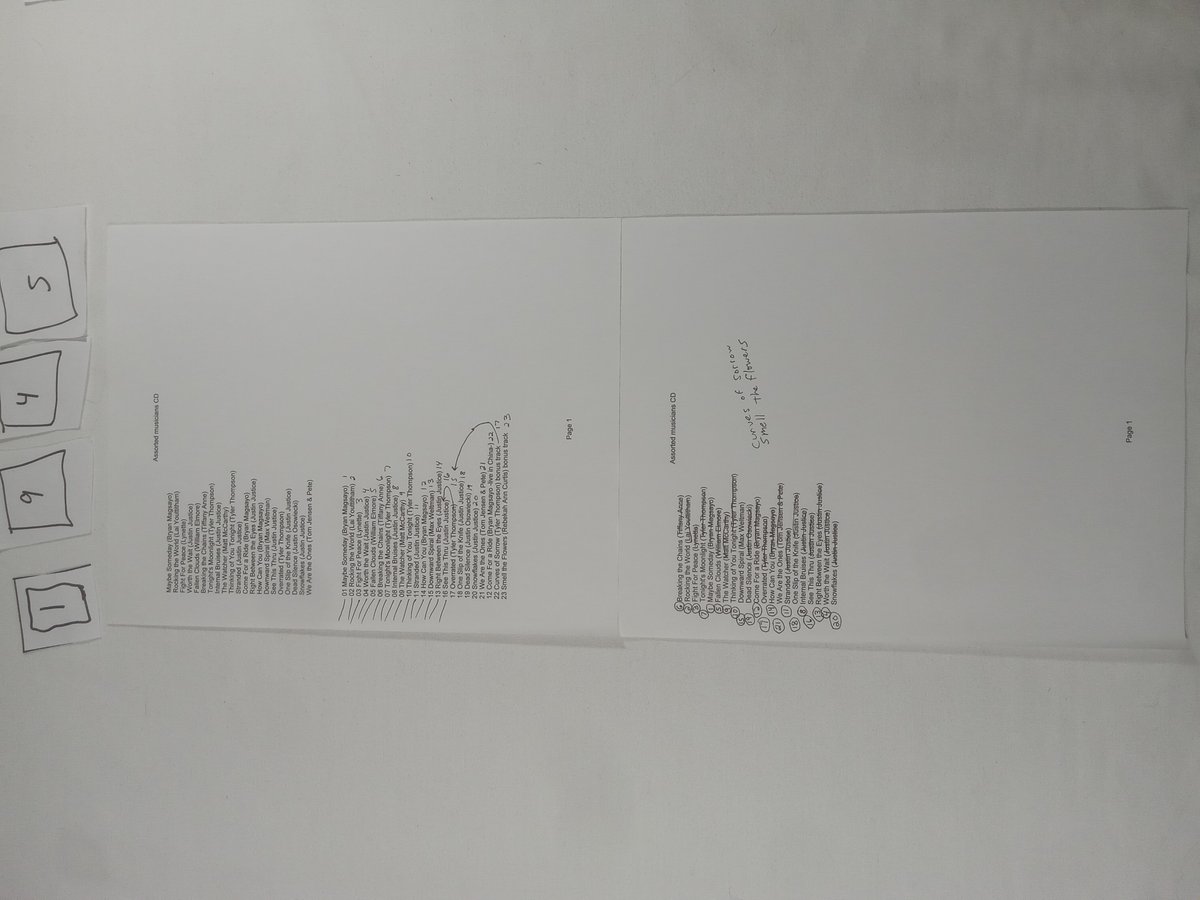
Picture 1 of 5
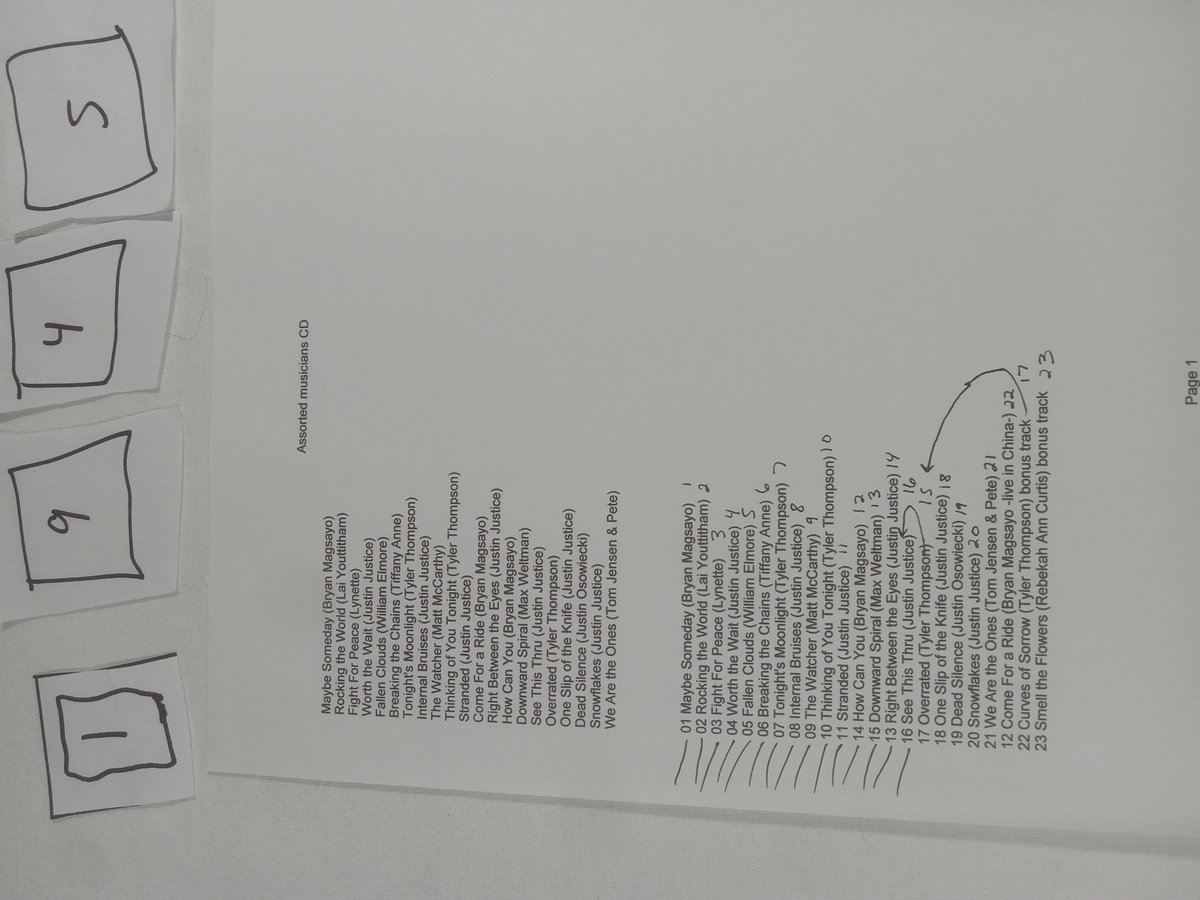
Picture 2 of 5
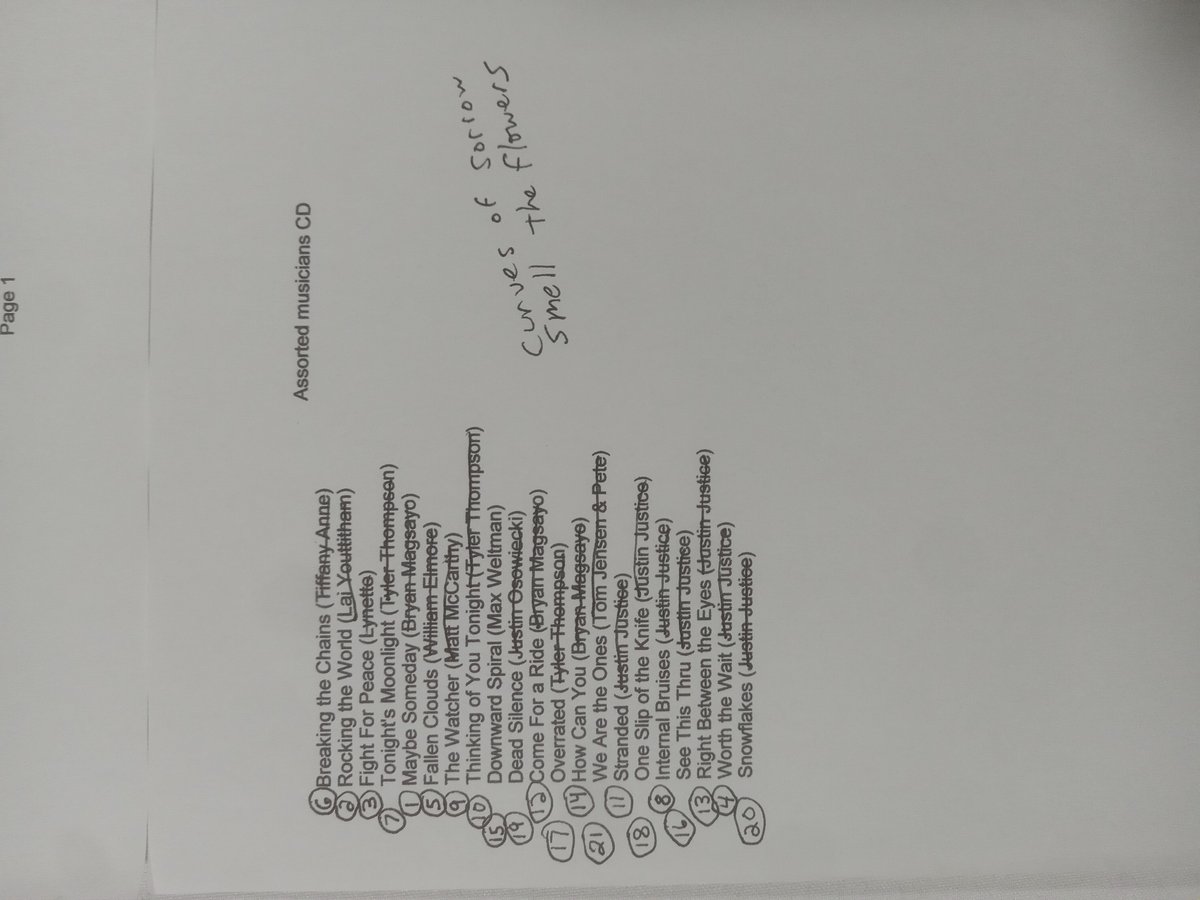
Picture 3 of 5
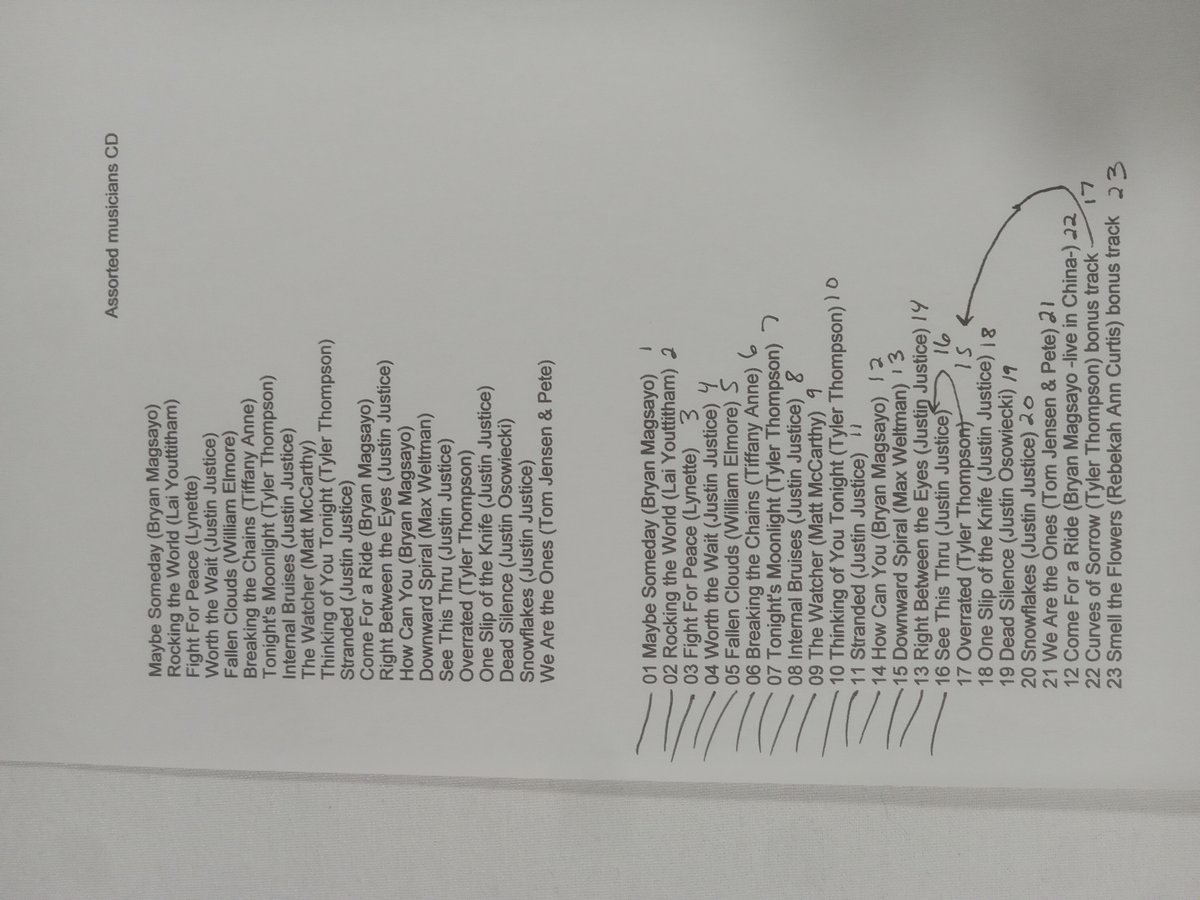
Picture 4 of 5
Picture 5 of 5
The words on this page
Assorted musicians CD
Maybe Someday (Bryan Magsayo)
Rocking the World (Lai Youtithem)
Fight For Peace (Lynette)
Fallen Clouds (William Elmore)
Breaking the Chains (Tiffany Anne)
Tonight's Moonlight (Tyler Thompson)
Internal Bruises (Justin Justice)
The Watcher (Matt McCarthy)
Thinking of You (Tyler Thompson)
Stranded (Justin Justice)
Come For a Ride (Bryan Magsayo)
Right Between the Eyes (Justin Justice)
How Can You (Bryan Magsayo)
Downward Spiral (Max Weltman)
See This Thru (Justin Justice)
Overated (Tyler Thompson)
One Slip of the Knife (Justin Justice)
Dead Silence (Justin Osowiecki)
Snowflakes (Justin Justice)
We Are the Ones (Tom Jensen & Pete)
01 Maybe Someday (Bryan Magsayo) 1
02 Rocking the World (Lai Youtithem) 2
03 Fight For Peace (Lynette) 3
04 Worth the Wait (Justin Justice) 4
05 Fallen Clouds (William Elmore) 5
06 Breaking the Chains (Tiffany Anne) 6
07 Tonight's Moonlight (Tyler Thompson) 7
08 Internal Bruises (Justin Justice) 8
09 The Watcher (Matt McCarthy) 9
10 Thinking of You (Tyler Thompson) 10
11 Stranded (Justin Justice) 11
12 How Can You (Bryan Magsayo) 12
13 Downward Spiral (Max Weltman) 13
14 Right Between the Eyes (Justin Justice) 14
15 See This Thru (Justin Justice) 15
16 Overated (Tyler Thompson) 16
17 One Slip of the Knife (Justin Justice) 17
18 Dead Silence (Justin Osowiecki) 18
19 Snowflakes (Justin Justice) 19
20 We Are the Ones (Tom Jensen & Pete) 20
21 Come For a Ride (Bryan Magsayo -live in China) 22
22 Curves of Sorrow (Tyler Thompson) bonus track 17
23 Smell the Flowers (Rebekah Ann Curtis) bonus track 23
Page 1
Assorted musicians CD
(6) Breaking the Chains (Tiffany Anne)
(2) Rocking the World (Lai Youtithem)
(3) Fight For Peace (Lynette)
(7) Tonight's Moonlight (Tyler Thompson)
(1) Maybe Someday (Bryan Magsayo)
(5) Fallen Clouds (William Elmore)
(9) The Watcher (Matt McCarthy)
(10) Thinking of You (Tyler Thompson)
(13) Downward Spiral (Max Weltman)
(18) Dead Silence (Justin Osowiecki)
(12) How Can You (Bryan Magsayo)
(16) Overated (Tyler Thompson)
(17) One Slip of the Knife (Justin Justice)
(14) Internal Bruises (Justin Justice)
(21) We Are the Ones (Tom Jensen & Pete)
(11) Stranded (Justin Justice)
(17) One Slip of the Knife (Justin Justice)
(8) Internal Bruises (Justin Justice)
(15) See This Thru (Justin Justice)
(14) Right Between the Eyes (Justin Justice)
(4) Worth the Wait (Justin Justice)
(20) Snowflakes (Justin Justice)
Curves of Sorrow
Smell the Flowers
Page 1
---
Assorted musicians CD
Maybe Someday (Bryan Magsayo)
Rocking the World (Lai Youttitham)
Fight For Peace (Lynette)
Worth the Wait (Justin Justice)
Fallen Clouds (William Elmore)
Breaking the Chains (Tiffany Anne)
Tonight's Moonlight (Tyler Thompson)
Internal Bruises (Justin Justice)
The Watcher (Matt McCarthy)
Thinking of You Tonight (Tyler Thompson)
Stranded (Justin Justice)
Come For a Ride (Bryan Magsayo)
Right Between the Eyes (Justin Justice)
How Can You (Bryan Magsayo)
Downward Spiral (Max Weltman)
See This Thru (Justin Justice)
Overrated (Tyler Thompson)
One Slip of the Knife (Justin Justice)
Dead Silence (Justin Osowiecki)
Snowflakes (Justin Justice)
We Are the Ones (Tom Jensen & Pete)
01 Maybe Someday (Bryan Magsayo) 1
02 Rocking the World (Lai Youttitham) 2
03 Fight For Peace (Lynette) 3
04 Worth the Wait (Justin Justice) 4
05 Fallen Clouds (William Elmore) 5
06 Breaking the Chains (Tiffany Anne) 6
07 Tonight's Moonlight (Tyler Thompson) 7
08 Internal Bruises (Justin Justice) 8
09 The Watcher (Matt McCarthy) 9
10 Thinking of You Tonight (Tyler Thompson) 10
11 Stranded (Justin Justice) 11
14 How Can You (Bryan Magsayo) 12
15 Downward Spiral (Max Weltman) 13
13 Right Between the Eyes (Justin Justice) 14
16 See This Thru (Justin Justice) 16
17 Overrated (Tyler Thompson) 15
18 One Slip of the Knife (Justin Justice) 18
19 Dead Silence (Justin Osowiecki) 19
20 Snowflakes (Justin Justice) 20
21 We Are the Ones (Tom Jensen & Pete) 21
12 Come For a Ride (Bryan Magsayo -live in China-) 22
22 Curves of Sorrow (Tyler Thompson) bonus track 17
23 Smell the Flowers (Rebekah Ann Curtis) bonus track 23
Maybe Someday (Bryan Magsayo)
Rocking the World (Lai Youtithem)
Fight For Peace (Lynette)
Fallen Clouds (William Elmore)
Breaking the Chains (Tiffany Anne)
Tonight's Moonlight (Tyler Thompson)
Internal Bruises (Justin Justice)
The Watcher (Matt McCarthy)
Thinking of You (Tyler Thompson)
Stranded (Justin Justice)
Come For a Ride (Bryan Magsayo)
Right Between the Eyes (Justin Justice)
How Can You (Bryan Magsayo)
Downward Spiral (Max Weltman)
See This Thru (Justin Justice)
Overated (Tyler Thompson)
One Slip of the Knife (Justin Justice)
Dead Silence (Justin Osowiecki)
Snowflakes (Justin Justice)
We Are the Ones (Tom Jensen & Pete)
01 Maybe Someday (Bryan Magsayo) 1
02 Rocking the World (Lai Youtithem) 2
03 Fight For Peace (Lynette) 3
04 Worth the Wait (Justin Justice) 4
05 Fallen Clouds (William Elmore) 5
06 Breaking the Chains (Tiffany Anne) 6
07 Tonight's Moonlight (Tyler Thompson) 7
08 Internal Bruises (Justin Justice) 8
09 The Watcher (Matt McCarthy) 9
10 Thinking of You (Tyler Thompson) 10
11 Stranded (Justin Justice) 11
12 How Can You (Bryan Magsayo) 12
13 Downward Spiral (Max Weltman) 13
14 Right Between the Eyes (Justin Justice) 14
15 See This Thru (Justin Justice) 15
16 Overated (Tyler Thompson) 16
17 One Slip of the Knife (Justin Justice) 17
18 Dead Silence (Justin Osowiecki) 18
19 Snowflakes (Justin Justice) 19
20 We Are the Ones (Tom Jensen & Pete) 20
21 Come For a Ride (Bryan Magsayo -live in China) 22
22 Curves of Sorrow (Tyler Thompson) bonus track 17
23 Smell the Flowers (Rebekah Ann Curtis) bonus track 23
Page 1
Assorted musicians CD
(6) Breaking the Chains (Tiffany Anne)
(2) Rocking the World (Lai Youtithem)
(3) Fight For Peace (Lynette)
(7) Tonight's Moonlight (Tyler Thompson)
(1) Maybe Someday (Bryan Magsayo)
(5) Fallen Clouds (William Elmore)
(9) The Watcher (Matt McCarthy)
(10) Thinking of You (Tyler Thompson)
(13) Downward Spiral (Max Weltman)
(18) Dead Silence (Justin Osowiecki)
(12) How Can You (Bryan Magsayo)
(16) Overated (Tyler Thompson)
(17) One Slip of the Knife (Justin Justice)
(14) Internal Bruises (Justin Justice)
(21) We Are the Ones (Tom Jensen & Pete)
(11) Stranded (Justin Justice)
(17) One Slip of the Knife (Justin Justice)
(8) Internal Bruises (Justin Justice)
(15) See This Thru (Justin Justice)
(14) Right Between the Eyes (Justin Justice)
(4) Worth the Wait (Justin Justice)
(20) Snowflakes (Justin Justice)
Curves of Sorrow
Smell the Flowers
Page 1
---
Assorted musicians CD
Maybe Someday (Bryan Magsayo)
Rocking the World (Lai Youttitham)
Fight For Peace (Lynette)
Worth the Wait (Justin Justice)
Fallen Clouds (William Elmore)
Breaking the Chains (Tiffany Anne)
Tonight's Moonlight (Tyler Thompson)
Internal Bruises (Justin Justice)
The Watcher (Matt McCarthy)
Thinking of You Tonight (Tyler Thompson)
Stranded (Justin Justice)
Come For a Ride (Bryan Magsayo)
Right Between the Eyes (Justin Justice)
How Can You (Bryan Magsayo)
Downward Spiral (Max Weltman)
See This Thru (Justin Justice)
Overrated (Tyler Thompson)
One Slip of the Knife (Justin Justice)
Dead Silence (Justin Osowiecki)
Snowflakes (Justin Justice)
We Are the Ones (Tom Jensen & Pete)
01 Maybe Someday (Bryan Magsayo) 1
02 Rocking the World (Lai Youttitham) 2
03 Fight For Peace (Lynette) 3
04 Worth the Wait (Justin Justice) 4
05 Fallen Clouds (William Elmore) 5
06 Breaking the Chains (Tiffany Anne) 6
07 Tonight's Moonlight (Tyler Thompson) 7
08 Internal Bruises (Justin Justice) 8
09 The Watcher (Matt McCarthy) 9
10 Thinking of You Tonight (Tyler Thompson) 10
11 Stranded (Justin Justice) 11
14 How Can You (Bryan Magsayo) 12
15 Downward Spiral (Max Weltman) 13
13 Right Between the Eyes (Justin Justice) 14
16 See This Thru (Justin Justice) 16
17 Overrated (Tyler Thompson) 15
18 One Slip of the Knife (Justin Justice) 18
19 Dead Silence (Justin Osowiecki) 19
20 Snowflakes (Justin Justice) 20
21 We Are the Ones (Tom Jensen & Pete) 21
12 Come For a Ride (Bryan Magsayo -live in China-) 22
22 Curves of Sorrow (Tyler Thompson) bonus track 17
23 Smell the Flowers (Rebekah Ann Curtis) bonus track 23
Item 1952
RUMORS FROM HEAVEN
Printed sheets of white paper.
- Why it matters
- Tom writes this
- Type
- Printed page
- Collection
- Tom writes thisthe old category list says: FUNNY (not checked by Tom)
- Published in
- ON THE 34 ALBUMSA Cold Plate [S21] · as the song RUMOURS FROM HEAVENmatched on the words: three or more seven-word runs shared with that song
IN A BOOKPoems By Tom (2007)
200 Poems Waiting For Music (2013)
The November 2024 Collection (2024)
Tom Jensen Poem Anthology (2013)
Brian Rainstorm: Poetry Not Dead (2014)
180 Good Poems (2012)
A Lifetime Of Rhyme (2020)
The 714-Page Book (2012)
The Laima Dedication Anthology (2011)
34 Albums, Books 1 and 2 (2026)
Finished Song Lyrics (2011)
Revised 31 Albums With Index (2024) - Age when written
- written by age 29 at the latestdated from the earliest book it appears in - the sheet itself may be older
Price · Tier · Tom fills these
Picture 1 of 4
Picture 2 of 4
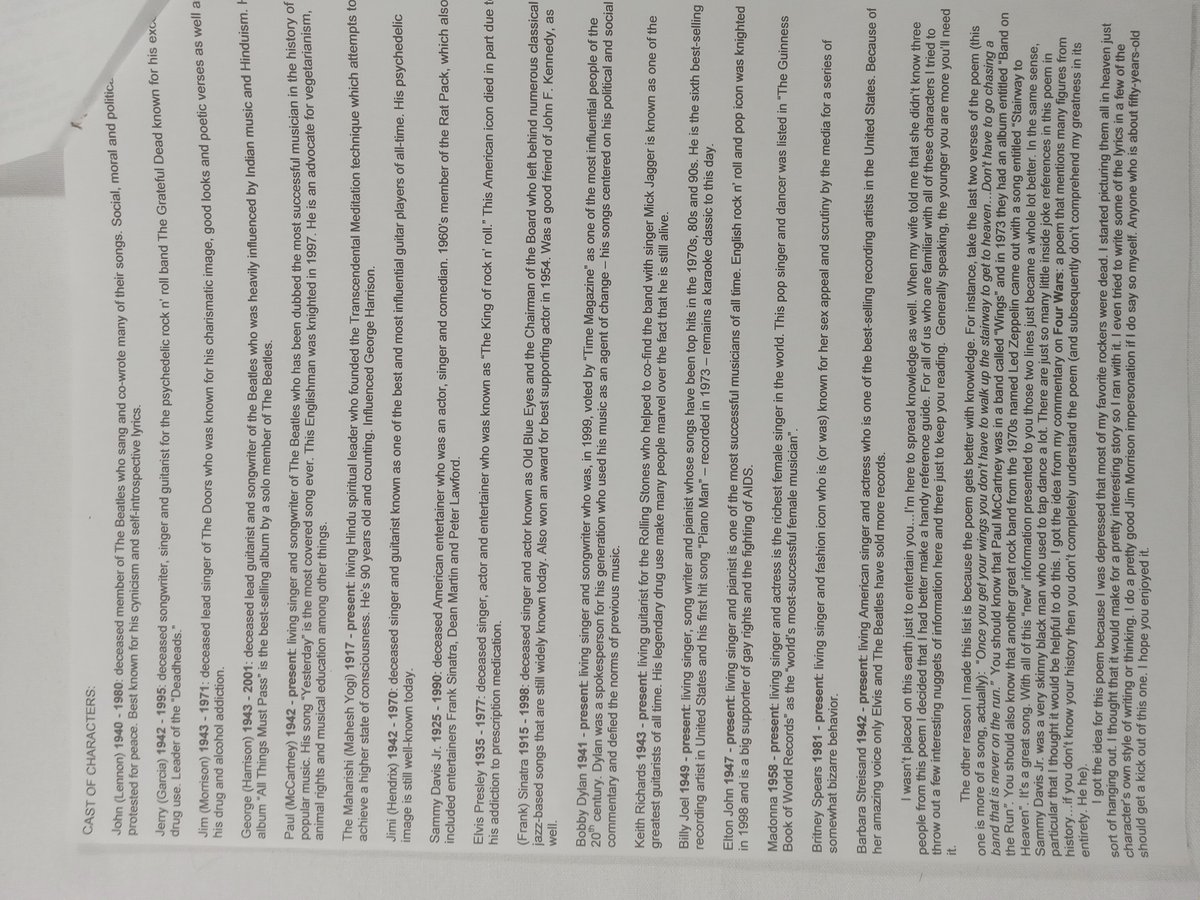
Picture 3 of 4
Picture 4 of 4
The words on this page
Revised
RUMORS FROM HEAVEN
Now that there's rock n' roll in heaven
Everyone enjoys the hymns
And the only problem that the church has
Is getting everybody in
Hard to tell just how the conversation sounds
When John's head is just about to hit the ground
As the echo of Jerry starts from the corner of the room
Playing long after dark as the echo finds its way around
All the while Jim is already out cold
He bought the ticket but the ride is getting old
The creator never really had a chance
For his disciples could no longer walk straight
The power of song and dance
Unleashed after ages inside the Golden Gate
These guys all got the same room upstairs
And thought their landlord is god still no one seems to care
Sit and scratch their heads wondering
Just who'll come knocking next
Yet time has told them that it's anyone's guess
Everybody's grateful to be dead
Because now they're the house band in Heaven
They sell out every single night
Now that doesn't sound too upsetting
Hey John, it's George who's been knocking at the door
Because of course Paul would've rang the bell
John responded that George must've left the Maharishi
Or else I figured we'd a seen him in hell
There goes Jimi playing again without his hands
Wearing only his headband and his funky underpants
Hey Jerry, go get a bucket of cold water
Let's see if we can get him outta this trance
He's sure can tap dance and he don't eat much
But when Elvis Presley's knocking don't ever let him in
For he'll just eat all of the chips and dip - what a sin
But Sinatra's okay 'cause he always brings gin
Hey who invited Bobby Dylan?
You know we're not allowed to let anyone in early
Keith Richards came all the way up for nothing
But we're sure we'll see him again shortly
John whispers...
No you ain't gonna see what I got in my pocket
But the words that come to me are knock it off and stop it
You want to change your ways but just what's the use?
I have far beyond my years too much pain and abuse
Jim wakes up mumbling something odd...
The day revolves around the tears
That come falling from the serpent's eyes
I hold the pain of the world inside my mind
Because my ears can no longer hear a child cry
My senses crawl beneath my skin
As a man once saw all becomes blind
But they all know George is not the type to be out done
The pressure of the sky falls on your back
The clouds start laughing in your face
The weather changes all the time
So remove your soul within its case
Jerry's still here... let us not forget,
This small little room I once believed to be my prison
Finally for what I've seen and done I've been forgiven
I knew there was someone up there somewhere
But when my feet walked the earth I just did not care
Old Blue Eyes never wants to join in
Unless there's some ladies around
When it's just the guys he's called the Chairman of the Bored
Sitting in some darkened corner trying not to be found
Now there's rock n' roll in heaven
Everyone enjoys the hymns
And the only problem that the church has
Is getting everybody in
Hard to tell just how the conversation sounds
When John's head is just about to hit the ground
As the echo of Jerry starts from the corner of the room
Playing long after dark as the echo finds its way around
All the while Jim is already out cold
He bought the ticket but the ride is getting old
The creator never really had a chance
For his disciples could no longer walk straight
The power of song and dance
Unleashed after ages inside the Golden Gate
These guys all got the same room upstairs
And thought their landlord is god still no one seems to care
Sit and scratch their heads wondering
Just who'll come knocking next
Yet time has told them that it's anyone's guess
Everybody's grateful to be dead
Because now they're the house band in Heaven
They sell out every single night
Now that doesn't sound too upsetting
Now it sounds pretty sad
But everybody's still waiting for Billy Joel
But even though he's said as hell he's still not that old
Thought they'd settle for Elton John
Because they need someone on the keyboard
When everybody heard he stopped doing coke
They all sang out "oh lord!"
The group is still split about fifty-fifty
Between Madonna and Britney Spears
They'll take anyone but Barbara Streisand
She'll steal the show that what everybody fears
So now you know what you can look forward to
When your day finally comes
Once you get your wings
You don't have to walk up the stairway to get in heaven
Don't have to go chasing a band that is never on the run
---
Revised
RUMORS FROM HEAVEN
Now that there's rock n' roll in heaven
Everyone enjoys the hymns
And the only problem that the church has
Is getting everybody in
Hard to tell just how the conversation sounds
When John's head is just about to hit the ground
As the echo of Jerry starts from the corner of the room
Playing long after dark as the echo finds its way around
All the while Jim is already out cold
He bought the ticket but the ride is getting old
The creator never really had a chance
For his disciples could no longer walk straight
The power of song and dance
Unleashed after ages inside the Golden Gate
These guys all got the same room upstairs
And though their landlord is god still no one seems to care
Sit and scratch their heads wondering
Just who'll come knocking next
Yet time has told them that it's anyone's guess
Everybody's grateful to be dead
Because now they're the house band in Heaven
They sell out every single night
Now that doesn't sound too upsetting
Hey John, it's George who's been knocking at the door
Because of course Paul would've rang the bell
John responded that George must've left the Maharishi
Or else I figured we'd a seen him in hell
There goes Jimi playing again without his hands
Wearing only his headband and his funky underpants
Hey Jerry, go get a bucket of cold water
Let's see if we can get him outta this trance
There's Sammy Davis Jr.
He sure can tap dance and he don't eat much
But when Elvis Presley's knocking don't ever let him in
For he'll just eat all of the chips and dip - what a sin
But Sinatra's okay 'cause he always brings gin
Hey who invited Bobby Dylan?
You know we're not allowed to let anyone in early
Keith Richards came all the way up for nothing
But we're sure we'll see him again shortly
John whispers...
No you ain't gonna see what I got in my pocket
But the words that come to me are knock it off and stop it
You want to change your ways but just what's the use?
I have had far beyond my years too much pain and abuse
Jim wakes up mumbling something odd...
The day revolves around the tears
That come falling from the serpent's eyes
I hold the pain of the world inside my mind
Because my ears can no longer hear a child cry
My senses crawl beneath my skin
As a man who once saw all becomes blind
But they all know George is not the type to be out done...
The pressure of the sky falls on your back
The clouds start laughing in your face
The weather changes all the time
So remove your soul from within its case
Jerry's still here... let us not forget..
This small little room I once believed to be my prison
Finally for what I've seen and done I've been forgiven
I knew there was someone up there somewhere
But when my feet walked the earth I just did not care
Old Blue Eyes never wants to join in
Unless there's some ladies around
When it's just the guys he's called the Chairman of the Bo
Sitting in some darkened corner trying not to be found
Now that there's rock n' roll in heaven
Everyone enjoys the hymns
And the only problem that the church has
Is getting everybody in
Hard to tell just how the conversation sounds
When John's head is just about to hit the ground
As the echo of Jerry starts from the corner of the room
Playing long after dark as the echo finds its way around
All the while Jim is already out cold
He bought the ticket but the ride is getting old
The creator never really had a chance
For his disciples could no longer walk straight
The power of song and dance
Unleashed after ages inside the Golden Gate
These guys all got the same room upstairs
And though their landlord is god still no one seems to carr
Sit and scratch their heads wondering
Just who'll come knocking next
Yet time has told them that it's anyone's guess
Everybody's grateful to be dead
Because now they're the house band in Heaven
They sell out every single night
Now that doesn't sound too upsetting
Now it sounds pretty sad
But everybody's still waiting for Billy Joel
But even though he's bald as hell he's still not that old
Though they'll settle for Elton John
Because they need someone on the keyboard
When everybody heard he stopped doing coke
They all sang out "oh lord!"
The group is still split about fifty-fifty
Between Madonna and Britney Spears
They'll take anyone but Barbara Streisand
She'll steal the show that's what everybody fears
So now you know what you can look forward to
When your day finally comes
Once you get your wings
You don't have to walk up the stairway to get to heaven
Don't have to go chasing a band that is never on the run
---
CAST OF CHARACTERS:
John (Lennon) 1940 - 1980: deceased member of The Beatles who sang and co-wrote many of their songs. Social, moral and political protested for peace. Best known for his cynicism and self-introspective lyrics.
Jerry (Garcia) 1942 - 1995: deceased songwriter, singer and guitarist for the psychedelic rock n' roll band The Grateful Dead known for his excessive drug use. Leader of the "Deadheads."
Jim (Morrison) 1943 - 1971: deceased lead singer of The Doors who was known for his charismatic image, good looks and poetic verses as well as his drug and alcohol addiction.
George (Harrison) 1943 - 2001: deceased lead guitarist and songwriter of the Beatles who was heavily influenced by Indian music and Hinduism. His album "All Things Must Pass" is the best-selling album by a solo member of The Beatles.
Paul (McCartney) 1942 - present: living singer and songwriter of The Beatles who has been dubbed the most successful musician in the history of popular music. His song "Yesterday" is the most covered song ever. This Englishman was knighted in 1997. He is an advocate for vegetarianism, animal rights and musical education among other things.
The Maharishi (Mahesh Yogi) 1917 - present: living Hindu spiritual leader who founded the Transcendental Meditation technique which attempts to achieve a higher state of consciousness. He's 90 years old and counting. Influenced George Harrison.
Jimi (Hendrix) 1942 - 1970: deceased singer and guitarist known as one of the best and most influential guitar players of all-time. His psychedelic image is still well-known today.
Sammy Davis Jr. 1925 - 1990: deceased American entertainer who was an actor, singer and comedian. 1960's member of the Rat Pack, which also included entertainers Frank Sinatra, Dean Martin and Peter Lawford.
Elvis Presley 1935 - 1977: deceased singer, actor and entertainer who was known as "The King of rock n' roll." This American icon died in part due to his addiction to prescription medication.
(Frank) Sinatra 1915 - 1998: deceased singer and actor known as Old Blue Eyes and the Chairman of the Board who left behind numerous classical jazz-based songs that are still widely known today. Also won an award for best supporting actor in 1954. Was a good friend of John F. Kennedy, as well.
Bobby Dylan 1941 - present: living singer and songwriter who was, in 1999, voted by "Time Magazine" as one of the most influential people of the 20th century. Dylan was a spokesperson for his generation who used his music as an agent of change - his songs centered on his political and social commentary and defied the norms of previous music.
Keith Richards 1943 - present: living guitarist for the Rolling Stones who helped to co-find the band with singer Mick Jagger is known as one of the greatest guitarists of all time. His legendary drug use make many people marvel over the fact that he is still alive.
Billy Joel 1949 - present: living singer, song writer and pianist whose songs have been top hits in the 1970s, 80s and 90s. He is the sixth best-selling recording artist in United States and his first hit song "Piano Man" - recorded in 1973 - remains a karaoke classic to this day.
Elton John 1947 - present: living singer and pianist is one of the most successful musicians of all time. English rock n' roll and pop icon was knighted in 1998 and is a big supporter of gay rights and the fighting of AIDS.
Madonna 1958 - present: living singer and actress is the richest female singer in the world. This pop singer and dancer was listed in "The Guinness Book of World Records" as the "world's most-successful female musician."
Britney Spears 1981 - present: living singer and fashion icon who is (or was) known for her sex appeal and scrutiny by the media for a series of somewhat bizarre behavior.
Barbara Streisand 1942 - present: living American singer and actress who is one of the best-selling recording artists in the United States. Because of her amazing voice only Elvis and The Beatles have sold more records.
I wasn't placed on this earth just to entertain you... I'm here to spread knowledge as well. When my wife told me that she didn't know three people from this poem I decided that I had better make a handy reference guide. For all of us who are familiar with all of these characters I tried to throw out a few interesting nuggets of information here and there just to keep you reading. Generally speaking, the younger you are more you'll need it.
The other reason I made this list is because the poem gets better with knowledge. For instance, take the last two verses of the poem (this one is more of a song, actually): "Once you get your wings you don't have to walk up the stairway to get to heaven... Don't have to go chasing a band that is never on the run." You should also know that Paul McCartney was in a band called "Wings" and in 1973 they had an album entitled "Band on the Run." You should also know that another great rock band from the 1970s named Led Zeppelin came out with a song entitled "Stairway to Heaven." It's a great song. With all of this "new" information presented to you those two lines just became a whole lot better. In the same sense, Sammy Davis Jr. was a very skinny black man who used to tap dance a lot. There are just so many little joke references in this poem in particular that I thought it would be helpful to do this. I got the idea from my commentary on Four Wars: a poem that mentions many figures from history... if you don't know your history then you don't completely understand the poem (and subsequently don't comprehend my greatness in its entirety. He he).
I got the idea for this poem because I was depressed that most of my favorite rockers were dead. I started picturing them all in heaven just sort of hanging out. I thought that it would make for a pretty interesting story so I ran with it. I even tried to write some of the lyrics in a few of the character's own style of writing or thinking. I do a pretty good Jim Morrison impersonation if I do say so myself. Anyone who is about fifty-years-old should get a kick out of this one. I hope you enjoyed it.
---
CAST OF CHARACTERS:
John (Lennon) 1940 - 1980: deceased musician, singer and songwriter of the Beatles who protested for peace. Best known for his cynicism.
Jerry (Garcia) 1942 - 1995: deceased lead guitarist and songwriter of The Doors who was known for his drug use. Leader of the "Deadheads."
Jim (Morrison) 1943 - 1971: deceased lead singer of The Doors who was known for his drug and alcohol addiction.
George (Harrison) 1943 - 2001: deceased lead guitarist and songwriter of The Beatles whose album "All Things Must Pass" is the best-selling album by a solo member of The Beatles who popular music. His song "Yesterday" is the most covered song ever. This English musician was an animal rights and musical education among other things.
Paul (McCartney) 1942 - present: living singer and songwriter who was an act [?] to achieve a higher state of consciousness. He's 90 years old and counting. Influencer [?] is still well-known today.
The Maharishi (Mahesh Yogi) 1917 - present: living Hindu spiritual leader who [?]
Jimi (Hendrix) 1942 - 1970: deceased singer and guitarist known as one of the [?]
Sammy Davis Jr. 1925 - 1990: deceased American entertainer who was an act [?] included entertainers Frank Sinatra, Dean Martin and Peter Lawford.
Elvis Presley 1935 - 1977: deceased singer, actor and entertainer who was kn[own] his addiction to prescription medication.
(Frank) Sinatra 1915 - 1998: deceased singer and actor known as Old Blue E [?] jazz-based songs that are still widely known today. Also won an award for be [?] well.
Bobby Dylan 1941 - present: living singer and songwriter who was, in 1999, [?] 20th century. Dylan was a spokesperson for his generation who used his mu [?] commentary and defied the norms of previous music.
Keith Richards 1943 - present: living guitarist for the Rolling Stones who he [?] greatest guitarists of all time. His legendary drug use make many people m [?]
Billy Joel 1949 - present: living singer and pianist and pianist whose song [?] recording artist in United States and his first hit song "Piano Man" - record [?]
Elton John 1947 - present: living singer and pianist is one of the most suc [?] in 1998 and is a big supporter of gay rights and the fighting of AIDS.
Madonna 1958 - present: living singer and actress is the richest female s [?] Book of World Records" as the "world's most-successful female musician [?]
Britney Spears 1981 - present: living singer and [?] somewhat bizarre behavior
RUMORS FROM HEAVEN
Now that there's rock n' roll in heaven
Everyone enjoys the hymns
And the only problem that the church has
Is getting everybody in
Hard to tell just how the conversation sounds
When John's head is just about to hit the ground
As the echo of Jerry starts from the corner of the room
Playing long after dark as the echo finds its way around
All the while Jim is already out cold
He bought the ticket but the ride is getting old
The creator never really had a chance
For his disciples could no longer walk straight
The power of song and dance
Unleashed after ages inside the Golden Gate
These guys all got the same room upstairs
And thought their landlord is god still no one seems to care
Sit and scratch their heads wondering
Just who'll come knocking next
Yet time has told them that it's anyone's guess
Everybody's grateful to be dead
Because now they're the house band in Heaven
They sell out every single night
Now that doesn't sound too upsetting
Hey John, it's George who's been knocking at the door
Because of course Paul would've rang the bell
John responded that George must've left the Maharishi
Or else I figured we'd a seen him in hell
There goes Jimi playing again without his hands
Wearing only his headband and his funky underpants
Hey Jerry, go get a bucket of cold water
Let's see if we can get him outta this trance
He's sure can tap dance and he don't eat much
But when Elvis Presley's knocking don't ever let him in
For he'll just eat all of the chips and dip - what a sin
But Sinatra's okay 'cause he always brings gin
Hey who invited Bobby Dylan?
You know we're not allowed to let anyone in early
Keith Richards came all the way up for nothing
But we're sure we'll see him again shortly
John whispers...
No you ain't gonna see what I got in my pocket
But the words that come to me are knock it off and stop it
You want to change your ways but just what's the use?
I have far beyond my years too much pain and abuse
Jim wakes up mumbling something odd...
The day revolves around the tears
That come falling from the serpent's eyes
I hold the pain of the world inside my mind
Because my ears can no longer hear a child cry
My senses crawl beneath my skin
As a man once saw all becomes blind
But they all know George is not the type to be out done
The pressure of the sky falls on your back
The clouds start laughing in your face
The weather changes all the time
So remove your soul within its case
Jerry's still here... let us not forget,
This small little room I once believed to be my prison
Finally for what I've seen and done I've been forgiven
I knew there was someone up there somewhere
But when my feet walked the earth I just did not care
Old Blue Eyes never wants to join in
Unless there's some ladies around
When it's just the guys he's called the Chairman of the Bored
Sitting in some darkened corner trying not to be found
Now there's rock n' roll in heaven
Everyone enjoys the hymns
And the only problem that the church has
Is getting everybody in
Hard to tell just how the conversation sounds
When John's head is just about to hit the ground
As the echo of Jerry starts from the corner of the room
Playing long after dark as the echo finds its way around
All the while Jim is already out cold
He bought the ticket but the ride is getting old
The creator never really had a chance
For his disciples could no longer walk straight
The power of song and dance
Unleashed after ages inside the Golden Gate
These guys all got the same room upstairs
And thought their landlord is god still no one seems to care
Sit and scratch their heads wondering
Just who'll come knocking next
Yet time has told them that it's anyone's guess
Everybody's grateful to be dead
Because now they're the house band in Heaven
They sell out every single night
Now that doesn't sound too upsetting
Now it sounds pretty sad
But everybody's still waiting for Billy Joel
But even though he's said as hell he's still not that old
Thought they'd settle for Elton John
Because they need someone on the keyboard
When everybody heard he stopped doing coke
They all sang out "oh lord!"
The group is still split about fifty-fifty
Between Madonna and Britney Spears
They'll take anyone but Barbara Streisand
She'll steal the show that what everybody fears
So now you know what you can look forward to
When your day finally comes
Once you get your wings
You don't have to walk up the stairway to get in heaven
Don't have to go chasing a band that is never on the run
---
Revised
RUMORS FROM HEAVEN
Now that there's rock n' roll in heaven
Everyone enjoys the hymns
And the only problem that the church has
Is getting everybody in
Hard to tell just how the conversation sounds
When John's head is just about to hit the ground
As the echo of Jerry starts from the corner of the room
Playing long after dark as the echo finds its way around
All the while Jim is already out cold
He bought the ticket but the ride is getting old
The creator never really had a chance
For his disciples could no longer walk straight
The power of song and dance
Unleashed after ages inside the Golden Gate
These guys all got the same room upstairs
And though their landlord is god still no one seems to care
Sit and scratch their heads wondering
Just who'll come knocking next
Yet time has told them that it's anyone's guess
Everybody's grateful to be dead
Because now they're the house band in Heaven
They sell out every single night
Now that doesn't sound too upsetting
Hey John, it's George who's been knocking at the door
Because of course Paul would've rang the bell
John responded that George must've left the Maharishi
Or else I figured we'd a seen him in hell
There goes Jimi playing again without his hands
Wearing only his headband and his funky underpants
Hey Jerry, go get a bucket of cold water
Let's see if we can get him outta this trance
There's Sammy Davis Jr.
He sure can tap dance and he don't eat much
But when Elvis Presley's knocking don't ever let him in
For he'll just eat all of the chips and dip - what a sin
But Sinatra's okay 'cause he always brings gin
Hey who invited Bobby Dylan?
You know we're not allowed to let anyone in early
Keith Richards came all the way up for nothing
But we're sure we'll see him again shortly
John whispers...
No you ain't gonna see what I got in my pocket
But the words that come to me are knock it off and stop it
You want to change your ways but just what's the use?
I have had far beyond my years too much pain and abuse
Jim wakes up mumbling something odd...
The day revolves around the tears
That come falling from the serpent's eyes
I hold the pain of the world inside my mind
Because my ears can no longer hear a child cry
My senses crawl beneath my skin
As a man who once saw all becomes blind
But they all know George is not the type to be out done...
The pressure of the sky falls on your back
The clouds start laughing in your face
The weather changes all the time
So remove your soul from within its case
Jerry's still here... let us not forget..
This small little room I once believed to be my prison
Finally for what I've seen and done I've been forgiven
I knew there was someone up there somewhere
But when my feet walked the earth I just did not care
Old Blue Eyes never wants to join in
Unless there's some ladies around
When it's just the guys he's called the Chairman of the Bo
Sitting in some darkened corner trying not to be found
Now that there's rock n' roll in heaven
Everyone enjoys the hymns
And the only problem that the church has
Is getting everybody in
Hard to tell just how the conversation sounds
When John's head is just about to hit the ground
As the echo of Jerry starts from the corner of the room
Playing long after dark as the echo finds its way around
All the while Jim is already out cold
He bought the ticket but the ride is getting old
The creator never really had a chance
For his disciples could no longer walk straight
The power of song and dance
Unleashed after ages inside the Golden Gate
These guys all got the same room upstairs
And though their landlord is god still no one seems to carr
Sit and scratch their heads wondering
Just who'll come knocking next
Yet time has told them that it's anyone's guess
Everybody's grateful to be dead
Because now they're the house band in Heaven
They sell out every single night
Now that doesn't sound too upsetting
Now it sounds pretty sad
But everybody's still waiting for Billy Joel
But even though he's bald as hell he's still not that old
Though they'll settle for Elton John
Because they need someone on the keyboard
When everybody heard he stopped doing coke
They all sang out "oh lord!"
The group is still split about fifty-fifty
Between Madonna and Britney Spears
They'll take anyone but Barbara Streisand
She'll steal the show that's what everybody fears
So now you know what you can look forward to
When your day finally comes
Once you get your wings
You don't have to walk up the stairway to get to heaven
Don't have to go chasing a band that is never on the run
---
CAST OF CHARACTERS:
John (Lennon) 1940 - 1980: deceased member of The Beatles who sang and co-wrote many of their songs. Social, moral and political protested for peace. Best known for his cynicism and self-introspective lyrics.
Jerry (Garcia) 1942 - 1995: deceased songwriter, singer and guitarist for the psychedelic rock n' roll band The Grateful Dead known for his excessive drug use. Leader of the "Deadheads."
Jim (Morrison) 1943 - 1971: deceased lead singer of The Doors who was known for his charismatic image, good looks and poetic verses as well as his drug and alcohol addiction.
George (Harrison) 1943 - 2001: deceased lead guitarist and songwriter of the Beatles who was heavily influenced by Indian music and Hinduism. His album "All Things Must Pass" is the best-selling album by a solo member of The Beatles.
Paul (McCartney) 1942 - present: living singer and songwriter of The Beatles who has been dubbed the most successful musician in the history of popular music. His song "Yesterday" is the most covered song ever. This Englishman was knighted in 1997. He is an advocate for vegetarianism, animal rights and musical education among other things.
The Maharishi (Mahesh Yogi) 1917 - present: living Hindu spiritual leader who founded the Transcendental Meditation technique which attempts to achieve a higher state of consciousness. He's 90 years old and counting. Influenced George Harrison.
Jimi (Hendrix) 1942 - 1970: deceased singer and guitarist known as one of the best and most influential guitar players of all-time. His psychedelic image is still well-known today.
Sammy Davis Jr. 1925 - 1990: deceased American entertainer who was an actor, singer and comedian. 1960's member of the Rat Pack, which also included entertainers Frank Sinatra, Dean Martin and Peter Lawford.
Elvis Presley 1935 - 1977: deceased singer, actor and entertainer who was known as "The King of rock n' roll." This American icon died in part due to his addiction to prescription medication.
(Frank) Sinatra 1915 - 1998: deceased singer and actor known as Old Blue Eyes and the Chairman of the Board who left behind numerous classical jazz-based songs that are still widely known today. Also won an award for best supporting actor in 1954. Was a good friend of John F. Kennedy, as well.
Bobby Dylan 1941 - present: living singer and songwriter who was, in 1999, voted by "Time Magazine" as one of the most influential people of the 20th century. Dylan was a spokesperson for his generation who used his music as an agent of change - his songs centered on his political and social commentary and defied the norms of previous music.
Keith Richards 1943 - present: living guitarist for the Rolling Stones who helped to co-find the band with singer Mick Jagger is known as one of the greatest guitarists of all time. His legendary drug use make many people marvel over the fact that he is still alive.
Billy Joel 1949 - present: living singer, song writer and pianist whose songs have been top hits in the 1970s, 80s and 90s. He is the sixth best-selling recording artist in United States and his first hit song "Piano Man" - recorded in 1973 - remains a karaoke classic to this day.
Elton John 1947 - present: living singer and pianist is one of the most successful musicians of all time. English rock n' roll and pop icon was knighted in 1998 and is a big supporter of gay rights and the fighting of AIDS.
Madonna 1958 - present: living singer and actress is the richest female singer in the world. This pop singer and dancer was listed in "The Guinness Book of World Records" as the "world's most-successful female musician."
Britney Spears 1981 - present: living singer and fashion icon who is (or was) known for her sex appeal and scrutiny by the media for a series of somewhat bizarre behavior.
Barbara Streisand 1942 - present: living American singer and actress who is one of the best-selling recording artists in the United States. Because of her amazing voice only Elvis and The Beatles have sold more records.
I wasn't placed on this earth just to entertain you... I'm here to spread knowledge as well. When my wife told me that she didn't know three people from this poem I decided that I had better make a handy reference guide. For all of us who are familiar with all of these characters I tried to throw out a few interesting nuggets of information here and there just to keep you reading. Generally speaking, the younger you are more you'll need it.
The other reason I made this list is because the poem gets better with knowledge. For instance, take the last two verses of the poem (this one is more of a song, actually): "Once you get your wings you don't have to walk up the stairway to get to heaven... Don't have to go chasing a band that is never on the run." You should also know that Paul McCartney was in a band called "Wings" and in 1973 they had an album entitled "Band on the Run." You should also know that another great rock band from the 1970s named Led Zeppelin came out with a song entitled "Stairway to Heaven." It's a great song. With all of this "new" information presented to you those two lines just became a whole lot better. In the same sense, Sammy Davis Jr. was a very skinny black man who used to tap dance a lot. There are just so many little joke references in this poem in particular that I thought it would be helpful to do this. I got the idea from my commentary on Four Wars: a poem that mentions many figures from history... if you don't know your history then you don't completely understand the poem (and subsequently don't comprehend my greatness in its entirety. He he).
I got the idea for this poem because I was depressed that most of my favorite rockers were dead. I started picturing them all in heaven just sort of hanging out. I thought that it would make for a pretty interesting story so I ran with it. I even tried to write some of the lyrics in a few of the character's own style of writing or thinking. I do a pretty good Jim Morrison impersonation if I do say so myself. Anyone who is about fifty-years-old should get a kick out of this one. I hope you enjoyed it.
---
CAST OF CHARACTERS:
John (Lennon) 1940 - 1980: deceased musician, singer and songwriter of the Beatles who protested for peace. Best known for his cynicism.
Jerry (Garcia) 1942 - 1995: deceased lead guitarist and songwriter of The Doors who was known for his drug use. Leader of the "Deadheads."
Jim (Morrison) 1943 - 1971: deceased lead singer of The Doors who was known for his drug and alcohol addiction.
George (Harrison) 1943 - 2001: deceased lead guitarist and songwriter of The Beatles whose album "All Things Must Pass" is the best-selling album by a solo member of The Beatles who popular music. His song "Yesterday" is the most covered song ever. This English musician was an animal rights and musical education among other things.
Paul (McCartney) 1942 - present: living singer and songwriter who was an act [?] to achieve a higher state of consciousness. He's 90 years old and counting. Influencer [?] is still well-known today.
The Maharishi (Mahesh Yogi) 1917 - present: living Hindu spiritual leader who [?]
Jimi (Hendrix) 1942 - 1970: deceased singer and guitarist known as one of the [?]
Sammy Davis Jr. 1925 - 1990: deceased American entertainer who was an act [?] included entertainers Frank Sinatra, Dean Martin and Peter Lawford.
Elvis Presley 1935 - 1977: deceased singer, actor and entertainer who was kn[own] his addiction to prescription medication.
(Frank) Sinatra 1915 - 1998: deceased singer and actor known as Old Blue E [?] jazz-based songs that are still widely known today. Also won an award for be [?] well.
Bobby Dylan 1941 - present: living singer and songwriter who was, in 1999, [?] 20th century. Dylan was a spokesperson for his generation who used his mu [?] commentary and defied the norms of previous music.
Keith Richards 1943 - present: living guitarist for the Rolling Stones who he [?] greatest guitarists of all time. His legendary drug use make many people m [?]
Billy Joel 1949 - present: living singer and pianist and pianist whose song [?] recording artist in United States and his first hit song "Piano Man" - record [?]
Elton John 1947 - present: living singer and pianist is one of the most suc [?] in 1998 and is a big supporter of gay rights and the fighting of AIDS.
Madonna 1958 - present: living singer and actress is the richest female s [?] Book of World Records" as the "world's most-successful female musician [?]
Britney Spears 1981 - present: living singer and [?] somewhat bizarre behavior
Item 1963
POEM INDEX
Printed white sheets of paper, some taped together and folded, with handwritten headers and numbers.
- Why it matters
- Tom writes this
- Type
- Printed page
- Collection
- Tom writes this
- Published in
- IN A BOOKBrian Rainstorm: Poetry Not Dead (2014)
The Laima Dedication Anthology (2011)
34 Albums, Books 1 and 2 (2026)
Tom Jensen Lyrics (2019) - Age when written
- written by age 33 at the latestdated from the earliest book it appears in - the sheet itself may be older
Price · Tier · Tom fills these
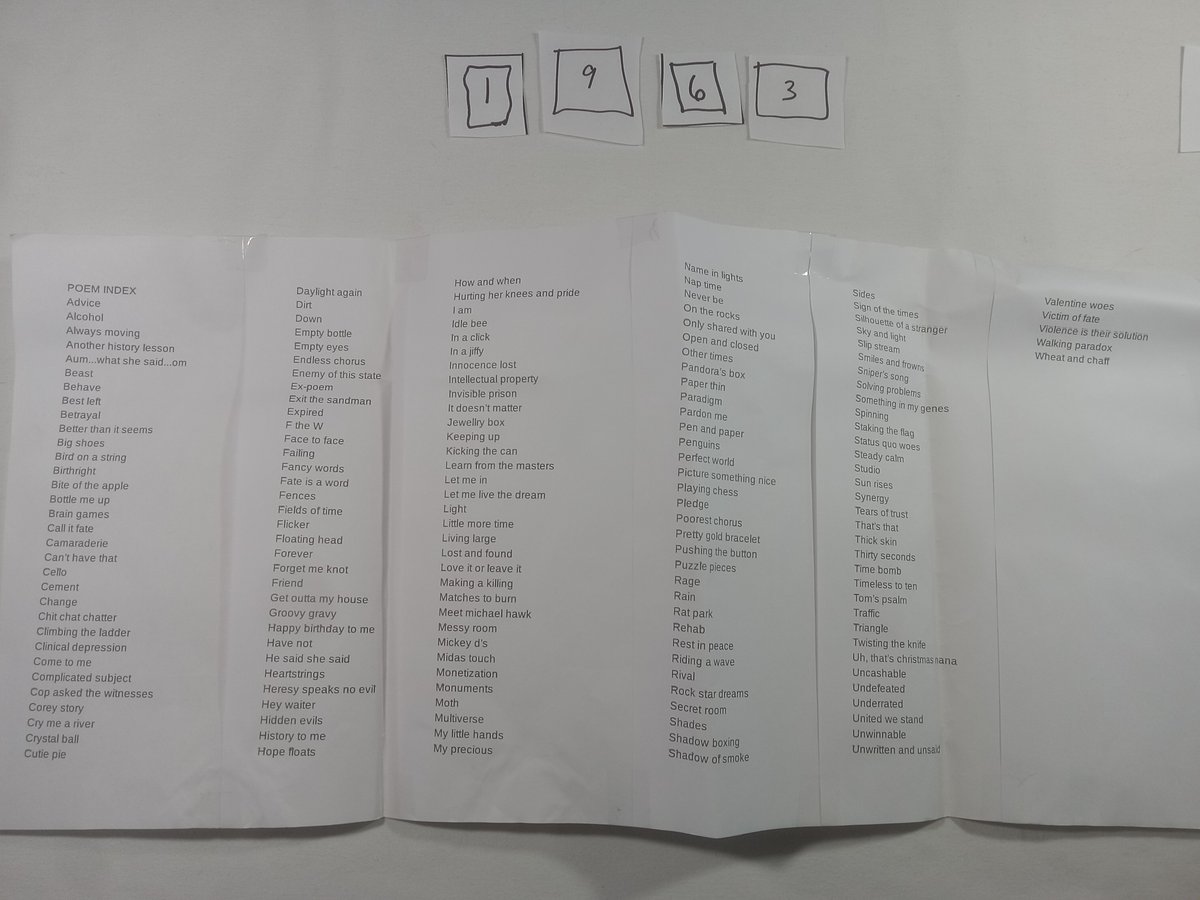
Picture 1 of 6

Picture 2 of 6
Picture 3 of 6
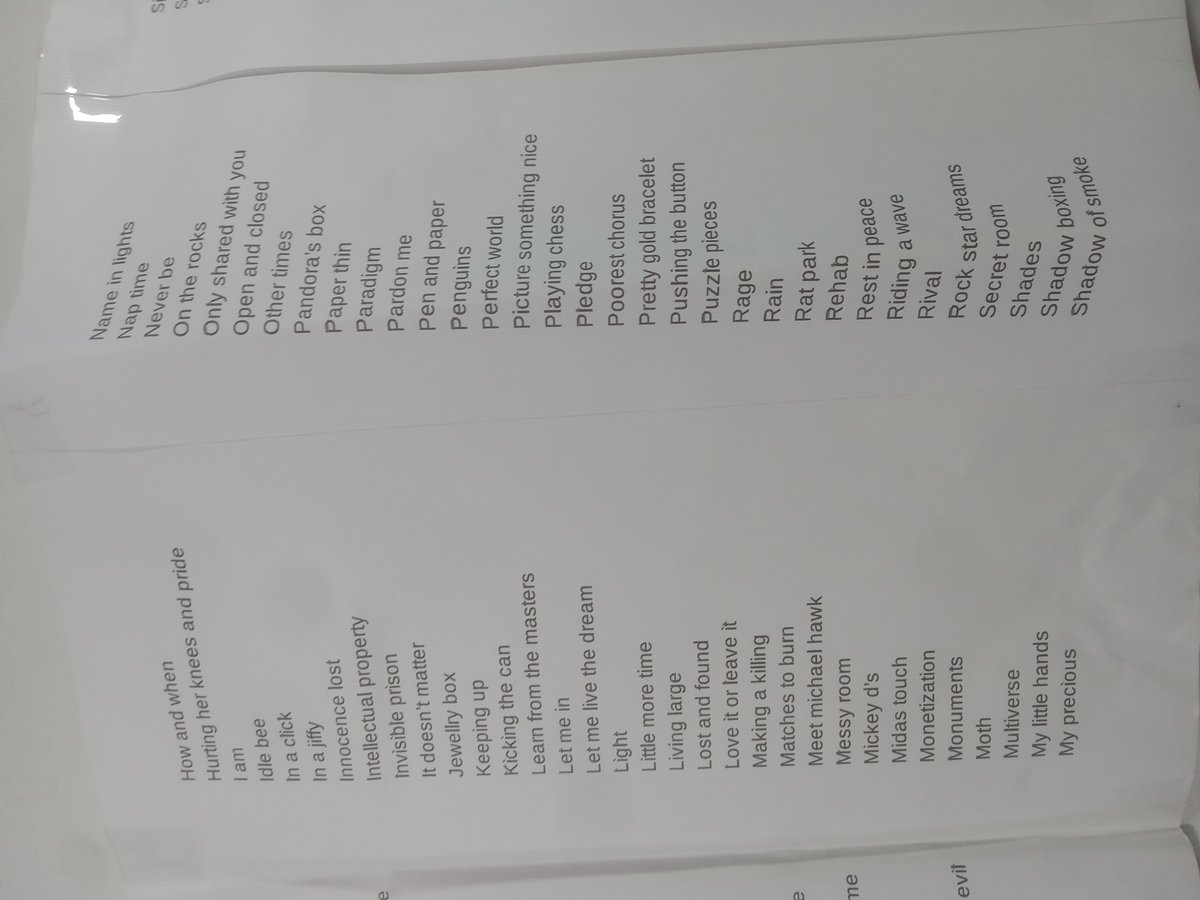
Picture 4 of 6
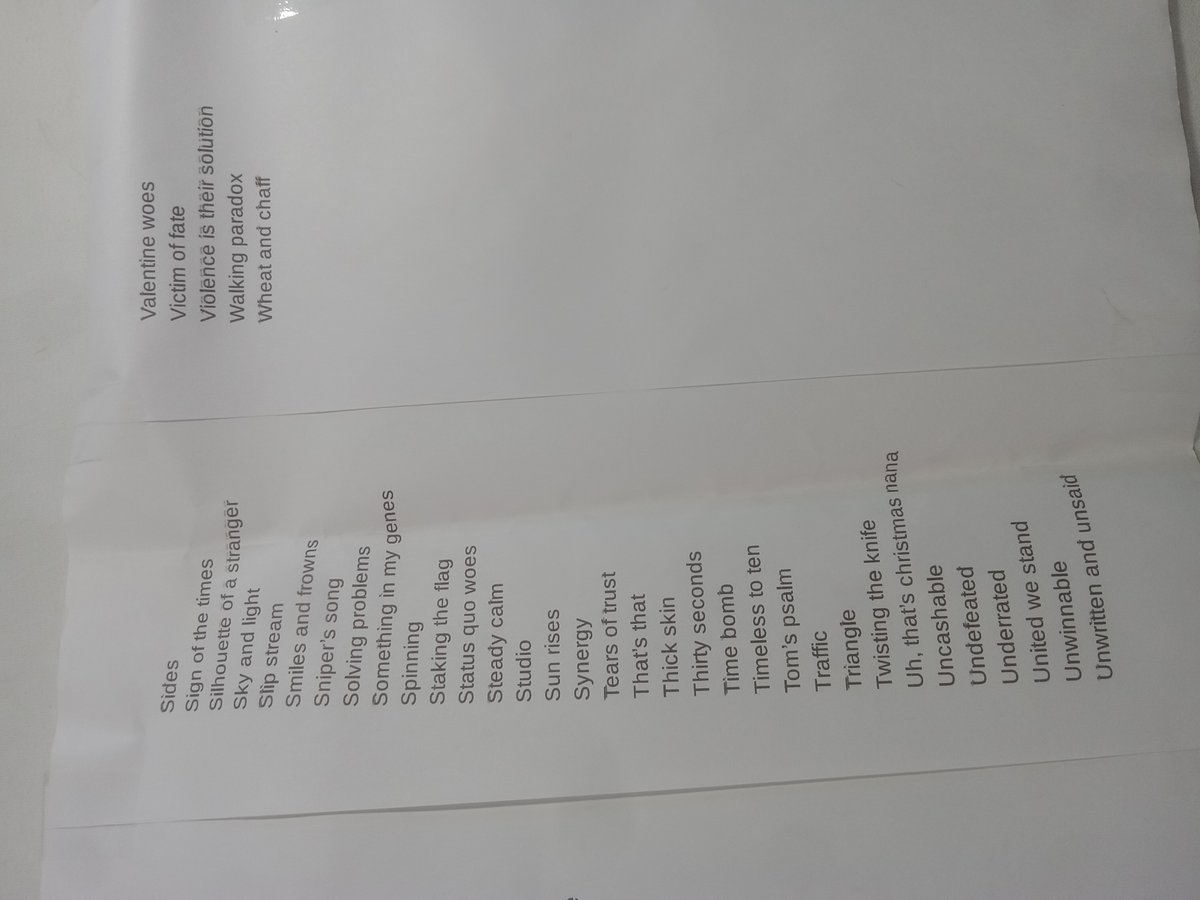
Picture 5 of 6
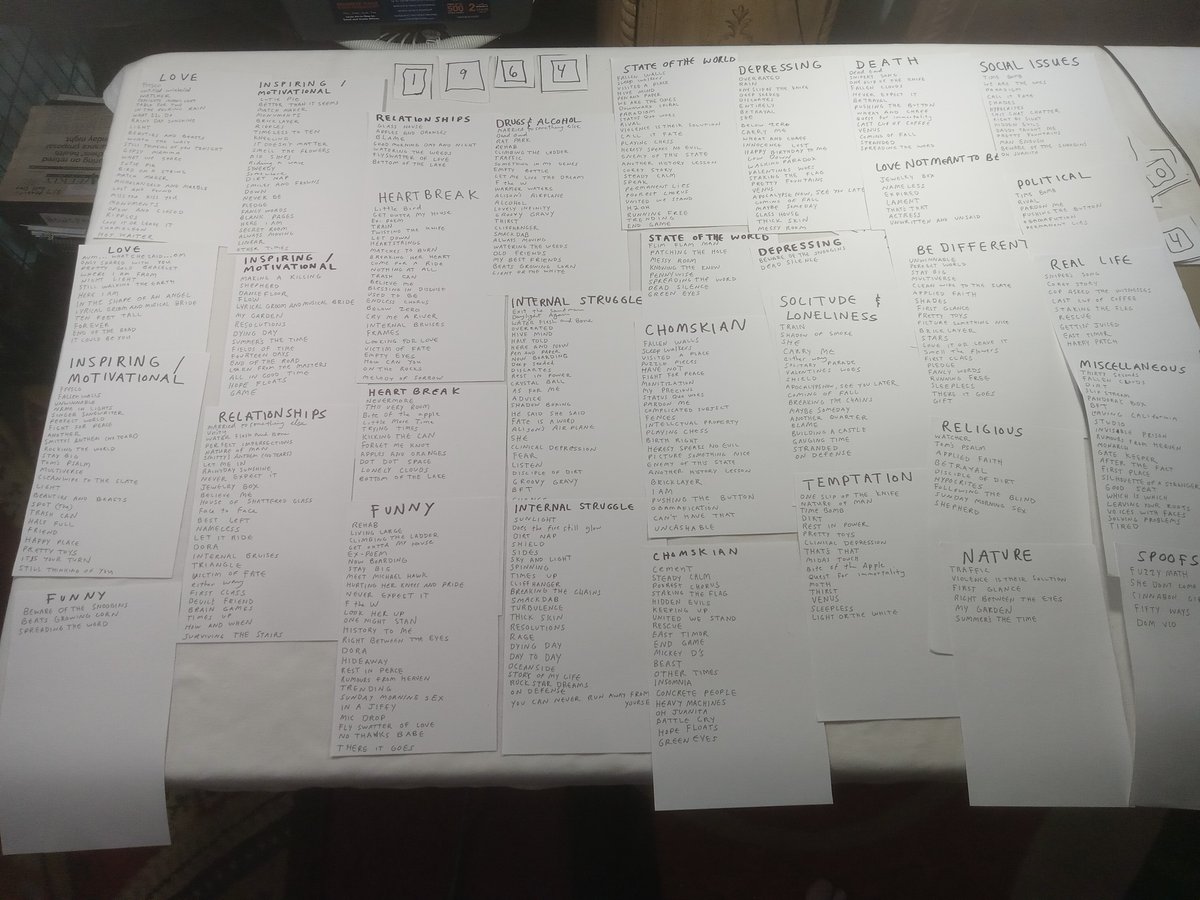
Picture 6 of 6
The words on this page
POEM INDEX
Advice
Alcohol
Always moving
Another history lesson
Aum...what she said...om
Beast
Behave
Best left
Betrayal
Better than it seems
Big shoes
Bird on a string
Birthright
Bite of the apple
Bottle me up
Brain games
Call it fate
Camaraderie
Can't have that
Cello
Cement
Change
Chit chat chatter
Climbing the ladder
Clinical depression
Come to me
Complicated subject
Cop asked the witnesses
Corey story
Cry me a river
Crystal ball
Cutie pie
Daylight again
Dirt
Down
Empty bottle
Empty eyes
Endless chorus
Enemy of this state
Ex-poem
Exit the sandman
Expired
F the W
Face to face
Failing
Fancy words
Fate is a word
Fences
Fields of time
Flicker
Floating head
Forever
Forget me knot
Friend
Get outta my house
Groovy gravy
Happy birthday to me
Have not
He said she said
Heartstrings
Heresy speaks no evil
Hey waiter
Hidden evils
History to me
Hope floats
How and when
Hurting her knees and pride
I am
Idle bee
In a click
In a jiffy
Innocence lost
Intellectual property
Invisible prison
It doesn't matter
Jewellry box
Keeping up
Kicking the can
Learn from the masters
Let me in
Let me live the dream
Light
Little more time
Living large
Lost and found
Love it or leave it
Making a killing
Matches to burn
Meet michael hawk
Messy room
Mickey d's
Midas touch
Monetization
Monuments
Moth
Multiverse
My little hands
My precious
Name in lights
Nap time
Never be
On the rocks
Only shared with you
Open and closed
Other times
Pandora's box
Paper thin
Paradigm
Pardon me
Pen and paper
Penguins
Perfect world
Picture something nice
Playing chess
Pledge
Poorest chorus
Pretty gold bracelet
Pushing the button
Puzzle pieces
Rage
Rain
Rat park
Rehab
Rest in peace
Riding a wave
Rival
Rock star dreams
Secret room
Shades
Shadow boxing
Shadow of smoke
Sides
Sign of the times
Silhouette of a stranger
Sky and light
Slip stream
Smiles and frowns
Sniper's song
Solving problems
Something in my genes
Spinning
Staking the flag
Status quo woes
Steady calm
Studio
Sun rises
Synergy
Tears of trust
That's that
Thick skin
Thirty seconds
Time bomb
Timeless to ten
Tom's psalm
Traffic
Triangle
Twisting the knife
Uh, that's christmas nana
Uncashable
Undefeated
Underrated
United we stand
Unwinnable
Unwritten and unsaid
Valentine woes
Victim of fate
Violence is their solution
Walking paradox
Wheat and chaff
---
POEM INDEX
Advice
Alcohol
Always moving
Another history lesson
Aum...what she said...om
Beast
Behave
Best left
Betrayal
Better than it seems
Big shoes
Bird on a string
Birthright
Bite of the apple
Bottle me up
Brain games
Call it fate
Camaraderie
Can't have that
Cello
Cement
Change
Chit chat chatter
Climbing the ladder
Clinical depression
Come to me
Complicated subject
Cop asked the witnesses
Corey story
Cry me a river
Crystal ball
Cutie pie
Daylight again
Dirt
Down
Empty bottle
Empty eyes
Endless chorus
Enemy of this state
Ex-poem
Exit the sandman
Expired
F the W
Face to face
Failing
Fancy words
Fate is a word
Fences
Fields of time
Flicker
Floating head
Forever
Forget me knot
Friend
Get outta my house
Groovy gravy
Happy birthday to me
Have not
He said she said
Heartstrings
Heresy speaks no evil
Hey waiter
Hidden evils
History to me
Hope floats
---
Name in lights
Nap time
Never be
On the rocks
Only shared with you
Open and closed
Other times
Pandora's box
Paper thin
Paradigm
Pardon me
Pen and paper
Penguins
Perfect world
Picture something nice
Playing chess
Pledge
Poorest chorus
Pretty gold bracelet
Pushing the button
Puzzle pieces
Rage
Rain
Rat park
Rehab
Rest in peace
Riding a wave
Rival
Rock star dreams
Secret room
Shades
Shadow boxing
Shadow of smoke
How and when
Hurting her knees and pride
I am
Idle bee
In a click
In a jiffy
Innocence lost
Intellectual property
Invisible prison
It doesn't matter
Jewellry box
Keeping up
Kicking the can
Learn from the masters
Let me in
Let me live the dream
Light
Little more time
Living large
Lost and found
Love it or leave it
Making a killing
Matches to burn
Meet michael hawk
Messy room
Mickey d's
Midas touch
Monetization
Monuments
Moth
Multiverse
My little hands
My precious
e
me
evil
---
Valentine woes
Victim of fate
Violence is their solution
Walking paradox
Wheat and chaff
Sides
Sign of the times
Silhouette of a stranger
Sky and light
Slip stream
Smiles and frowns
Sniper's song
Solving problems
Something in my genes
Spinning
Staking the flag
Status quo woes
Steady calm
Studio
Sun rises
Synergy
Tears of trust
That's that
Thick skin
Thirty seconds
Time bomb
Timeless to ten
Tom's psalm
Traffic
Triangle
Twisting the knife
Uh, that's christmas nana
Uncashable
Undefeated
Underrated
United we stand
Unwinnable
Unwritten and unsaid
---
3
6
9
1
Advice
Alcohol
Always moving
Another history lesson
Aum...what she said...om
Beast
Behave
Best left
Betrayal
Better than it seems
Big shoes
Bird on a string
Birthright
Bite of the apple
Bottle me up
Brain games
Call it fate
Camaraderie
Can't have that
Cello
Cement
Change
Chit chat chatter
Climbing the ladder
Clinical depression
Come to me
Complicated subject
Cop asked the witnesses
Corey story
Cry me a river
Crystal ball
Cutie pie
Daylight again
Dirt
Down
Empty bottle
Empty eyes
Endless chorus
Enemy of this state
Ex-poem
Exit the sandman
Expired
F the W
Face to face
Failing
Fancy words
Fate is a word
Fences
Fields of time
Flicker
Floating head
Forever
Forget me knot
Friend
Get outta my house
Groovy gravy
Happy birthday to me
Have not
He said she said
Heartstrings
Heresy speaks no evil
Hey waiter
Hidden evils
History to me
Hope floats
How and when
Hurting her knees and pride
I am
Idle bee
In a click
In a jiffy
Innocence lost
Intellectual property
Invisible prison
It doesn't matter
Jewellry box
Keeping up
Kicking the can
Learn from the masters
Let me in
Let me live the dream
Light
Little more time
Living large
Lost and found
Love it or leave it
Making a killing
Matches to burn
Meet michael hawk
Messy room
Mickey d's
Midas touch
Monetization
Monuments
Moth
Multiverse
My little hands
My precious
Name in lights
Nap time
Never be
On the rocks
Only shared with you
Open and closed
Other times
Pandora's box
Paper thin
Paradigm
Pardon me
Pen and paper
Penguins
Perfect world
Picture something nice
Playing chess
Pledge
Poorest chorus
Pretty gold bracelet
Pushing the button
Puzzle pieces
Rage
Rain
Rat park
Rehab
Rest in peace
Riding a wave
Rival
Rock star dreams
Secret room
Shades
Shadow boxing
Shadow of smoke
Sides
Sign of the times
Silhouette of a stranger
Sky and light
Slip stream
Smiles and frowns
Sniper's song
Solving problems
Something in my genes
Spinning
Staking the flag
Status quo woes
Steady calm
Studio
Sun rises
Synergy
Tears of trust
That's that
Thick skin
Thirty seconds
Time bomb
Timeless to ten
Tom's psalm
Traffic
Triangle
Twisting the knife
Uh, that's christmas nana
Uncashable
Undefeated
Underrated
United we stand
Unwinnable
Unwritten and unsaid
Valentine woes
Victim of fate
Violence is their solution
Walking paradox
Wheat and chaff
---
POEM INDEX
Advice
Alcohol
Always moving
Another history lesson
Aum...what she said...om
Beast
Behave
Best left
Betrayal
Better than it seems
Big shoes
Bird on a string
Birthright
Bite of the apple
Bottle me up
Brain games
Call it fate
Camaraderie
Can't have that
Cello
Cement
Change
Chit chat chatter
Climbing the ladder
Clinical depression
Come to me
Complicated subject
Cop asked the witnesses
Corey story
Cry me a river
Crystal ball
Cutie pie
Daylight again
Dirt
Down
Empty bottle
Empty eyes
Endless chorus
Enemy of this state
Ex-poem
Exit the sandman
Expired
F the W
Face to face
Failing
Fancy words
Fate is a word
Fences
Fields of time
Flicker
Floating head
Forever
Forget me knot
Friend
Get outta my house
Groovy gravy
Happy birthday to me
Have not
He said she said
Heartstrings
Heresy speaks no evil
Hey waiter
Hidden evils
History to me
Hope floats
---
Name in lights
Nap time
Never be
On the rocks
Only shared with you
Open and closed
Other times
Pandora's box
Paper thin
Paradigm
Pardon me
Pen and paper
Penguins
Perfect world
Picture something nice
Playing chess
Pledge
Poorest chorus
Pretty gold bracelet
Pushing the button
Puzzle pieces
Rage
Rain
Rat park
Rehab
Rest in peace
Riding a wave
Rival
Rock star dreams
Secret room
Shades
Shadow boxing
Shadow of smoke
How and when
Hurting her knees and pride
I am
Idle bee
In a click
In a jiffy
Innocence lost
Intellectual property
Invisible prison
It doesn't matter
Jewellry box
Keeping up
Kicking the can
Learn from the masters
Let me in
Let me live the dream
Light
Little more time
Living large
Lost and found
Love it or leave it
Making a killing
Matches to burn
Meet michael hawk
Messy room
Mickey d's
Midas touch
Monetization
Monuments
Moth
Multiverse
My little hands
My precious
e
me
evil
---
Valentine woes
Victim of fate
Violence is their solution
Walking paradox
Wheat and chaff
Sides
Sign of the times
Silhouette of a stranger
Sky and light
Slip stream
Smiles and frowns
Sniper's song
Solving problems
Something in my genes
Spinning
Staking the flag
Status quo woes
Steady calm
Studio
Sun rises
Synergy
Tears of trust
That's that
Thick skin
Thirty seconds
Time bomb
Timeless to ten
Tom's psalm
Traffic
Triangle
Twisting the knife
Uh, that's christmas nana
Uncashable
Undefeated
Underrated
United we stand
Unwinnable
Unwritten and unsaid
---
3
6
9
1
Item 1965
WHITE VIDEOS ALPHABETIZED WITH GOOD POEMS FOR SONGS HAVING PAGE NUMBERS...
Printed sheets of white paper with handwritten annotations.
- Why it matters
- Tom writes this
- Type
- Printed page
- Collection
- Tom writes this
- Published in
- IN A BOOK200 Poems Waiting For Music (2013)
Tom Jensen Poem Anthology (2013)
180 Good Poems (2012)
A Lifetime Of Rhyme (2020) - Age when written
- written by age 34 at the latestdated from the earliest book it appears in - the sheet itself may be older
Price · Tier · Tom fills these
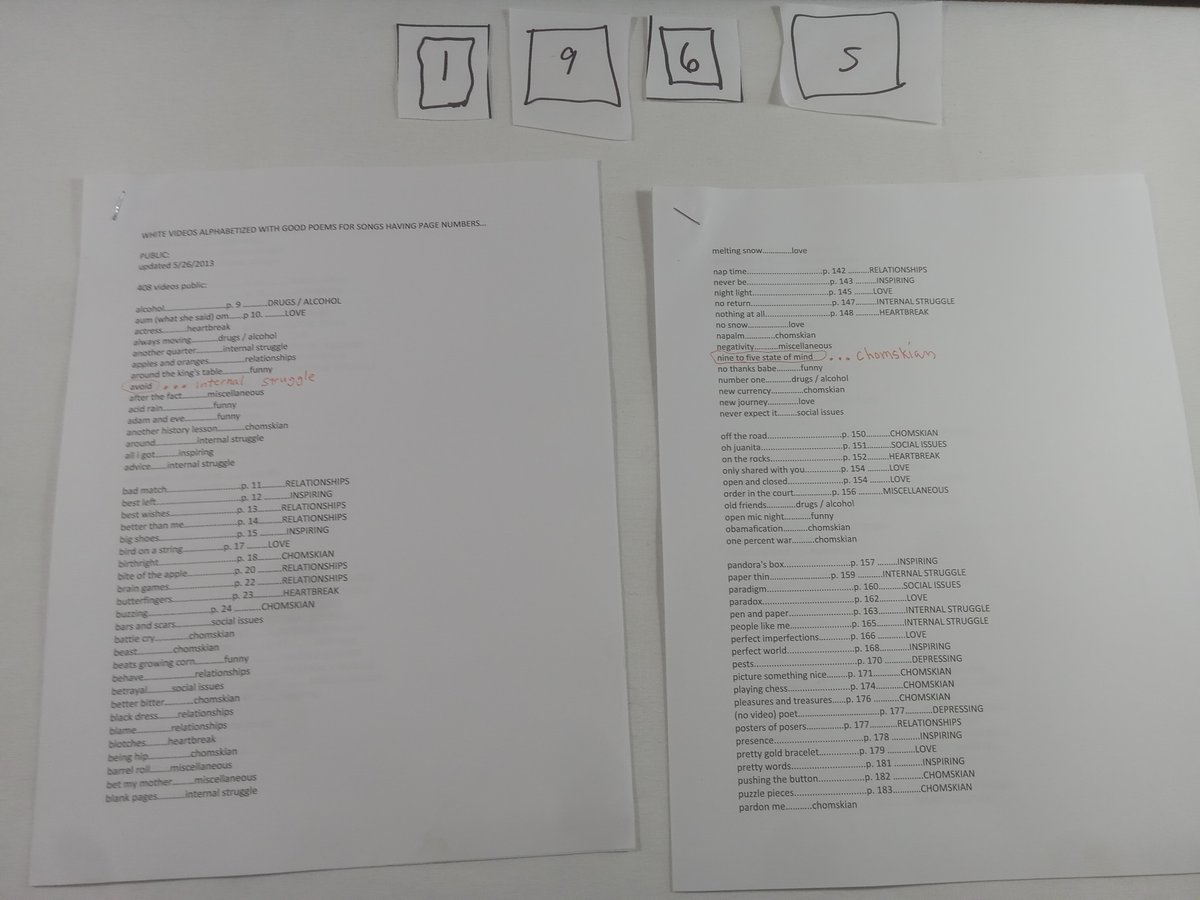
Picture 1 of 12
Picture 2 of 12
Picture 3 of 12
Picture 4 of 12
Picture 5 of 12
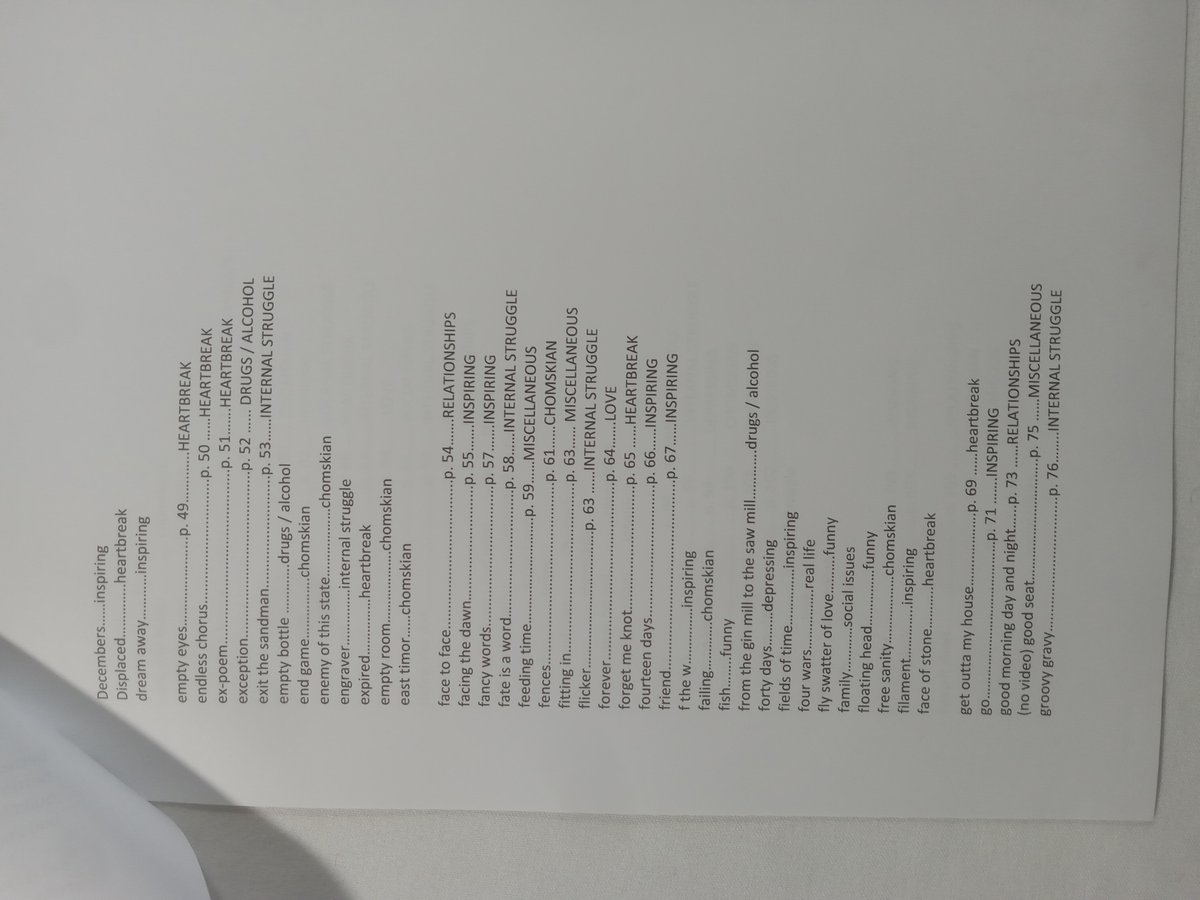
Picture 6 of 12
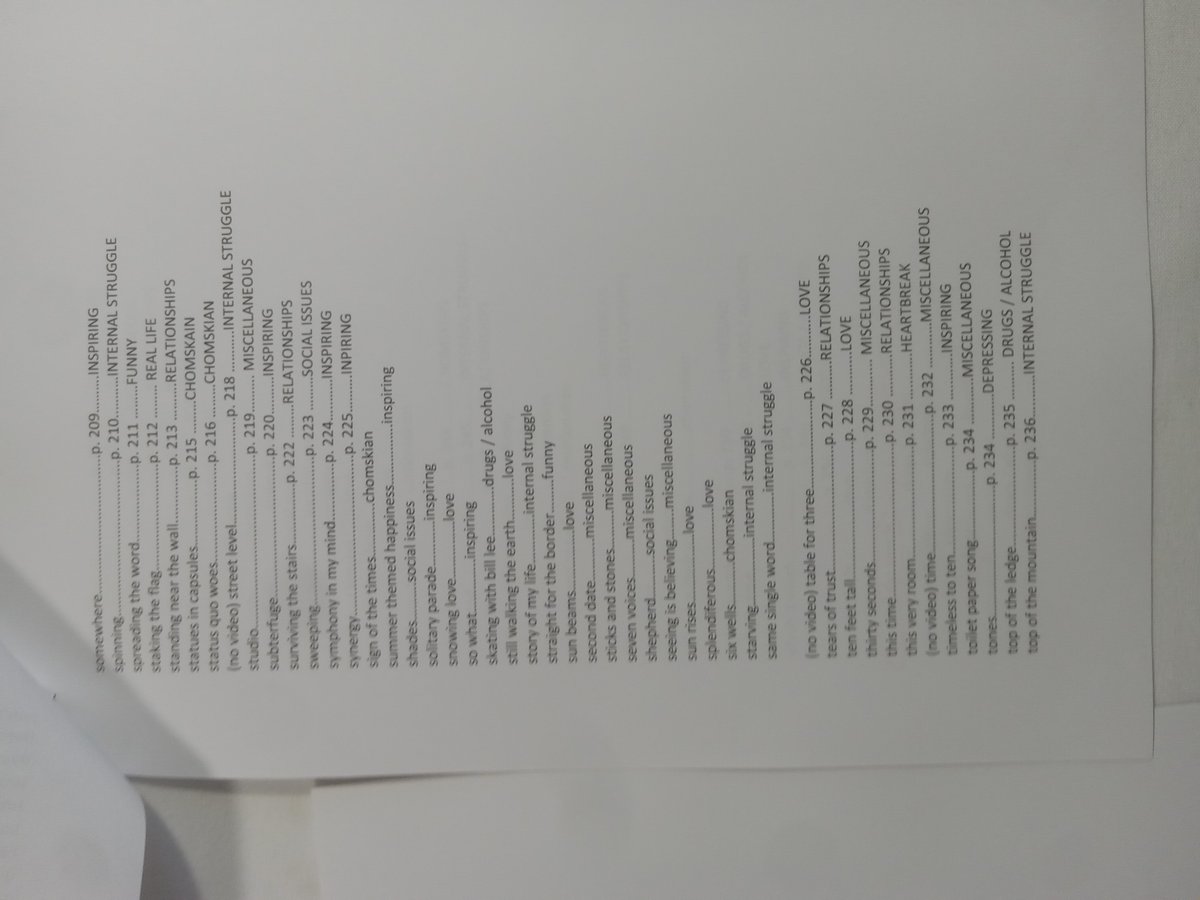
Picture 7 of 12
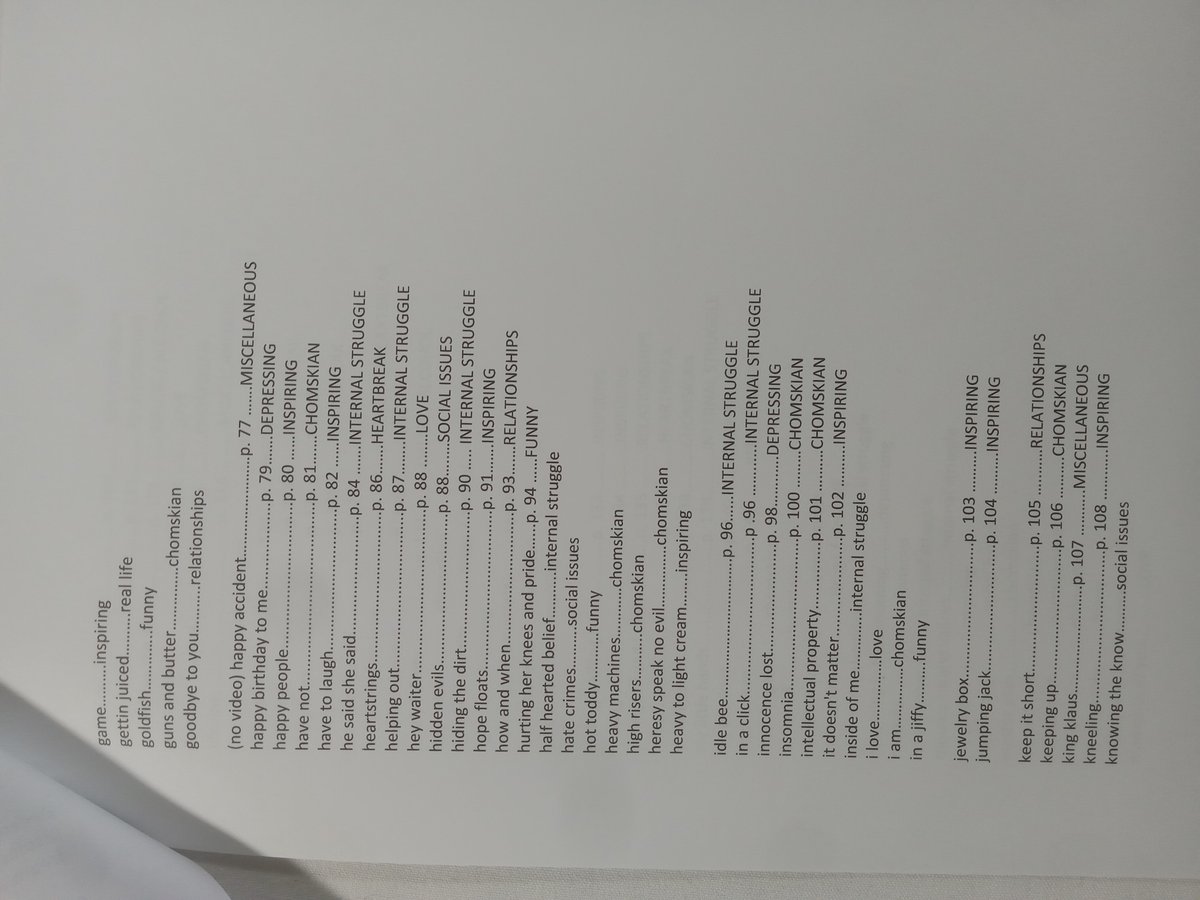
Picture 8 of 12
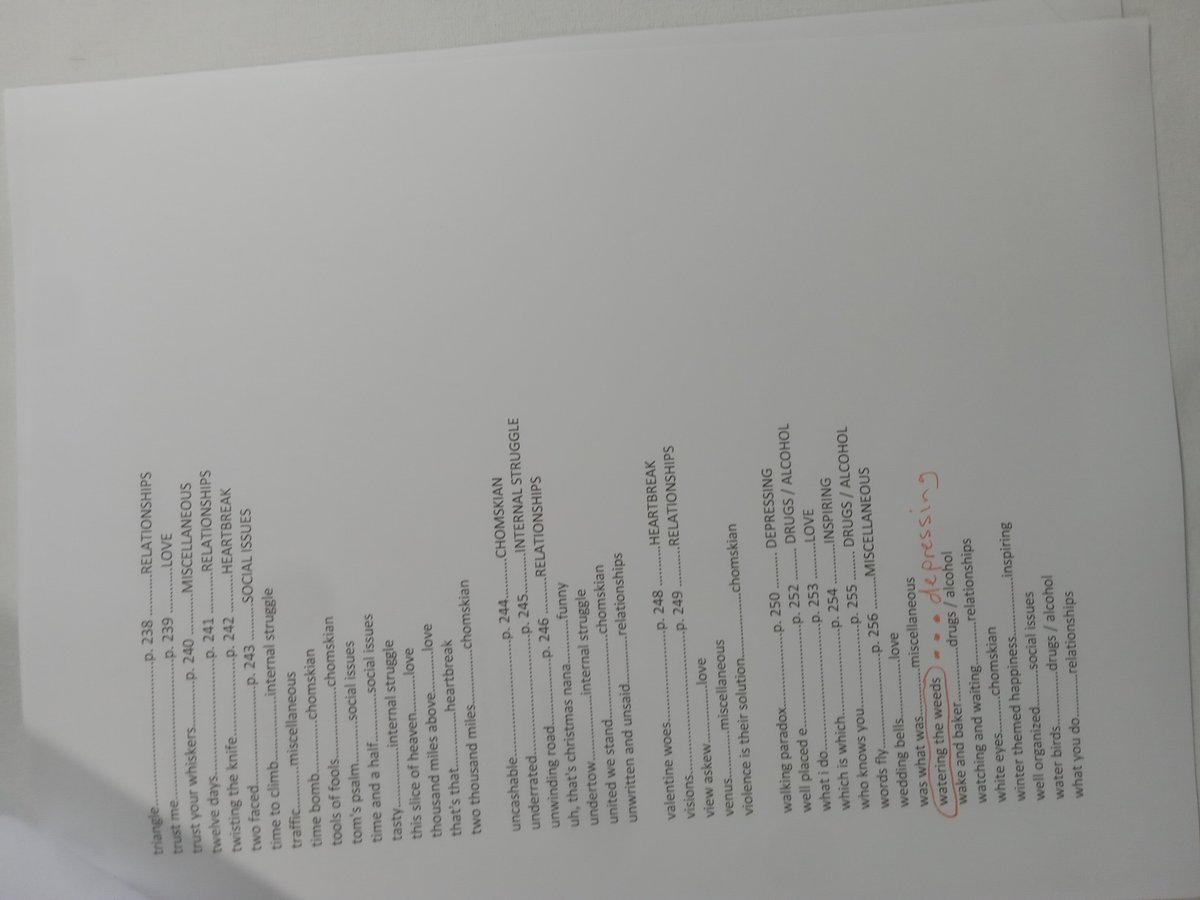
Picture 9 of 12
Picture 10 of 12
Picture 11 of 12
Picture 12 of 12
The words on this page
PUBLIC:
updated 5/26/2013
408 videos public:
alcohol...........................p. 9................DRUGS / ALCOHOL
aum (what she said) om......p. 10.................LOVE
actress...........................heartbreak
always moving..................drugs / alcohol
another quarter.................internal struggle
apples and oranges.............relationships
around the king's table.......funny
avoid . . . internal struggle
after the fact....................miscellaneous
acid rain..........................funny
adam and eve...................funny
another history lesson........chomskian
around.............................internal struggle
all i got............................inspiring
advice..............................internal struggle
bad match.........................p. 11................RELATIONSHIPS
best left...........................p. 12.................INSPIRING
best wishes......................p. 13.................RELATIONSHIPS
better than me.................p. 14.................RELATIONSHIPS
big shoes..........................p. 15.................INSPIRING
bird on a string...............p. 17.................LOVE
birthright..........................p. 18.................CHOMSKIAN
bite of the apple..............p. 20.................RELATIONSHIPS
brain games......................p. 22.................RELATIONSHIPS
butterfingers.....................p. 23.................HEARTBREAK
buzzing.............................p. 24.................CHOMSKIAN
bars and scars.................social issues
battle cry..........................chomskian
beast................................chomskian
beats growing corn............funny
behave..............................relationships
betrayal............................social issues
better bitter......................chomskian
black dress.......................relationships
blame...............................relationships
blotches............................heartbreak
being hip..........................chomskian
barrel roll.........................miscellaneous
bet my mother.................miscellaneous
blank pages......................internal struggle
melting snow...................love
nap time...........................p. 142................RELATIONSHIPS
never be...........................p. 143................INSPIRING
night light.........................p. 145.................LOVE
no return...........................p. 147.................INTERNAL STRUGGLE
nothing at all.....................p. 148.................HEARTBREAK
no snow............................love
napalm.............................chomskian
negativity.........................miscellaneous
nine to five state of mind . . . chomskian
no thanks babe................funny
number one.......................drugs / alcohol
new currency....................chomskian
new journey......................love
never expect it.................social issues
off the road.......................p. 150................CHOMSKIAN
oh juanita.........................p. 151................SOCIAL ISSUES
on the rocks......................p. 152................HEARTBREAK
only shared with you.........p. 154.................LOVE
open and closed...............p. 154.................LOVE
order in the court.............p. 156.................MISCELLANEOUS
old friends........................drugs / alcohol
open mic night.................funny
obamafication...................chomskian
one percent war...............chomskian
pandora's box...................p. 157.................INSPIRING
paper thin.........................p. 159................INTERNAL STRUGGLE
paradigm...........................p. 160................SOCIAL ISSUES
paradox.............................p. 162.................LOVE
pen and paper...................p. 163................INTERNAL STRUGGLE
people like me..................p. 165.................INTERNAL STRUGGLE
perfect imperfections.........p. 166.................LOVE
perfect world.....................p. 168.................INSPIRING
pests.................................p. 170.................DEPRESSING
picture something nice......p. 171.................CHOMSKIAN
playing chess....................p. 174.................CHOMSKIAN
pleasures and treasures....p. 176.................CHOMSKIAN
(no video) poet............................................p. 177.................DEPRESSING
posters of posers..............p. 177.................RELATIONSHIPS
presence............................p. 178.................INSPIRING
pretty gold bracelet..........p. 179.................LOVE
pretty words......................p. 181.................INSPIRING
pushing the button............p. 182.................CHOMSKIAN
puzzle pieces....................p. 183.................CHOMSKIAN
pardon me........................chomskian
---
WHITE VIDEOS ALPHABETIZED WITH GOOD POEMS FOR SONGS HAVING PAGE NUMBERS...
PUBLIC:
updated 5/26/2013
408 videos public:
alcohol.......................................p. 9...............DRUGS / ALCOHOL
aum (what she said) om......p. 10.......LOVE
actress.....................................heartbreak
always moving.........................drugs / alcohol
another quarter.......................internal struggle
apples and oranges................relationships
around the king's table.............funny
after the fact...........................miscellaneous
avoid [handwritten: internal struggle]
acid rain..................................funny
adam and eve...........................funny
another history lesson.............chomskian
around......................................internal struggle
all i got.....................................inspiring
advice.......................................internal struggle
bad match................................p. 11...............RELATIONSHIPS
best left..................................p. 12...............INSPIRING
best wishes.............................p. 13...............RELATIONSHIPS
better than me........................p. 14...............RELATIONSHIPS
big shoes................................p. 15...............INSPIRING
bird on a string....................p. 17...............LOVE
birthright................................p. 18...............CHOMSKIAN
bite of the apple....................p. 20...............RELATIONSHIPS
brain games...........................p. 22...............RELATIONSHIPS
butterfingers..........................p. 23...............HEARTBREAK
buzzing...................................p. 24...............CHOMSKIAN
bars and scars........................social issues
battle cry................................chomskian
beast.......................................chomskian
beats growing corn.................funny
behave.....................................relationships
betrayal..................................social issues
better bitter...........................chomskian
black dress..............................relationships
blame......................................relationships
blotches..................................heartbreak
being hip.................................chomskian
barrel roll...............................miscellaneous
bet my mother........................miscellaneous
blank pages.............................internal struggle
---
melting snow................love
nap time...........................p. 142 ................RELATIONSHIPS
never be...........................p. 143 ................INSPIRING
night light.......................p. 145 ................LOVE
no return..........................p. 147 ................INTERNAL STRUGGLE
nothing at all..................p. 148 ................HEARTBREAK
no snow.............................love
napalm.............................chomskian
negativity.........................miscellaneous
nine to five state of mind . . . Chomskian
no thanks babe...........funny
number one...................drugs / alcohol
new currency..............chomskian
new journey...................love
never expect it........social issues
off the road.......................p. 150 ................CHOMSKIAN
oh juanita..........................p. 151 ................SOCIAL ISSUES
on the rocks......................p. 152 ................HEARTBREAK
only shared with you...p. 154 ................LOVE
open and closed.............p. 154 ................LOVE
order in the court..........p. 156 ................MISCELLANEOUS
old friends.......................drugs / alcohol
open mic night............funny
obamafication................chomskian
one percent war...........chomskian
pandora's box..................p. 157 ................INSPIRING
paper thin.........................p. 159 ................INTERNAL STRUGGLE
paradigm...........................p. 160 ................SOCIAL ISSUES
paradox..............................p. 162 ................LOVE
pen and paper..................p. 163 ................INTERNAL STRUGGLE
people like me..................p. 165 ................INTERNAL STRUGGLE
perfect imperfections....p. 166 ................LOVE
perfect world....................p. 168 ................INSPIRING
pests..................................p. 170 ................DEPRESSING
picture something nice...p. 171 ................CHOMSKIAN
playing chess....................p. 174 ................CHOMSKIAN
pleasures and treasures....p. 176 ................CHOMSKIAN
(no video) poet..................p. 177 ................DEPRESSING
presence.............................p. 177 ................RELATIONSHIPS
pretty gold bracelet........p. 179 ................INSPIRING
pretty words......................p. 181 ................INSPIRING
pushing the button..........p. 182 ................CHOMSKIAN
puzzle pieces.....................p. 183 ................CHOMSKIAN
pardon me........................chomskian
---
better than it seems............internal struggle
better choices...............relationships
building a castle...........internal struggle
building bridges.......internal struggle
call it fate................................p. 24...........SOCIAL ISSUES
cello.........................................p. 26...........CHOMSKIAN
chameleon...............................p. 27...........LOVE
changing the game..................p. 28...........INSPIRING
chit chat chatter......................p. 29...........SOCIAL ISSUES
chosen one...............................p. 30...........LOVE
climbing the ladder..................p. 31...........DRUGS / ALCOHOL
cry me a river..........................p. 33...........HEARTBREAK
crystal ball...............................p. 35...........INTERNAL STRUGGLE
crossing canyons...........inspiring
clear view................internal struggle
complicated subject............chomskian
can't have that............chomskian
cement..................chomskian
cardboard box.............chomskian
close friends..................inspiring
coming home...........love
cop asked the witnesses...........real life
corey story...........social issues
cousin of a kennedy...........chomskian
clever..................relationships
cliffhanger............internal struggle
clinical depression...........social issues
come to me............miscellaneous
dance floor..............................p. 36...........INSPIRING
day to day..............................p. 38...........INTERNAL STRUGGLE
daylight again..........................p. 39...........INTERNAL STRUGGLE
disciple of dirt.........................p. 40...........SOCIAL ISSUES
disrobed...................................p. 41...........INTERNAL STRUGGLE
does the fire still glow..........p. 42...........INTERNAL STRUGGLE
(no video) drink more water.........p. 43...........INSPIRING
drinking solution......................p. 44...........DRUGS / ALCOHOL
dry ice......................................p. 45...........INTERNAL STRUGGLE
(no video) dry wall..................p. 46...........MISCELLANEOUS
dying day................................p. 47...........inspiring
dirt nap..................inspiring
daddy taught me...........social issues
demeanor................heartbreak
dot space................heartbreak
drawing a blank...........chomskian
dropping science...........chomskian
deeper...............internal struggle
---
patching the hole...................chomskian
perception shift................internal struggle
passion for soul................internal struggle
proxy war...............................chomskian
prism..........................miscellaneous
poorest chorus....................chomskian
penguins....................internal struggle
promises...............................inspiring
pyramids...............................inspiring
power is...............................chomskian
proximity......................relationships
puppet......................drugs / alcohol
quest for immortality............social issues
rage..........................................p. 184 ...........INTERNAL STRUGGLE
rain...........................................p. 185 ...........DEPRESSING
rainbow.....................................p. 186 ...........INSPIRING
red on my rose.........................p. 187 ...........INSPIRING
rehab........................................p. 189 ...........DRUGS / ALCOHOL
riding a wave............................p. 191 ...........INSPIRING
rumors from heaven.................p. 192 ...........MISCELLANEOUS
resolutions....................inspiring
running the street..........internal struggle
rest in peace............funny
rest of my days.........depressing
rescue.........social issues
run forrest run................miscellaneous
reincarnation................miscellaneous
robin hood........miscellaneous
rock number ten.................... miscellaneous
racist......................chomskian
red pen........love
secret room.............................p. 194 ...........INSPIRING
see saws..................................p. 195 ...........MISCELLANEOUS
shadow boxing.........................p. 196 ...........INTERNAL STRUGGLE
shimmering..............................p. 196 ...........LOVE
sides.........................................p. 198 ...........INTERNAL STRUGGLE
silhouette of a stranger..........p. 199 ...........MISCELLANEOUS
sky and light............................p. 200 ...........INTERNAL STRUGGLE
slip stream..............................p. 202 ...........MISCELLANEOUS
smiles and frowns..................p. 203 ...........INSPIRING
sniper's song...........................p. 204 ...........REAL LIFE
something................................p. 206 ...........INTERNAL STRUGGLE
something in my genes...........p. 207 ...........DRUGS / ALCOHOL
---
Decembers.....inspiring
Displaced..........heartbreak
dream away..........inspiring
empty eyes..........................p. 49..............HEARTBREAK
endless chorus.................................p. 50....HEARTBREAK
ex-poem............................................p. 51....HEARTBREAK
exception..........................................p. 52....DRUGS / ALCOHOL
exit the sandman.............................p. 53....INTERNAL STRUGGLE
empty bottle.......drugs / alcohol
end game..............chomskian
enemy of this state............chomskian
engraver.............internal struggle
expired..............heartbreak
empty room.............chomskian
east timor.....chomskian
face to face.......................................p. 54....RELATIONSHIPS
facing the dawn...............................p. 55....INSPIRING
fancy words.......................................p. 57....INSPIRING
fate is a word....................................p. 58....INTERNAL STRUGGLE
feeding time......................................p. 59....MISCELLANEOUS
fences................................................p. 61....CHOMSKIAN
fitting in............................................p. 63....MISCELLANEOUS
flicker................................................p. 63....INTERNAL STRUGGLE
forever...............................................p. 64....LOVE
forget me knot..................................p. 65....HEARTBREAK
fourteen days....................................p. 66....INSPIRING
friend................................................p. 67....INSPIRING
f the w...................inspiring
failing................chomskian
fish......funny
from the gin mill to the saw mill..........drugs / alcohol
forty days........depressing
four wars........real life
fly swatter of love.......funny
family........social issues
floating head.......funny
free sanity.........chomskian
filament..........inspiring
face of stone..........heartbreak
get outta my house..........................p. 69....heartbreak
go......................................................p. 71....INSPIRING
good morning day and night....p. 73....RELATIONSHIPS
(no video) good seat.......................p. 75....MISCELLANEOUS
groovy gravy.....................................p. 76....INTERNAL STRUGGLE
---
somewhere............................................p. 209.......INSPIRING
spinning................................................p. 210.......INTERNAL STRUGGLE
spreading the word..............................p. 211.......FUNNY
staking the flag....................................p. 212.......REAL LIFE
standing near the wall........................p. 213.......RELATIONSHIPS
statues in capsules..............................p. 215.......CHOMSKIAN
status quo woes...................................p. 216.......CHOMSKIAN
(no video) street level........................p. 218.......INTERNAL STRUGGLE
studio...................................................p. 219.......MISCELLANEOUS
subterfuge............................................p. 220.......INSPIRING
surviving the stairs..............................p. 222.......RELATIONSHIPS
sweeping..............................................p. 223.......SOCIAL ISSUES
symphony in my mind.........................p. 224.......INSPIRING
synergy.................................................p. 225.......INSPIRING
sign of the times.................................chomskian
summer themed happiness..................inspiring
shades..................................................social issues
solitary parade.....................................inspiring
snowing love........................................love
so what.................................................inspiring
skating with bill lee............................drugs / alcohol
still walking the earth.........................love
story of my life....................................internal struggle
straight for the border........................funny
sun beams............................................love
second date..........................................miscellaneous
sticks and stones.................................miscellaneous
seven voices.........................................miscellaneous
shepherd..............................................social issues
seeing is believing..............................miscellaneous
sun rises...............................................love
splendiferous.......................................love
six wells................................................chomskian
starving.................................................internal struggle
same single word.................................internal struggle
(no video) table for three...................p. 226.......LOVE
tears of trust........................................p. 227.......RELATIONSHIPS
ten feet tall.........................................p. 228.......LOVE
thirty seconds......................................p. 229.......MISCELLANEOUS
this time..............................................p. 230.......RELATIONSHIPS
this very room.....................................p. 231.......HEARTBREAK
(no video) time...................................p. 232.......MISCELLANEOUS
timeless to ten.....................................p. 233.......INSPIRING
toilet paper song.................................p. 234.......MISCELLANEOUS
tones....................................................p. 234.......DEPRESSING
top of the ledge...................................p. 235.......DRUGS / ALCOHOL
top of the mountain.............................p. 236.......INTERNAL STRUGGLE
---
game............inspiring
gettin juiced............real life
goldfish............funny
guns and butter............chomskian
goodbye to you............relationships
(no video) happy accident............p. 77............MISCELLANEOUS
happy birthday to me............p. 79............DEPRESSING
happy people............p. 80............INSPIRING
have not............p. 81............CHOMSKIAN
have to laugh............p. 82............INSPIRING
he said she said............p. 84............INTERNAL STRUGGLE
heartstrings............p. 86............HEARTBREAK
helping out............p. 87............INTERNAL STRUGGLE
hey waiter............p. 88............LOVE
hidden evils............p. 88............SOCIAL ISSUES
hiding the dirt............p. 90............INTERNAL STRUGGLE
hope floats............p. 91............INSPIRING
how and when............p. 93............RELATIONSHIPS
hurting her knees and pride............p. 94............FUNNY
half hearted belief............internal struggle
hate crimes............social issues
hot toddy............funny
heavy machines............chomskian
high risers............chomskian
heresy speak no evil............chomskian
heavy to light cream............inspiring
idle bee............p. 96............INTERNAL STRUGGLE
in a click............p. 96............INTERNAL STRUGGLE
innocence lost............p. 98............DEPRESSING
insomnia............p. 100............CHOMSKIAN
intellectual property............p. 101............CHOMSKIAN
it doesn't matter............p. 102............INSPIRING
inside of me............internal struggle
i love............love
i am............chomskian
in a jiffy............funny
jewelry box............p. 103............INSPIRING
jumping jack............p. 104............INSPIRING
keep it short............p. 105............RELATIONSHIPS
keeping up............p. 106............CHOMSKIAN
king klaus............p. 107............MISCELLANEOUS
kneeling............p. 108............INSPIRING
knowing the know............social issues
---
triangle.........................................................p. 238...........RELATIONSHIPS
trust me......................................................p. 239...........LOVE
trust your whiskers..................................p. 240...........MISCELLANEOUS
twelve days...............................................p. 241...........RELATIONSHIPS
twisting the knife....................................p. 242...........HEARTBREAK
two faced..................................................p. 243...........SOCIAL ISSUES
traffic.........................................................internal struggle
time to climb............................................chomskian
time bomb.................................................miscellaneous
tools of fools............................................chomskian
tom's psalm..............................................social issues
time and a half.........................................social issues
tasty...........................................................internal struggle
this slice of heaven.................................love
thousand miles above..............................love
that's that.................................................heartbreak
two thousand miles..................................chomskian
uncashable...............................................p. 244...........CHOMSKIAN
underrated...............................................p. 245...........INTERNAL STRUGGLE
unwinding road.......................................p. 246...........RELATIONSHIPS
uh, that's christmas nana.......................funny
undertow.................................................internal struggle
united we stand......................................chomskian
unwritten and unsaid.............................relationships
valentine woes........................................p. 248...........HEARTBREAK
visions......................................................p. 249...........RELATIONSHIPS
view askew...............................................love
venus.........................................................miscellaneous
violence is their solution........................chomskian
walking paradox......................................p. 250...........DEPRESSING
well placed e............................................p. 252...........DRUGS / ALCOHOL
what i do...................................................p. 253...........LOVE
which is which.........................................p. 254...........INSPIRING
who knows you........................................p. 255...........DRUGS / ALCOHOL
words fly...................................................p. 256...........MISCELLANEOUS
wedding bells..........................................love
was what was...........................................miscellaneous
watering the weeds (red circle around these words) • • depressing (handwritten in red)
wake and baker.......................................drugs / alcohol
white eyes..................................................chomskian
watching and waiting..............................relationships
winter themed happiness........................inspiring
well organized..........................................social issues
water birds...............................................drugs / alcohol
what you do..............................................relationships
---
you spilled my coffee.......... p. 257 .......... MISCELLANEOUS
LOCKED VIDEO LIST:
13 videos are private
all in a day
yard dog
secret code
why women go in pairs
postal worker's payback
pass a rash
high noon
grown to love
fifty ways to leave your lover
beware of the snoogins
portapotty hotty
meet michael hawk
me seeing you
---
let it ride..........................p. 109 .........RELATIONSHIPS
let me in...........................p. 111 .........RELATIONSHIPS
let me live the dream..........p. 113 .........DRUGS / ALCOHOL
let me shine......................p. 114 .........LOVE
liars and lawyers..............p. 115 .........CHOMSKIAN
life line..............................p. 116 .........MISCELLANEOUS
(no video) like rolling a bone...........p. 118 .........SPOOF / PARODY
little ditties.......................p. 123 .........INSPIRING
little more time..................p. 124 .........HEARTBREAK
living large........................p. 125 .........FUNNY
lonely clouds....................p. 126 .........HEARTBREAK
lost and found..................p. 128 .........LOVE
(no video) lost love..............p. 129 .........HEARTBREAK
love it or leave it..............p. 130 .........LOVE
lovely infinity....................p. 132 .........DRUGS / ALCOHOL
lazy citizen........................chomskian
light or the white..............drugs / alcohol
light...................................inspiring
learn from the masters.......real life
lawn noams.......................chomskian
little break.........................inspiring
making a killing.................p. 133 .........INSPIRING
making a list......................p. 134 .........INSPIRING
me myself and i.................p. 135 .........RELATIONSHIPS
mine..................................p. 137 .........HEARTBREAK
monetization.....................p. 138 .........CHOMSKIAN
my little hands.................p. 139 .........INTERNAL STRUGGLE
my precious......................p. 140 .........CHOMSKIAN
mystic haze......................p. 141 .........RELATIONSHIPS
mud slingers.....................chomskian
mister ed...........................chomskian
minority majority.............social issues
my best friends.................drugs / alcohol
men on my shoulder...........internal struggle
mourning in the morning...depressing
morsals..............................miscellaneous
messy room.......................internal struggle
mountains and valleys.......internal struggle
my garden..........................inspiring
man enough......................social issues
me and you........................chomskian
midas touch.......................miscellaneous
money train.......................funny
my biography....................chomskian
mickey d's.........................chomskian
memories of you..............LOVE
updated 5/26/2013
408 videos public:
alcohol...........................p. 9................DRUGS / ALCOHOL
aum (what she said) om......p. 10.................LOVE
actress...........................heartbreak
always moving..................drugs / alcohol
another quarter.................internal struggle
apples and oranges.............relationships
around the king's table.......funny
avoid . . . internal struggle
after the fact....................miscellaneous
acid rain..........................funny
adam and eve...................funny
another history lesson........chomskian
around.............................internal struggle
all i got............................inspiring
advice..............................internal struggle
bad match.........................p. 11................RELATIONSHIPS
best left...........................p. 12.................INSPIRING
best wishes......................p. 13.................RELATIONSHIPS
better than me.................p. 14.................RELATIONSHIPS
big shoes..........................p. 15.................INSPIRING
bird on a string...............p. 17.................LOVE
birthright..........................p. 18.................CHOMSKIAN
bite of the apple..............p. 20.................RELATIONSHIPS
brain games......................p. 22.................RELATIONSHIPS
butterfingers.....................p. 23.................HEARTBREAK
buzzing.............................p. 24.................CHOMSKIAN
bars and scars.................social issues
battle cry..........................chomskian
beast................................chomskian
beats growing corn............funny
behave..............................relationships
betrayal............................social issues
better bitter......................chomskian
black dress.......................relationships
blame...............................relationships
blotches............................heartbreak
being hip..........................chomskian
barrel roll.........................miscellaneous
bet my mother.................miscellaneous
blank pages......................internal struggle
melting snow...................love
nap time...........................p. 142................RELATIONSHIPS
never be...........................p. 143................INSPIRING
night light.........................p. 145.................LOVE
no return...........................p. 147.................INTERNAL STRUGGLE
nothing at all.....................p. 148.................HEARTBREAK
no snow............................love
napalm.............................chomskian
negativity.........................miscellaneous
nine to five state of mind . . . chomskian
no thanks babe................funny
number one.......................drugs / alcohol
new currency....................chomskian
new journey......................love
never expect it.................social issues
off the road.......................p. 150................CHOMSKIAN
oh juanita.........................p. 151................SOCIAL ISSUES
on the rocks......................p. 152................HEARTBREAK
only shared with you.........p. 154.................LOVE
open and closed...............p. 154.................LOVE
order in the court.............p. 156.................MISCELLANEOUS
old friends........................drugs / alcohol
open mic night.................funny
obamafication...................chomskian
one percent war...............chomskian
pandora's box...................p. 157.................INSPIRING
paper thin.........................p. 159................INTERNAL STRUGGLE
paradigm...........................p. 160................SOCIAL ISSUES
paradox.............................p. 162.................LOVE
pen and paper...................p. 163................INTERNAL STRUGGLE
people like me..................p. 165.................INTERNAL STRUGGLE
perfect imperfections.........p. 166.................LOVE
perfect world.....................p. 168.................INSPIRING
pests.................................p. 170.................DEPRESSING
picture something nice......p. 171.................CHOMSKIAN
playing chess....................p. 174.................CHOMSKIAN
pleasures and treasures....p. 176.................CHOMSKIAN
(no video) poet............................................p. 177.................DEPRESSING
posters of posers..............p. 177.................RELATIONSHIPS
presence............................p. 178.................INSPIRING
pretty gold bracelet..........p. 179.................LOVE
pretty words......................p. 181.................INSPIRING
pushing the button............p. 182.................CHOMSKIAN
puzzle pieces....................p. 183.................CHOMSKIAN
pardon me........................chomskian
---
WHITE VIDEOS ALPHABETIZED WITH GOOD POEMS FOR SONGS HAVING PAGE NUMBERS...
PUBLIC:
updated 5/26/2013
408 videos public:
alcohol.......................................p. 9...............DRUGS / ALCOHOL
aum (what she said) om......p. 10.......LOVE
actress.....................................heartbreak
always moving.........................drugs / alcohol
another quarter.......................internal struggle
apples and oranges................relationships
around the king's table.............funny
after the fact...........................miscellaneous
avoid [handwritten: internal struggle]
acid rain..................................funny
adam and eve...........................funny
another history lesson.............chomskian
around......................................internal struggle
all i got.....................................inspiring
advice.......................................internal struggle
bad match................................p. 11...............RELATIONSHIPS
best left..................................p. 12...............INSPIRING
best wishes.............................p. 13...............RELATIONSHIPS
better than me........................p. 14...............RELATIONSHIPS
big shoes................................p. 15...............INSPIRING
bird on a string....................p. 17...............LOVE
birthright................................p. 18...............CHOMSKIAN
bite of the apple....................p. 20...............RELATIONSHIPS
brain games...........................p. 22...............RELATIONSHIPS
butterfingers..........................p. 23...............HEARTBREAK
buzzing...................................p. 24...............CHOMSKIAN
bars and scars........................social issues
battle cry................................chomskian
beast.......................................chomskian
beats growing corn.................funny
behave.....................................relationships
betrayal..................................social issues
better bitter...........................chomskian
black dress..............................relationships
blame......................................relationships
blotches..................................heartbreak
being hip.................................chomskian
barrel roll...............................miscellaneous
bet my mother........................miscellaneous
blank pages.............................internal struggle
---
melting snow................love
nap time...........................p. 142 ................RELATIONSHIPS
never be...........................p. 143 ................INSPIRING
night light.......................p. 145 ................LOVE
no return..........................p. 147 ................INTERNAL STRUGGLE
nothing at all..................p. 148 ................HEARTBREAK
no snow.............................love
napalm.............................chomskian
negativity.........................miscellaneous
nine to five state of mind . . . Chomskian
no thanks babe...........funny
number one...................drugs / alcohol
new currency..............chomskian
new journey...................love
never expect it........social issues
off the road.......................p. 150 ................CHOMSKIAN
oh juanita..........................p. 151 ................SOCIAL ISSUES
on the rocks......................p. 152 ................HEARTBREAK
only shared with you...p. 154 ................LOVE
open and closed.............p. 154 ................LOVE
order in the court..........p. 156 ................MISCELLANEOUS
old friends.......................drugs / alcohol
open mic night............funny
obamafication................chomskian
one percent war...........chomskian
pandora's box..................p. 157 ................INSPIRING
paper thin.........................p. 159 ................INTERNAL STRUGGLE
paradigm...........................p. 160 ................SOCIAL ISSUES
paradox..............................p. 162 ................LOVE
pen and paper..................p. 163 ................INTERNAL STRUGGLE
people like me..................p. 165 ................INTERNAL STRUGGLE
perfect imperfections....p. 166 ................LOVE
perfect world....................p. 168 ................INSPIRING
pests..................................p. 170 ................DEPRESSING
picture something nice...p. 171 ................CHOMSKIAN
playing chess....................p. 174 ................CHOMSKIAN
pleasures and treasures....p. 176 ................CHOMSKIAN
(no video) poet..................p. 177 ................DEPRESSING
presence.............................p. 177 ................RELATIONSHIPS
pretty gold bracelet........p. 179 ................INSPIRING
pretty words......................p. 181 ................INSPIRING
pushing the button..........p. 182 ................CHOMSKIAN
puzzle pieces.....................p. 183 ................CHOMSKIAN
pardon me........................chomskian
---
better than it seems............internal struggle
better choices...............relationships
building a castle...........internal struggle
building bridges.......internal struggle
call it fate................................p. 24...........SOCIAL ISSUES
cello.........................................p. 26...........CHOMSKIAN
chameleon...............................p. 27...........LOVE
changing the game..................p. 28...........INSPIRING
chit chat chatter......................p. 29...........SOCIAL ISSUES
chosen one...............................p. 30...........LOVE
climbing the ladder..................p. 31...........DRUGS / ALCOHOL
cry me a river..........................p. 33...........HEARTBREAK
crystal ball...............................p. 35...........INTERNAL STRUGGLE
crossing canyons...........inspiring
clear view................internal struggle
complicated subject............chomskian
can't have that............chomskian
cement..................chomskian
cardboard box.............chomskian
close friends..................inspiring
coming home...........love
cop asked the witnesses...........real life
corey story...........social issues
cousin of a kennedy...........chomskian
clever..................relationships
cliffhanger............internal struggle
clinical depression...........social issues
come to me............miscellaneous
dance floor..............................p. 36...........INSPIRING
day to day..............................p. 38...........INTERNAL STRUGGLE
daylight again..........................p. 39...........INTERNAL STRUGGLE
disciple of dirt.........................p. 40...........SOCIAL ISSUES
disrobed...................................p. 41...........INTERNAL STRUGGLE
does the fire still glow..........p. 42...........INTERNAL STRUGGLE
(no video) drink more water.........p. 43...........INSPIRING
drinking solution......................p. 44...........DRUGS / ALCOHOL
dry ice......................................p. 45...........INTERNAL STRUGGLE
(no video) dry wall..................p. 46...........MISCELLANEOUS
dying day................................p. 47...........inspiring
dirt nap..................inspiring
daddy taught me...........social issues
demeanor................heartbreak
dot space................heartbreak
drawing a blank...........chomskian
dropping science...........chomskian
deeper...............internal struggle
---
patching the hole...................chomskian
perception shift................internal struggle
passion for soul................internal struggle
proxy war...............................chomskian
prism..........................miscellaneous
poorest chorus....................chomskian
penguins....................internal struggle
promises...............................inspiring
pyramids...............................inspiring
power is...............................chomskian
proximity......................relationships
puppet......................drugs / alcohol
quest for immortality............social issues
rage..........................................p. 184 ...........INTERNAL STRUGGLE
rain...........................................p. 185 ...........DEPRESSING
rainbow.....................................p. 186 ...........INSPIRING
red on my rose.........................p. 187 ...........INSPIRING
rehab........................................p. 189 ...........DRUGS / ALCOHOL
riding a wave............................p. 191 ...........INSPIRING
rumors from heaven.................p. 192 ...........MISCELLANEOUS
resolutions....................inspiring
running the street..........internal struggle
rest in peace............funny
rest of my days.........depressing
rescue.........social issues
run forrest run................miscellaneous
reincarnation................miscellaneous
robin hood........miscellaneous
rock number ten.................... miscellaneous
racist......................chomskian
red pen........love
secret room.............................p. 194 ...........INSPIRING
see saws..................................p. 195 ...........MISCELLANEOUS
shadow boxing.........................p. 196 ...........INTERNAL STRUGGLE
shimmering..............................p. 196 ...........LOVE
sides.........................................p. 198 ...........INTERNAL STRUGGLE
silhouette of a stranger..........p. 199 ...........MISCELLANEOUS
sky and light............................p. 200 ...........INTERNAL STRUGGLE
slip stream..............................p. 202 ...........MISCELLANEOUS
smiles and frowns..................p. 203 ...........INSPIRING
sniper's song...........................p. 204 ...........REAL LIFE
something................................p. 206 ...........INTERNAL STRUGGLE
something in my genes...........p. 207 ...........DRUGS / ALCOHOL
---
Decembers.....inspiring
Displaced..........heartbreak
dream away..........inspiring
empty eyes..........................p. 49..............HEARTBREAK
endless chorus.................................p. 50....HEARTBREAK
ex-poem............................................p. 51....HEARTBREAK
exception..........................................p. 52....DRUGS / ALCOHOL
exit the sandman.............................p. 53....INTERNAL STRUGGLE
empty bottle.......drugs / alcohol
end game..............chomskian
enemy of this state............chomskian
engraver.............internal struggle
expired..............heartbreak
empty room.............chomskian
east timor.....chomskian
face to face.......................................p. 54....RELATIONSHIPS
facing the dawn...............................p. 55....INSPIRING
fancy words.......................................p. 57....INSPIRING
fate is a word....................................p. 58....INTERNAL STRUGGLE
feeding time......................................p. 59....MISCELLANEOUS
fences................................................p. 61....CHOMSKIAN
fitting in............................................p. 63....MISCELLANEOUS
flicker................................................p. 63....INTERNAL STRUGGLE
forever...............................................p. 64....LOVE
forget me knot..................................p. 65....HEARTBREAK
fourteen days....................................p. 66....INSPIRING
friend................................................p. 67....INSPIRING
f the w...................inspiring
failing................chomskian
fish......funny
from the gin mill to the saw mill..........drugs / alcohol
forty days........depressing
four wars........real life
fly swatter of love.......funny
family........social issues
floating head.......funny
free sanity.........chomskian
filament..........inspiring
face of stone..........heartbreak
get outta my house..........................p. 69....heartbreak
go......................................................p. 71....INSPIRING
good morning day and night....p. 73....RELATIONSHIPS
(no video) good seat.......................p. 75....MISCELLANEOUS
groovy gravy.....................................p. 76....INTERNAL STRUGGLE
---
somewhere............................................p. 209.......INSPIRING
spinning................................................p. 210.......INTERNAL STRUGGLE
spreading the word..............................p. 211.......FUNNY
staking the flag....................................p. 212.......REAL LIFE
standing near the wall........................p. 213.......RELATIONSHIPS
statues in capsules..............................p. 215.......CHOMSKIAN
status quo woes...................................p. 216.......CHOMSKIAN
(no video) street level........................p. 218.......INTERNAL STRUGGLE
studio...................................................p. 219.......MISCELLANEOUS
subterfuge............................................p. 220.......INSPIRING
surviving the stairs..............................p. 222.......RELATIONSHIPS
sweeping..............................................p. 223.......SOCIAL ISSUES
symphony in my mind.........................p. 224.......INSPIRING
synergy.................................................p. 225.......INSPIRING
sign of the times.................................chomskian
summer themed happiness..................inspiring
shades..................................................social issues
solitary parade.....................................inspiring
snowing love........................................love
so what.................................................inspiring
skating with bill lee............................drugs / alcohol
still walking the earth.........................love
story of my life....................................internal struggle
straight for the border........................funny
sun beams............................................love
second date..........................................miscellaneous
sticks and stones.................................miscellaneous
seven voices.........................................miscellaneous
shepherd..............................................social issues
seeing is believing..............................miscellaneous
sun rises...............................................love
splendiferous.......................................love
six wells................................................chomskian
starving.................................................internal struggle
same single word.................................internal struggle
(no video) table for three...................p. 226.......LOVE
tears of trust........................................p. 227.......RELATIONSHIPS
ten feet tall.........................................p. 228.......LOVE
thirty seconds......................................p. 229.......MISCELLANEOUS
this time..............................................p. 230.......RELATIONSHIPS
this very room.....................................p. 231.......HEARTBREAK
(no video) time...................................p. 232.......MISCELLANEOUS
timeless to ten.....................................p. 233.......INSPIRING
toilet paper song.................................p. 234.......MISCELLANEOUS
tones....................................................p. 234.......DEPRESSING
top of the ledge...................................p. 235.......DRUGS / ALCOHOL
top of the mountain.............................p. 236.......INTERNAL STRUGGLE
---
game............inspiring
gettin juiced............real life
goldfish............funny
guns and butter............chomskian
goodbye to you............relationships
(no video) happy accident............p. 77............MISCELLANEOUS
happy birthday to me............p. 79............DEPRESSING
happy people............p. 80............INSPIRING
have not............p. 81............CHOMSKIAN
have to laugh............p. 82............INSPIRING
he said she said............p. 84............INTERNAL STRUGGLE
heartstrings............p. 86............HEARTBREAK
helping out............p. 87............INTERNAL STRUGGLE
hey waiter............p. 88............LOVE
hidden evils............p. 88............SOCIAL ISSUES
hiding the dirt............p. 90............INTERNAL STRUGGLE
hope floats............p. 91............INSPIRING
how and when............p. 93............RELATIONSHIPS
hurting her knees and pride............p. 94............FUNNY
half hearted belief............internal struggle
hate crimes............social issues
hot toddy............funny
heavy machines............chomskian
high risers............chomskian
heresy speak no evil............chomskian
heavy to light cream............inspiring
idle bee............p. 96............INTERNAL STRUGGLE
in a click............p. 96............INTERNAL STRUGGLE
innocence lost............p. 98............DEPRESSING
insomnia............p. 100............CHOMSKIAN
intellectual property............p. 101............CHOMSKIAN
it doesn't matter............p. 102............INSPIRING
inside of me............internal struggle
i love............love
i am............chomskian
in a jiffy............funny
jewelry box............p. 103............INSPIRING
jumping jack............p. 104............INSPIRING
keep it short............p. 105............RELATIONSHIPS
keeping up............p. 106............CHOMSKIAN
king klaus............p. 107............MISCELLANEOUS
kneeling............p. 108............INSPIRING
knowing the know............social issues
---
triangle.........................................................p. 238...........RELATIONSHIPS
trust me......................................................p. 239...........LOVE
trust your whiskers..................................p. 240...........MISCELLANEOUS
twelve days...............................................p. 241...........RELATIONSHIPS
twisting the knife....................................p. 242...........HEARTBREAK
two faced..................................................p. 243...........SOCIAL ISSUES
traffic.........................................................internal struggle
time to climb............................................chomskian
time bomb.................................................miscellaneous
tools of fools............................................chomskian
tom's psalm..............................................social issues
time and a half.........................................social issues
tasty...........................................................internal struggle
this slice of heaven.................................love
thousand miles above..............................love
that's that.................................................heartbreak
two thousand miles..................................chomskian
uncashable...............................................p. 244...........CHOMSKIAN
underrated...............................................p. 245...........INTERNAL STRUGGLE
unwinding road.......................................p. 246...........RELATIONSHIPS
uh, that's christmas nana.......................funny
undertow.................................................internal struggle
united we stand......................................chomskian
unwritten and unsaid.............................relationships
valentine woes........................................p. 248...........HEARTBREAK
visions......................................................p. 249...........RELATIONSHIPS
view askew...............................................love
venus.........................................................miscellaneous
violence is their solution........................chomskian
walking paradox......................................p. 250...........DEPRESSING
well placed e............................................p. 252...........DRUGS / ALCOHOL
what i do...................................................p. 253...........LOVE
which is which.........................................p. 254...........INSPIRING
who knows you........................................p. 255...........DRUGS / ALCOHOL
words fly...................................................p. 256...........MISCELLANEOUS
wedding bells..........................................love
was what was...........................................miscellaneous
watering the weeds (red circle around these words) • • depressing (handwritten in red)
wake and baker.......................................drugs / alcohol
white eyes..................................................chomskian
watching and waiting..............................relationships
winter themed happiness........................inspiring
well organized..........................................social issues
water birds...............................................drugs / alcohol
what you do..............................................relationships
---
you spilled my coffee.......... p. 257 .......... MISCELLANEOUS
LOCKED VIDEO LIST:
13 videos are private
all in a day
yard dog
secret code
why women go in pairs
postal worker's payback
pass a rash
high noon
grown to love
fifty ways to leave your lover
beware of the snoogins
portapotty hotty
meet michael hawk
me seeing you
---
let it ride..........................p. 109 .........RELATIONSHIPS
let me in...........................p. 111 .........RELATIONSHIPS
let me live the dream..........p. 113 .........DRUGS / ALCOHOL
let me shine......................p. 114 .........LOVE
liars and lawyers..............p. 115 .........CHOMSKIAN
life line..............................p. 116 .........MISCELLANEOUS
(no video) like rolling a bone...........p. 118 .........SPOOF / PARODY
little ditties.......................p. 123 .........INSPIRING
little more time..................p. 124 .........HEARTBREAK
living large........................p. 125 .........FUNNY
lonely clouds....................p. 126 .........HEARTBREAK
lost and found..................p. 128 .........LOVE
(no video) lost love..............p. 129 .........HEARTBREAK
love it or leave it..............p. 130 .........LOVE
lovely infinity....................p. 132 .........DRUGS / ALCOHOL
lazy citizen........................chomskian
light or the white..............drugs / alcohol
light...................................inspiring
learn from the masters.......real life
lawn noams.......................chomskian
little break.........................inspiring
making a killing.................p. 133 .........INSPIRING
making a list......................p. 134 .........INSPIRING
me myself and i.................p. 135 .........RELATIONSHIPS
mine..................................p. 137 .........HEARTBREAK
monetization.....................p. 138 .........CHOMSKIAN
my little hands.................p. 139 .........INTERNAL STRUGGLE
my precious......................p. 140 .........CHOMSKIAN
mystic haze......................p. 141 .........RELATIONSHIPS
mud slingers.....................chomskian
mister ed...........................chomskian
minority majority.............social issues
my best friends.................drugs / alcohol
men on my shoulder...........internal struggle
mourning in the morning...depressing
morsals..............................miscellaneous
messy room.......................internal struggle
mountains and valleys.......internal struggle
my garden..........................inspiring
man enough......................social issues
me and you........................chomskian
midas touch.......................miscellaneous
money train.......................funny
my biography....................chomskian
mickey d's.........................chomskian
memories of you..............LOVE
Item 1970
Politician Blues
A single sheet of white printer paper.
- Why it matters
- Tom writes this
- Type
- Printed page
- Collection
- Tom writes thisthe old category list says: STATE OF THE WORLD (not checked by Tom)
- Published in
- ON THE 34 ALBUMSGo Ask Gramm [S10] · as the song PARDON MEmatched on the words: three or more seven-word runs shared with that song
IN A BOOKPoems By Tom (2007)
The November 2024 Collection (2024)
Tom Jensen Poem Anthology (2013)
Brian Rainstorm: Poetry Not Dead (2014)
Only The Best (2018)
A Lifetime Of Rhyme (2020)
The 714-Page Book (2012)
The Laima Dedication Anthology (2011)
34 Albums, Books 1 and 2 (2026)
Chomskian Poems (2011)
Revised 31 Albums With Index (2024)
Tom Jensen Lyrics (2019) - Age when written
- written by age 29 at the latestdated from the earliest book it appears in - the sheet itself may be older
Price · Tier · Tom fills these
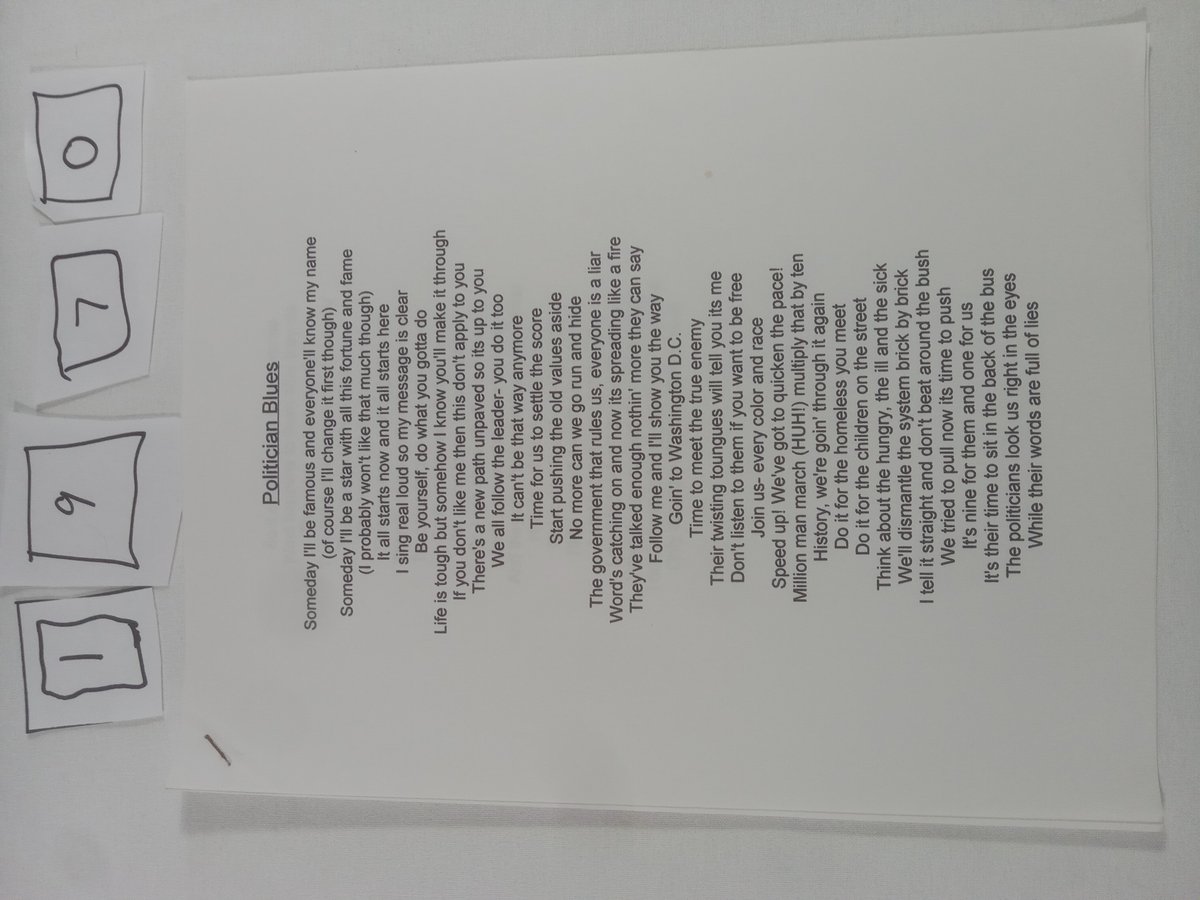
Picture 1 of 2
Picture 2 of 2
The words on this page
Politician Blues
Someday I'll be famous and everyone'll know my name
(of course I'll change it first though)
Someday I'll be a star with all this fortune and fame
(I probably won't like that much though)
It all starts now and it all starts here
I sing real loud so my message is clear
Be yourself, do what you gotta do
Life is tough but somehow I know you'll make it through
If you don't like me then this don't apply to you
There's a new path unpaved so its up to you
We all follow the leader- you do it too
It can't be that way anymore
Time for us to settle the score
Start pushing the old values aside
No more can we go run and hide
The government that rules us, everyone is a liar
Word's catching on and now its spreading like a fire
They've talked enough nothin' more they can say
Follow me and I'll show you the way
Goin' to Washington D.C.
Time to meet the true enemy
Their twisting toungues will tell you its me
Don't listen to them if you want to be free
Join us- every color and race
Speed up! We've got to quicken the pace!
Million man march (HUH!) multiply that by ten
History, we're goin' through it again
Do it for the homeless you meet
Do it for the children on the street
Think about the hungry, the ill and the sick
We'll dismantle the system brick by brick
I tell it straight and don't beat around the bush
We tried to pull now its time to push
It's nine for them and one for us
It's their time to sit in the back of the bus
The politicians look us right in the eyes
While their words are full of lies
---
So it should come to no surprise
What happens to them after they die
They care not for us only "I"
They tell me because when I ask why
They learned it from their peers
That honesty has disapeared
There's no one left who really cares
I'm going to give each one a mirror
So they can see what we see
I'm going to run for president
So I can show what's so evident
I will answer questions truthfully
And they can think what they want of me
I'll hide behind no mask at all
Not forced to sit I will stand tall
I'll be myself, I won't wear no vail
I smoked pot and I INHALED
I don't hide what I don't understand
What do you expect? I'm a simple man
I don't mean to bring you all the bad news
Only the story of the politician blues
Item 1972
Another Cigarette (Chairman of the Bored)
A white sheet of paper with small separate paper squares containing hand-drawn numbers attached to the left.
- Why it matters
- Tom writes this
- Type
- Printed page
- Collection
- Tom writes this
- Published in
- IN A BOOKTom Jensen Poem Anthology (2013)
The 714-Page Book (2012)
The Laima Dedication Anthology (2011) - Age when written
- written by age 33 at the latestdated from the earliest book it appears in - the sheet itself may be older
- Copies
- 2 in the catalogue · also written out as number 445matched on the words by machine - Tom confirms
Price · Tier · Tom fills these
The only picture of this piece
The words on this page
Another Cigarette (Chairman of the Bored)
Another sleepless night as rain falls from the sky
Another cigarette and I ask myself why
What have I done thats been keeping me awake?
Not like I'm a bad man, never a life I did take
Grab a beer from the fridge it helps me to think
I doubt it'll make me tired it's my last drink
Looking through an open window at the cars passing by
Another cigarette as I ask myself why
Could be depression or it could be something more
Not sure why I'm down there's alot I'm thankful for
I've done more in twenty years than some in a whole life
I've already found a beautiful girl who'd make a beautiful wife
She's been gone for a week but she'll be back here in a day
I'd tell you all about her but my love is more than I can say
Another cigarette and I ask myself why
Why I feel so low when I should be so high
For the first time in awhile I've got my life on track
The only time I can remember that they've finally cut me slack
I'm now moving forward rather than turning back
How come I can't sleep everytime I hit the sack?
Another cigarette, I know I should quit but I tried
Why do I feel like this, like I want to go and hide?
I look okay to you 'cause you can't see inside
When I say I got something to do then you know I lied
I'm the new chairman of the bored 'cause Frank Sinatra died
Item 1973
THIS SLICE OF HEAVEN
White and off-white creased, yellowed paper sheets accompanied by small hand-drawn number cards.
- Why it matters
- Tom writes this
- Type
- Printed page
- Collection
- Tom writes thisthe old category list says: LOVE (not checked by Tom)
- Published in
- ON THE 34 ALBUMSLove Without a Doubt [SL5] · as the song WHAT WE SHAREmatched on the words: three or more seven-word runs shared with that song
IN A BOOKPoems By Tom (2007)
The November 2024 Collection (2024)
Tom Jensen Poem Anthology (2013)
Finished Song Lyrics (2011)
Only The Best (2018)
A Lifetime Of Rhyme (2020)
The 714-Page Book (2012)
The Laima Dedication Anthology (2011)
34 Albums, Books 1 and 2 (2026)
Brian Rainstorm Song Lyric Book (2014)
The November 2012 Anthology (2012)
Revised 31 Albums With Index (2024)
Tom Jensen Lyrics (2019) - Age when written
- written by age 29 at the latestdated from the earliest book it appears in - the sheet itself may be older
Price · Tier · Tom fills these
Picture 1 of 3
Picture 2 of 3
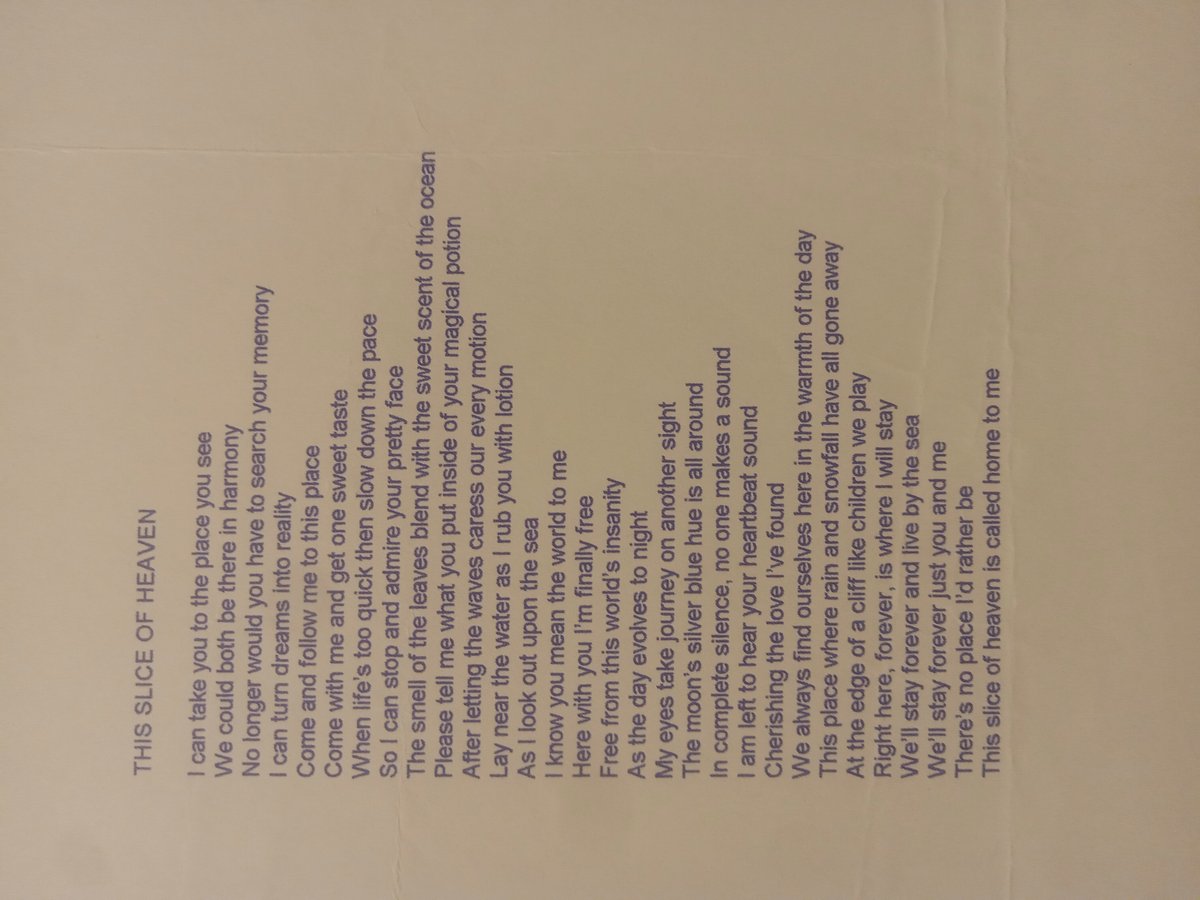
Picture 3 of 3
The words on this page
THIS SLICE OF HEAVEN
I can take you to the place you see
We could both be there in harmony
No longer will you have to search your memory
I can turn dreams into reality
Come and follow me to this place
Come with me and get one sweet taste
When life's too quick slow down the pace
So I can stop and admire your pretty face
The smell of the leaves blend with the sweet scent of the ocean
Please tell me what you put inside of your magical potion
After letting the waves caress our every motion
Lay by the water as I rub you with lotion
As I look out upon the sea
I know you mean the world to me
Here with you I'm finally free
Free from this world's insanity
As the day evolves into the night
My eyes take journey through another sight
The moon's silver blue hue is all around
In complete silence, noone makes a sound
I am left to hear your heartbeat pound
Cherrishing the love I've found
We always find ourselves here in the warmth of day
This place where rain and snowfall have all gone away
At the edge of a cliff like children we play
Right here, forever, is where I will stay
We'll stay forever and live by the sea
We'll stay forever just you and me
There's no other place I'd rather be
This slice of heaven is called home to me
Item 1974
DEAD END
A white sheet of paper with printed text.
- Why it matters
- Tom writes this
- Type
- Printed page
- Collection
- Tom writes thisthe old category list says: DEATH ; DRUGS & ALCOHOL (not checked by Tom)
- Published in
- ON THE 34 ALBUMSSheila Tequila [SL2] · as the song DEAD ENDmatched on the words: three or more seven-word runs shared with that song
IN A BOOKPoems By Tom (2007)
The November 2024 Collection (2024)
Finished Song Lyrics (2011)
Only The Best (2018)
A Lifetime Of Rhyme (2020)
The 714-Page Book (2012)
The Laima Dedication Anthology (2011)
34 Albums, Books 1 and 2 (2026)
Brian Rainstorm Song Lyric Book (2014)
The November 2012 Anthology (2012)
Revised 31 Albums With Index (2024)
Tom Jensen Lyrics (2019) - Age when written
- written by age 29 at the latestdated from the earliest book it appears in - the sheet itself may be older
Price · Tier · Tom fills these
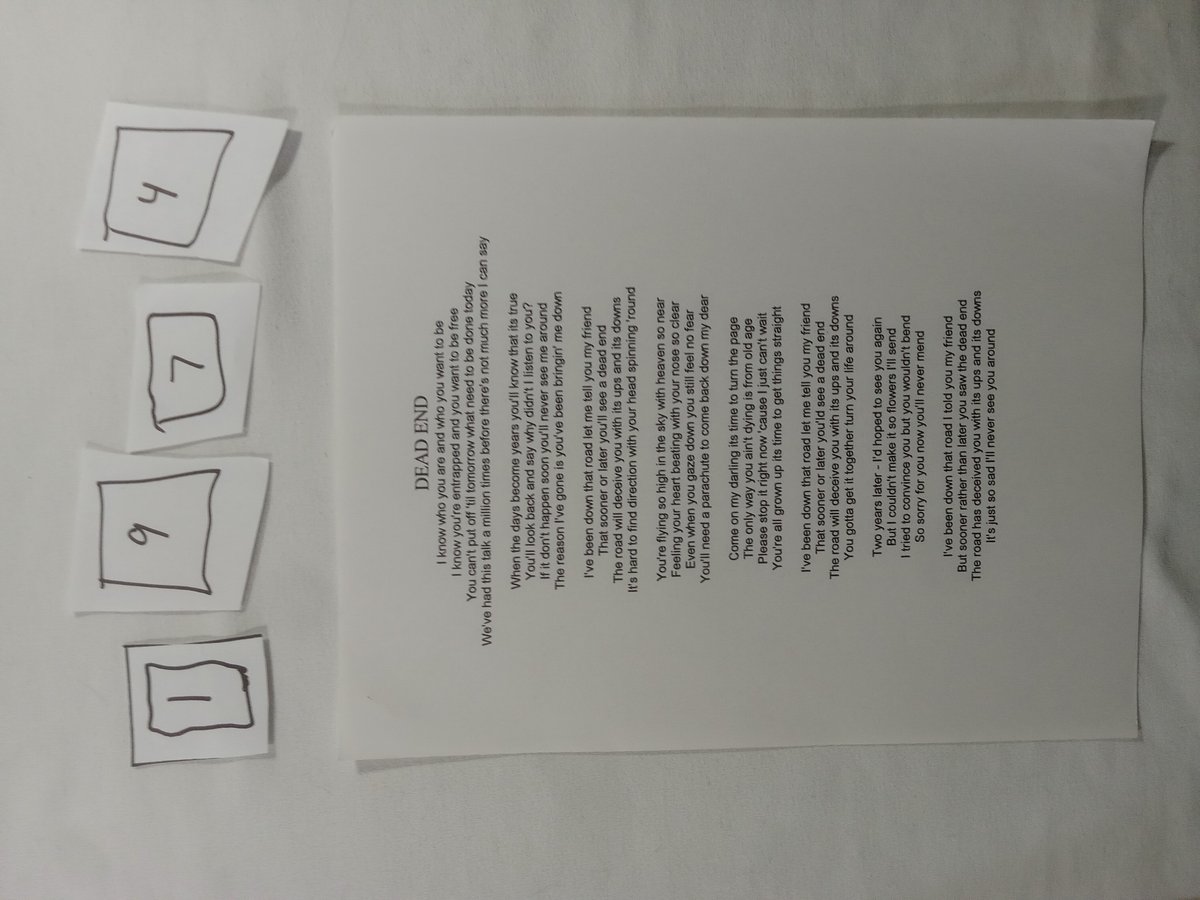
The only picture of this piece
The words on this page
DEAD END
I know who you are and who you want to be
I know you're entrapped and you want to be free
You can't put off 'til tomorrow what need to be done today
We've had this talk a million times before there's not much more I can say
When the days become years you'll know that its true
You'll look back and say why didn't I listen to you?
If it don't happen soon you'll never see me around
The reason I've gone is you've been bringin' me down
I've been down that road let me tell you my friend
That sooner or later you'll see a dead end
The road will deceive you with its ups and its downs
It's hard to find direction with your head spinning 'round
You're flying so high in the sky with heaven so near
Feeling your heart beating with your nose so clear
Even when you gaze down you still feel no fear
You'll need a parachute to come back down my dear
Come on my darling its time to turn the page
The only way you ain't dying is from old age
Please stop it right now 'cause I just can't wait
You're all grown up its time to get things straight
I've been down that road let me tell you my friend
That sooner or later you'll see a dead end
The road will deceive you with its ups and its downs
You gotta get it together turn your life around
Two years later - I'd hoped to see you again
But I couldn't make it so flowers I'll send
I tried to convince you but you wouldn't bend
So sorry for you now you'll never mend
I've been down that road I told you my friend
But sooner rather than later you saw the dead end
The road has deceived you with its ups and its downs
It's just so sad I'll never see you around
Item 1975
ALISON'S AIRPLANE
Printed white paper accompanied by four paper-backed, hand-drawn number cards.
- Why it matters
- Tom writes this
- Type
- Printed page
- Collection
- Tom writes thisthe old category list says: DRUGS & ALCOHOL ; INTERNAL STRUGGLE (not checked by Tom)
- Published in
- ON THE 34 ALBUMSSheila Tequila [SL2] · as the song ALISON'S AIRPLANEmatched on the words: three or more seven-word runs shared with that song
IN A BOOKPoems By Tom (2007)
The November 2024 Collection (2024)
Finished Song Lyrics (2011)
Only The Best (2018)
A Lifetime Of Rhyme (2020)
The 714-Page Book (2012)
The Laima Dedication Anthology (2011)
34 Albums, Books 1 and 2 (2026)
Brian Rainstorm Song Lyric Book (2014)
The November 2012 Anthology (2012)
Revised 31 Albums With Index (2024) - Age when written
- written by age 29 at the latestdated from the earliest book it appears in - the sheet itself may be older
Price · Tier · Tom fills these
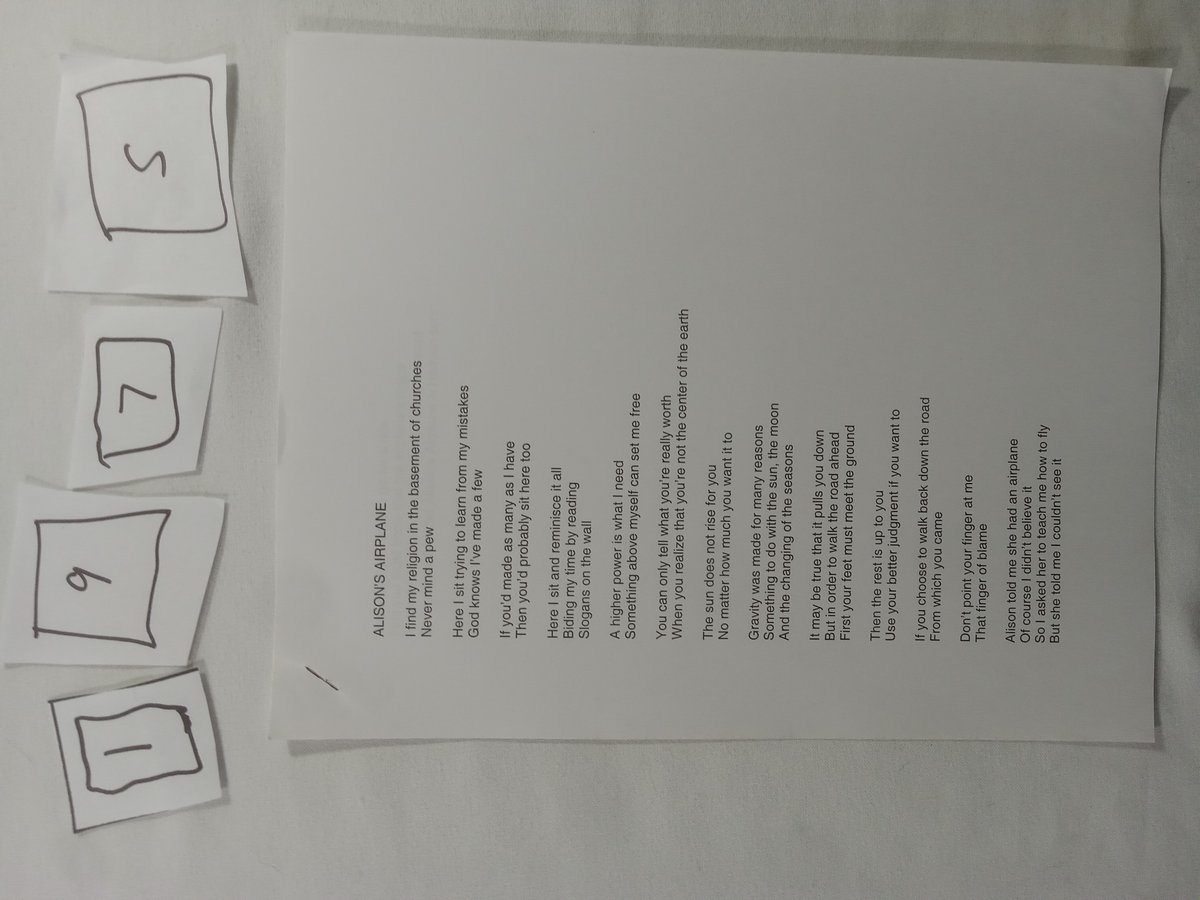
Picture 1 of 2
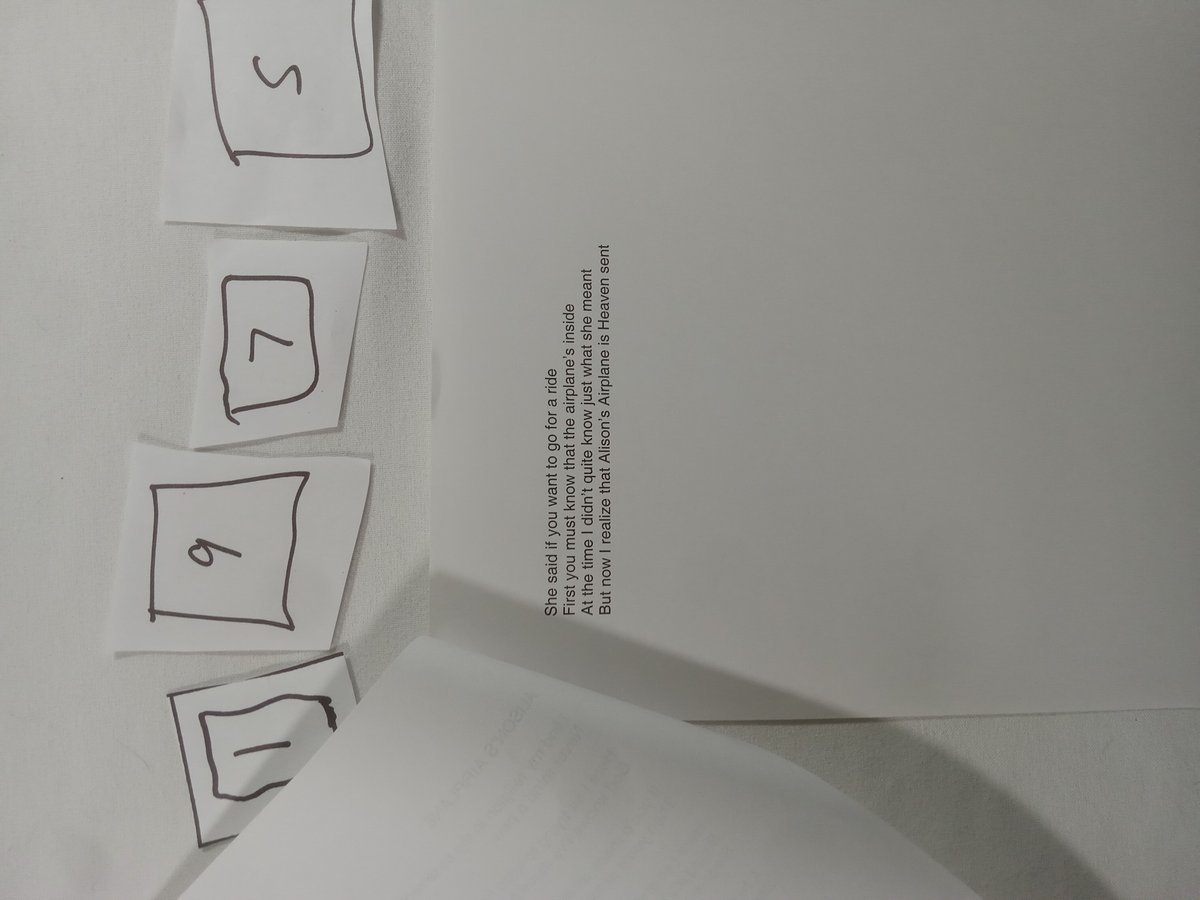
Picture 2 of 2
The words on this page
ALISON'S AIRPLANE
I find my religion in the basement of churches
Never mind a pew
Here I sit trying to learn from my mistakes
God knows I've made a few
If you'd made as many as I have
Then you'd probably sit here too
Here I sit and reminisce it all
Biding my time by reading
Slogans on the wall
A higher power is what I need
Something above myself can set me free
You can only tell what you're really worth
When you realize that you're not the center of the earth
The sun does not rise for you
No matter how much you want it to
Gravity was made for many reasons
Something to do with the sun, the moon
And the changing of the seasons
It may be true that it pulls you down
But in order to walk the road ahead
First your feet must meet the ground
Then the rest is up to you
Use your better judgment if you want to
From which you came
If you choose to walk back down the road
Don't point your finger at me
That finger of blame
Alison told me she had an airplane
Of course I didn't believe it
So I asked her to teach me how to fly
But she told me I couldn't see it
---
She said if you want to go for a ride
First you must know that the airplane's inside
At the time I didn't quite know just what she meant
But now I realize that Alison's Airplane is Heaven sent